Provenance
Commissioned by Louis Léon Clapisson (husband of sitter), Neuilly, for 3,000 francs [per Bailey 1997]; by descent to Marie Henriette Valentine Billet Clapisson (wife), Neuilly, 1894; sold to Durand-Ruel, Paris, November 12, 1908, for 15,000 francs [per Distel, “Appendix II: The Notebooks of Léon Clapisson,” Bailey 1997]. Durand-Ruel, New York, by July 8, 1913; sold to Martin A. Ryerson (d. 1932), Chicago, July 8, 1913, for $12,000 [per purchase receipt on Durand-Ruel letterhead, dated July 8, 1913, records that this painting (no. 3422, as Portrait de Mme Clapisson, 1883) was sold by Durand-Ruel, New York, to Martin A. Ryerson for $12,000; photocopy in curatorial object file]; bequeathed to the Art Institute of Chicago, 1933.
Accession Number
16622
Medium
Oil on canvas
Dimensions
81.2 × 65.3 cm (32 × 25 3/4 in.); Framed: 103.2 × 87 × 10.8 cm (40 5/8 × 34 1/4 × 4 1/4 in.)
Classification
Painting
Credit Line
Mr. and Mrs. Martin A. Ryerson Collection
Background & Context
Background Story
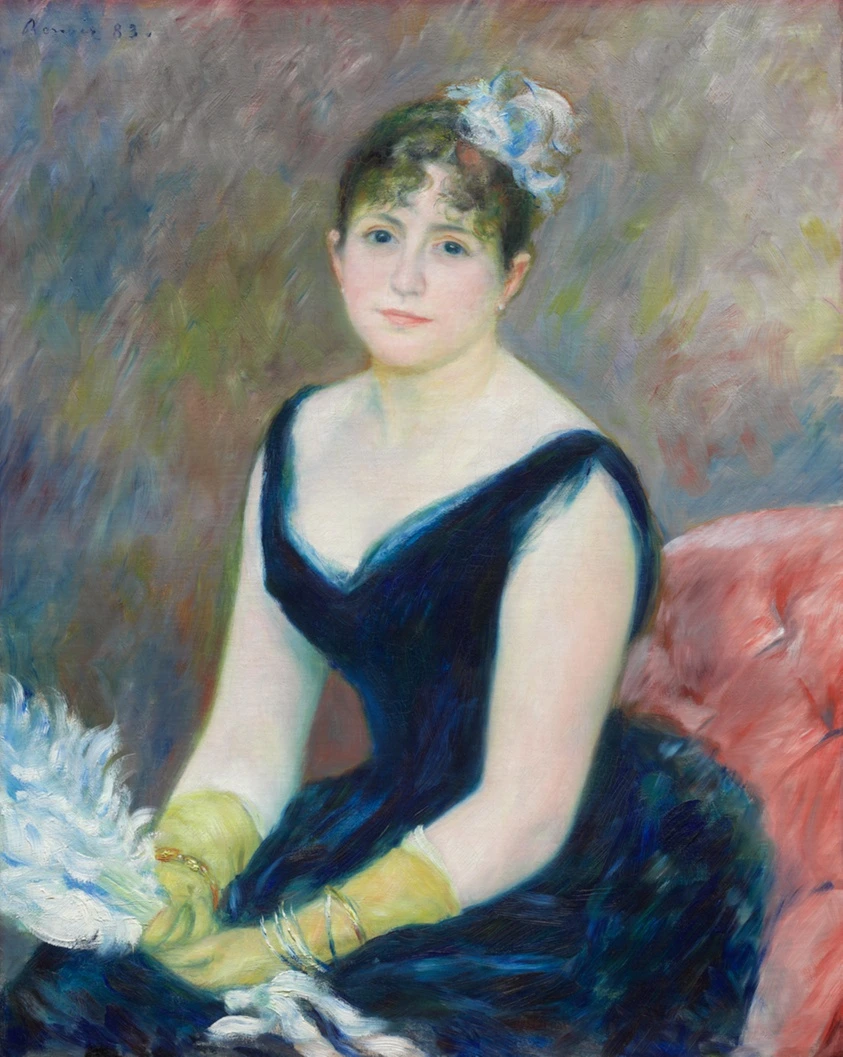
Pierre-Auguste Renoir (1841-1919) painted Madame Leon Clapisson in 1883, depicting the wife of a wealthy Parisian businessman in the elegant, fluent manner that distinguishes Renoir's best portraiture from his Impressionist landscapes. The portrait was commissioned by Madame Clapisson's husband, and Renoir presents the sitter in the elegant, flattering manner that made him one of the most sought-after portrait painters of the 1880s. The 1883 date places this in Renoir's most productive portrait period, when he was producing the commissioned portraits that provided his principal income and allowed him to pursue his more experimental Impressionist landscapes.
Cultural Impact
Madame Leon Clapisson is important in Renoir's portraiture because it demonstrates the elegant, flattering manner that made him one of the most sought-after portrait painters of the 1880s. Renoir's ability to present his sitters with elegance and charm—while maintaining the fluent brushwork and coloristic richness that distinguish his best work—made his commissioned portraits among the most accomplished of the period, and Madame Clapisson shows this ability at its most effective.
Why It Matters
Madame Leon Clapisson is Renoir's elegant portraiture: a wealthy Parisianbusinessman's wife rendered with the elegant, flattering manner and fluent brushwork that made him one of the most sought-after portrait painters of the 1880s. The 1883 portrait shows Renoir's commissioned portraiture at its most accomplished.