Provenance
Paul-Victor Poupin, Paris, by Apr. 1876 [per Catalogue de la 2e exposition de peinture, exh. cat. (Alcan-Lévy, 1876), p. 21, cat. 219, which lists Femme au piano as “appartient à M. Poupin”]. Possibly Durand-Ruel, Paris, by Apr. 1883 [per exhibition catalogue, cat. 13 is listed as Femme au piano with an asking price of £100, however Durand-Ruel Archives cannot confirm that the Art Institute’s painting was the one exhibited in London in April–July 1883; Paul-Louis Durand-Ruel and Flavie Durand-Ruel, Durand-Ruel Archives, to the Art Institute of Chicago, Oct. 5, 2010, curatorial object file, Art Institute of Chicago: “Il est possible qu’il s’agisse du même tableau mais nous n’avons aucun document nous le prouvant”]. Sold (possibly by the artist) to Durand-Ruel, Paris, Sept. 8, 1886, for 1,200 francs [per Durand-Ruel, Paris, stock book for 1884–90 (no. 1200, as La Femme au piano), as confirmed by Paul-Louis Durand-Ruel and Flavie Durand-Ruel, Durand-Ruel Archives, to the Art Institute of Chicago, Oct. 5, 2010, curatorial object file]. Possibly sold at Moore’s Art Galleries, New York, May 6, 1887, lot 93, for $675 [per Dauberville and Dauberville 2007. See also Moore’s Art Galleries, New York, The Durand-Ruel Collection of French Paintings, sale cat. (Moore’s Art Galleries, May 5–6, 1887), p. 28, lot 93. However, according to the Durand-Ruel Archives, “Le tableau n’a pas été vendu en 1887 lors de la vente à la ‘Moore’s Art Galleries’: il s’agissait d’une vente fictive (aucun tableau n’a été vendu) destinée à faire de la publicité pour les tableaux apportés par Durand-Ruel à New York.” See Paul-Louis Durand-Ruel and Flavie Durand-Ruel, Durand-Ruel Archives, to the Art Institute of Chicago, Oct. 5, 2010, curatorial object file]. Durand-Ruel, New York, by Dec. 16, 1911. [per Durand-Ruel, New York, stock book for 1888–93 (no. 112, as Jeune femme au piano), as confirmed by Paul-Louis Durand-Ruel and Flavie Durand-Ruel, Durand-Ruel Archives, to the Art Institute of Chicago, Oct. 5, 2010, curatorial object file]; sold to Martin A. Ryerson (d. 1932), Chicago, Dec. 16, 1911, for $16,000. [per Durand-Ruel, New York, stock book for 1888–93 (no. 112, as Jeune femme au piano), as confirmed by Paul-Louis Durand-Ruel and Flavie Durand-Ruel, Durand-Ruel Archives, to the Art Institute of Chicago, Oct. 5, 2010, curatorial object file]; by descent to his wife Carrie Hutchinson Ryerson (1859–1937), Chicago, 1932 [Last Will and Testament of Martin A. Ryerson, Died August 11, 1932, copy in Institutional Archives, Art Institute of Chicago]; bequeathed to the Art Institute of Chicago, 1937.
Accession Number
25825
Medium
Oil on canvas
Dimensions
93 × 74 cm (36 9/16 × 29 1/8 in.); Framed: 111.2 × 98.8 × 11.8 cm (43 3/4 × 38 7/8 × 4 5/8 in.)
Classification
oil on canvas
Credit Line
Mr. and Mrs. Martin A. Ryerson Collection
Tags
Color: Teal
Background & Context
Background Story
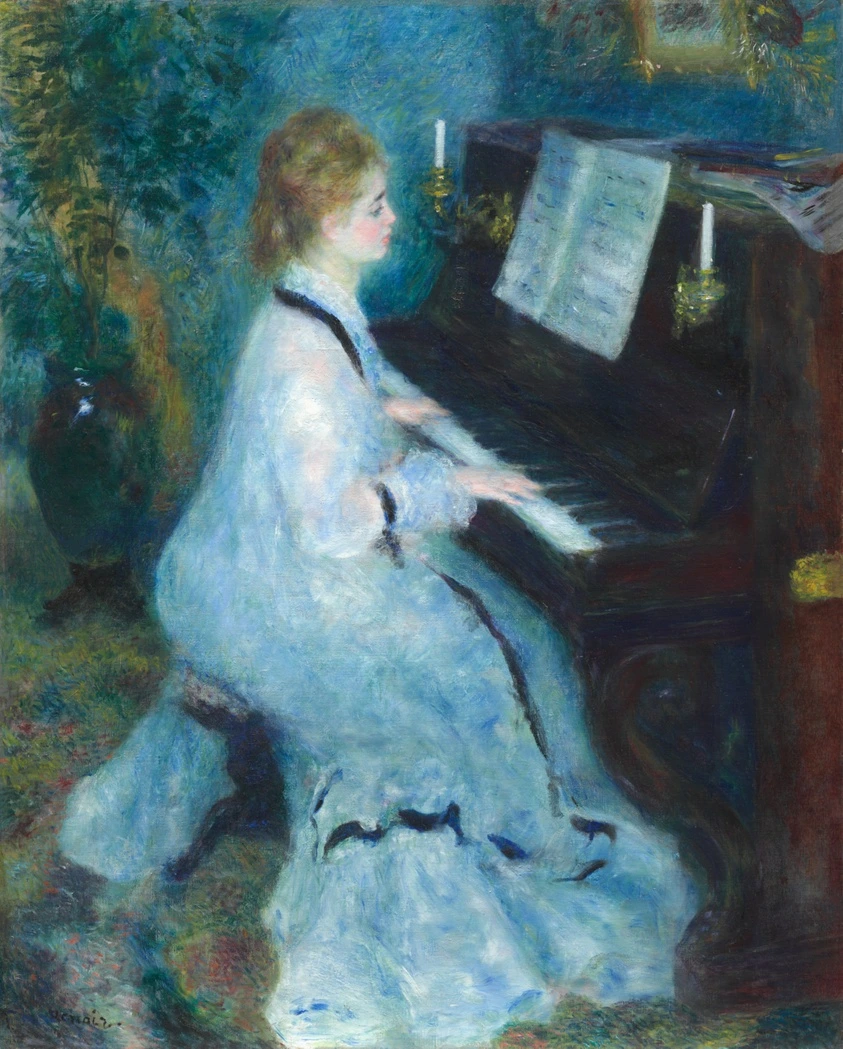
Pierre-Auguste Renoir (1841-1919) was a French painter known as one of the most important members of the Impressionist group, whose paintings of women, children, and domestic subjects in the luminous, colorful manner make him one of the most beloved painters in the history of art. Woman at the Piano from 1875-76 depicts a woman playing the piano in the luminous, colorful manner that distinguishes Renoir's best work from the more analytical painting of his Impressionist contemporaries. The 1875-76 date places this in Renoir's most productive Impressionist period, when he was developing the luminous, colorful manner that would make him one of the most beloved painters in the history of art.
Cultural Impact
Woman at the Piano is important in the history of Impressionism because it demonstrates the luminous, colorful manner that Renoir brought to domestic subjects as one of the most important members of the Impressionist group. Renoir's paintings of women and domestic subjects—combining luminous color with the warmth and sensuousness that are his most distinctive contributions—represent one of the most beloved traditions in Impressionist painting, and the 1875-76 painting shows this tradition in its early, most luminous phase.
Why It Matters
Woman at the Piano is Renoir's luminous Impressionism: a woman playing the piano rendered in the colorful, warm manner of one of the most beloved painters in the history of art. The 1875-76 painting shows Renoir's Impressionist period at its most luminous—the combination of color and warmth that would make him one of the most beloved painters in the history of art.