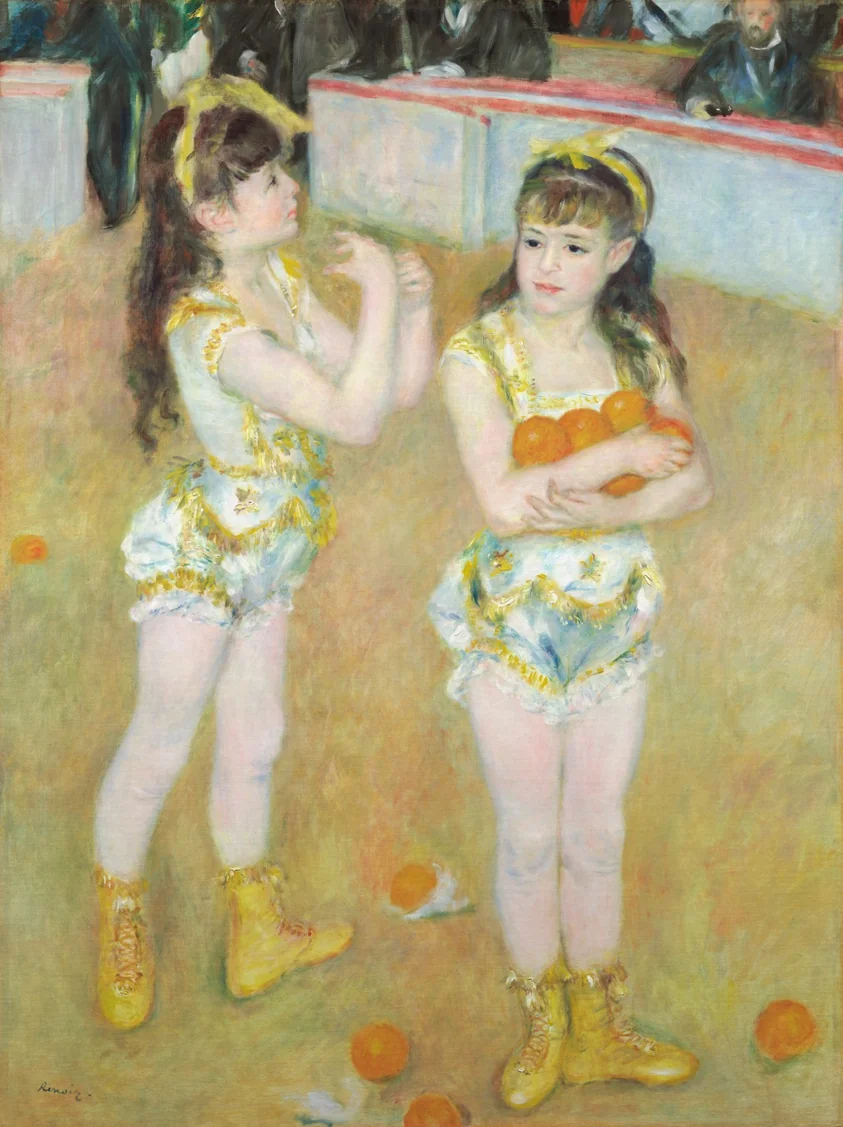
Acrobats at the Cirque Fernando (Francisca and Angelina Wartenberg)

Description

This painting depicts a favorite Parisian pastime in the late nineteenth century: attending the circus. Among the enthusiastic crowds at these events were men on the prowl in a world of young female entertainers. But Pierre-Auguste Renoir barely alluded to the unwholesome aspects of this environment, relegating a group of dark-suited men, seated in the front row, to the very top of the composition. “For me a picture . . . should be something likeable, joyous, and pretty,” Renoir insisted. “There are enough ugly things in life for us not to add to them.”

Acrobats at the Cirque Fernando reflects this worldview as well as the artist’s enchantment with the innocence of childhood. The two circus girls in this painting, Francisca and Angelina Wartenberg, were actually seventeen and fourteen years old, respectively, when Renoir made this painting, although they appear much younger here. Although they were acrobats in the circus, Renoir posed the sisters in costume at his studio, allowing him to capture them in daylight—he feared that the circus’s harsh gas lighting would turn “faces into grimaces.” He portrayed them standing in the middle of the circus ring, having just finished their act and taking their bows. One sister turns to the crowd, acknowledging its approval, while the other faces the viewer with an armful of oranges, a rare treat that audiences tossed in tribute. Renoir enveloped the girls in a virtual halo of pinks, oranges, yellows, and whites, as if acknowledging the rose-colored lens through which he preferred to view such scenes. The painting’s first owner, Chicago collector Bertha Honoré Palmer, became so enamored of it that she kept it with her at all times, even on her travels abroad.

Provenance

The artist (d. 1919); deposited with Durand-Ruel, Paris, Apr. 6, 1881 [per Durand-Ruel, Paris, stock book for 1879–84 (no. 3155, as Les Petites acrobates), as confirmed by Paul-Louis Durand-Ruel and Flavie Durand-Ruel, Durand-Ruel Archives, Oct. 5, 2010, curatorial object file]; sold to Durand-Ruel, Paris, May 12, 1882, for 2,000 francs. [This transaction is recorded in the Durand-Ruel, Paris, stock book for 1880–82 (no. 2362, as Les Saltimbanques), as confirmed by Paul-Louis Durand-Ruel and Flavie Durand-Ruel, Durand-Ruel Archives, Oct. 5, 2010, curatorial object file]; sold to Potter Palmer (d. 1902), Chicago, May 11, 1892, for 8,000 francs [per Durand-Ruel, Paris, stock book for 1891 (no. 319, as Dans le cirque), as confirmed by Paul-Louis Durand-Ruel and Flavie Durand-Ruel, Durand-Ruel Archives, Oct. 5, 2010, curatorial object file]; by descent to his wife, Bertha Honoré Palmer (d. 1918), Chicago; by descent their sons, Honoré and Potter Potter; given to the Art Institute of Chicago, 1922.

Acrobats at the Cirque Fernando (Francisca and Angelina Wartenberg)

Pierre-Auguste Renoir

1879

Accession Number

81558

Medium

Oil on canvas

Dimensions

131.2 × 99.2 cm (51 1/2 × 39 1/16 in.); Framed: 160.1 × 129 × 10.2 cm (63 × 50 3/4 × 4 in.)

Classification

Painting

Museum

The Art Institute of Chicago

Chicago, United States

Credit Line

Potter Palmer Collection
Tags

Painting Impressionist & Modern (1851–1900) Oil Painting Canvas

Background & Context

Background Story

This is one of Renoir's most enchanting works from his great Impressionist decade. Painted in 1879, it shows the young Wartenberg sisters performing as acrobats at the Cirque Fernando, the beloved Montmartre venue that also inspired Degas and Toulouse-Lautrec. Renoir captures the girls mid-performance — one balanced upside down, the other holding her steady — but the painting is less about acrobatics than about the shimmering atmosphere of the circus: the gaslight, the audience beyond, the golden dust of the ring.

Cultural Impact

The Cirque Fernando was one of Impressionism's recurring subjects. Degas painted it from the wings, focusing on the alien perspective of the performer looking out at the audience. Renoir reverses this: we see the performers from the audience's point of view, bathed in warm light. The painting also reveals Renoir's debt to 18th-century fêtes galantes — the outdoor entertainments of Watteau and Lancret — transposed into modern Paris.

Why It Matters

This painting marks Renoir at his Impressionist peak, just before his trip to Algeria and his subsequent turn toward Ingres-like classical drawing. The freedom of brushwork, the warmth of palette, and the sheer joy in the scene are signatures of Renoir at his best.