Provenance
The artist; sold to Durand-Ruel, Paris, July 8, 1881, for 600 francs [per John Collins to the Art Institute of Chicago, July 28, 1997, copy in curatorial object file. See also Colin B. Bailey, with the assistance of John B. Collins, Renoir’s Portraits: Impressions of an Age, exh. cat. (National Gallery of Canada/Yale University Press, 1997), p. 308, n. 8.]. Alphonse Legrand, Paris, by November 21, 1887 [this and the two following per John Rewald, “Theo van Gogh, Goupil, and the Impressionists,” Gazette des beaux-arts 81, 1248 (Jan. 1973), p. 14; and Rewald, “Theo van Gogh, Goupil, and the Impressionists—II,” Gazette des beaux-arts 81, 1249 (Feb. 1973), p. 103]; sold to Boussod, Valadon & Cie (Theo van Gogh), Paris, November 21, 1887, for 200 francs; sold to Guyotin, Paris, Nov. 22, 1887, for 350 francs; sold to Durand-Ruel, Paris, Mar. 21, 1892, for 1,300 francs [per Durand-Ruel, Paris, stock book for 1891 (no. 2064, as Déjeuner de canotiers), as confirmed by Paul-Louis Durand-Ruel and Flavie Durand-Ruel, Durand-Ruel Archives, Oct. 5, 2010, curatorial object file]; transferred from Durand-Ruel, Paris, to Durand-Ruel, New York, Mar. 22, 1892. [per Anne Distel, “Oarsmen (known as Luncheon by the River),” in Hayward Gallery, Galeries Nationales du Grand Palais, Paris, and Museum of Fine Arts, Boston, Renoir, exh. cat. (Arts Council of Great Britain, 1985), p. 216. Also noted by John Collins; see John Collins to the Art Institute of Chicago, July 28, 1997, curatorial object file, Art Institute of Chicago]; sold to Potter Palmer (d. 1902), Chicago, Apr. 9, 1892, for $1,100 [per Durand-Ruel, New York, stock book for 1888–93 (no. 932, as Déjeuner de canotiers), as confirmed by Paul-Louis Durand-Ruel and Flavie Durand-Ruel, Durand-Ruel Archives, Oct. 5, 2010, curatorial object file]; by descent to the Palmer family; given to the Art Institute of Chicago, 1922.
Accession Number
81555
Medium
Oil on canvas
Dimensions
55 × 65.9 cm (21 5/8 × 25 15/16 in.); Framed: 80.4 × 91.2 × 11.2 cm (31 5/8 × 35 7/8 × 4 3/8 in.)
Classification
Painting
Credit Line
Potter Palmer Collection
Tags
Painting Impressionist & Modern (1851–1900) Oil Painting Canvas
Background & Context
Background Story
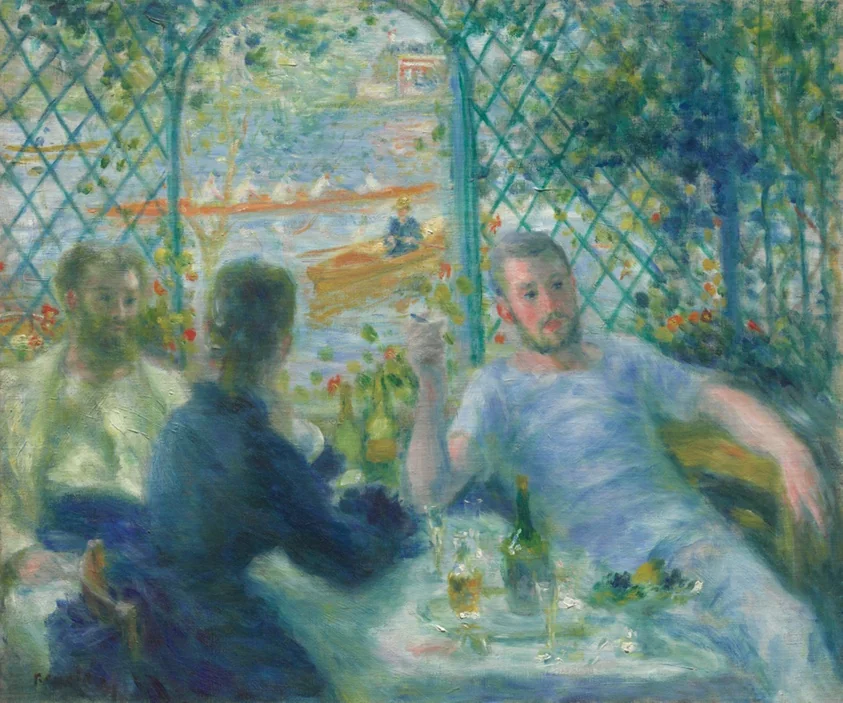
Lunch at the Restaurant Fournaise was painted in 1875, during Renoir's most productive period at the riverside town of Chatou on the Seine. The painting depicts a man and woman seated at a table on the terrace of the Restaurant Fournaise - the same establishment that served as the setting for Renoir's masterpiece Luncheon of the Boating Party (1881).
The scene captures the emerging culture of leisure that defined the Impressionist era: Parisians escaping the city for riverside restaurants, where dining, drinking, and boating intertwined in a new form of middle-class pleasure. The woman, fashionably dressed in white, appears lost in thought, while her companion leans forward with the attentiveness of suitor or husband. The shimmering Seine and the lush green foliage frame their intimate conversation.
The Restaurant Fournaise was a genuine institution - a family-run establishment that rented boats and served simple riverside meals. Renoir was a regular patron, and his paintings of the restaurant constitute a visual documentary of a vanishing way of life. The looseness of the brushwork - particularly in the water and foliage - shows Renoir pushing toward the fully Impressionist technique he would perfect in Luncheon of the Boating Party.
Cultural Impact
Renoir's restaurant scenes created an enduring image of French leisure culture - the riverside lunch that became a defining ritual of bourgeois modernity. This painting, together with Luncheon of the Boating Party, established the outdoor restaurant as one of the great subjects of Impressionist painting.
Why It Matters
This painting records the social world that made Impressionism possible: a culture of leisure, consumption, and riverside pleasure that provided the movement with its subjects and its audience. It is simultaneously a portrait of a relationship and a portrait of a way of life.


