Description
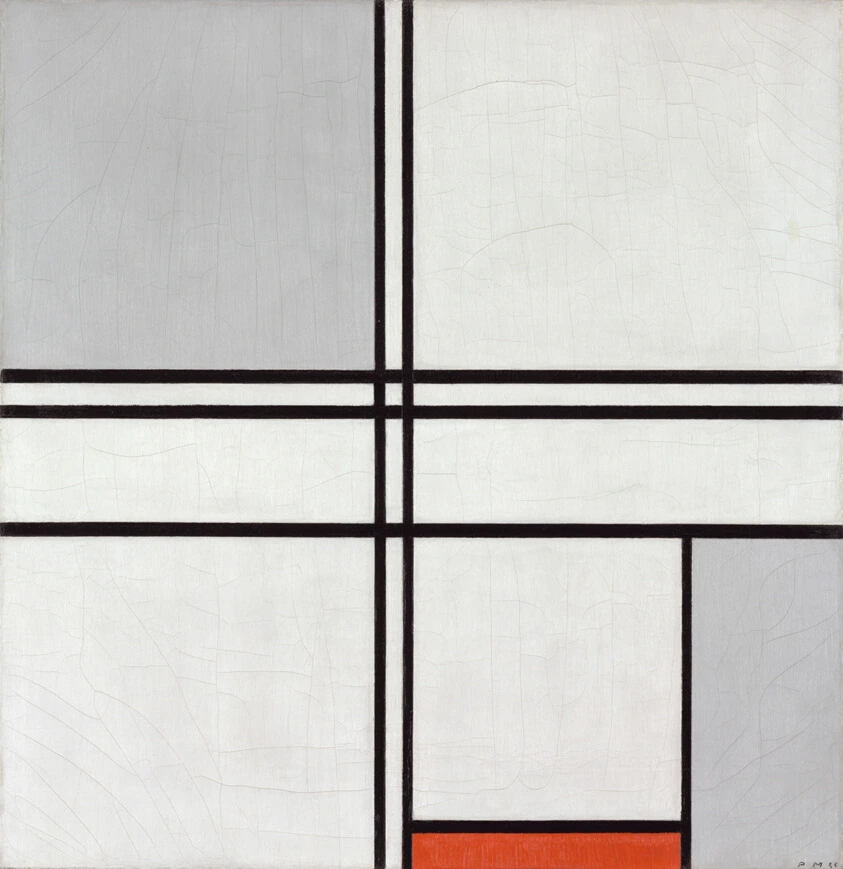
Piet Mondrian, a painter of the revolutionary international movement De Stijl (the Style), argued that "the straight line tells the truth." Why, then, we might wonder, would he choose to hang a painting off axis, where its edges imply dynamic diagonals? Among other motivations, rotating the canvas allowed Mondrian to reconsider a question he spent his career exploring, namely, the relationship between the contents of a painting and what contains them. In Lozenge Composition, the squared-off black lines imply enclosure, while a single line (above the blue area) extends to the slanted edge, suggesting extension beyond the canvas. This implication of what might lie beyond also prompted Mondrian to invoke the full expanse of the wall by hanging diagonal paintings well above eye level.
Provenance
Accession Number
109819
Medium
Oil on canvas
Dimensions
60 × 60 cm (23 5/8 × 23 5/8 in.)
Classification
oil on canvas
Credit Line
Gift of Edgar Kaufmann, Jr.