Bathers by a River

Description

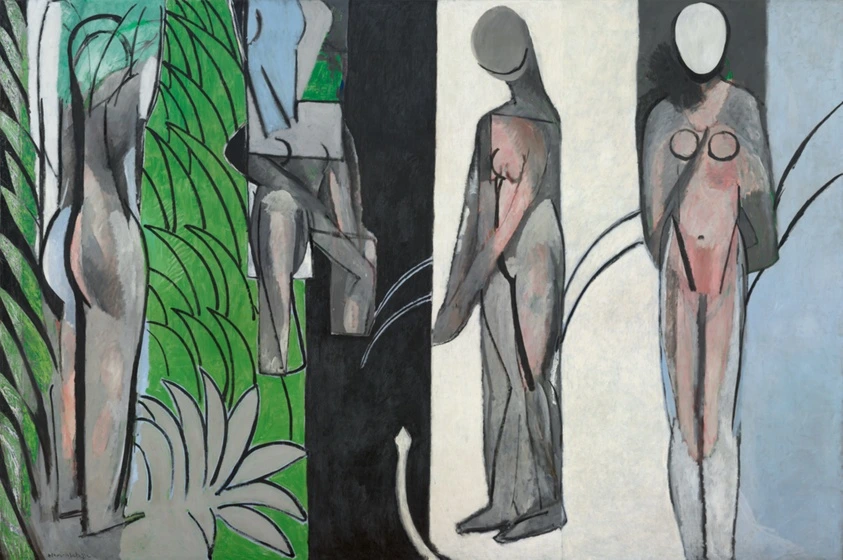
Henri Matisse considered Bathers by a River to be one of the five most “pivotal” works of his career, and with good reason: it facilitated the evolution of the artist’s style over the course of nearly a decade. Originally, the work was related to a 1909 commission by the Russian collector Sergei Shchukin, who wanted two large canvases to decorate the staircase of his Moscow home. Matisse proposed three pastoral images, though Shchukin decided to purchase only two works, Dance II and Music (both State Hermitage Museum, Saint Petersburg).

Four years later, Matisse returned to this canvas, the rejected third image, altering the idyllic scene and changing the pastel palette to reflect his new interest in Cubism. He reordered the composition, making the figures more columnar, with faceless, ovoid heads. Over the next years, Matisse transformed the background into four vertical bands and turned the formerly blue river into a thick black vertical band. With its restricted palette and severely abstracted forms, Bathers by a River is far removed from Dance II and Music, which convey a graceful lyricism. The sobriety and hint of danger in Bathers by a River may in part reflect the artist’s concerns during the terrible, war-torn period during which he completed it.

Provenance

The artist; sold to Paul Guillaume (1891–1934), Paris, Sept. 14, 1926 [Chicago 2010]; by descent to his wife, Mme. Paul Guillaume (a.k.a. Domenica, née Juliette Léonie Lacaze; remarried as Mme. Jean Walter, 1898–1977), Paris, 1934; sold to Henry Pearlman (1895–1974), New York, summer 1951 [letter from Rose Pearlman, Dec. 4, 1975; copy in curatorial file]; acquired through exchange by the Art Institute of Chicago, Apr. 2, 1953.

Bathers by a River

Henri Matisse

1909–10, 1913, and 1916–17

Accession Number

79307

Medium

Oil on canvas

Dimensions

260 × 392 cm (102 1/2 × 154 3/16 in.)

Classification

oil on canvas

Museum

The Art Institute of Chicago

Chicago, United States

Credit Line

Charles H. and Mary F. S. Worcester Collection

Background & Context

Background Story

Bathers by a River is one of Matisse's most radical and most worked-over paintings, begun in 1909-10 and revised in 1913 and again in 1916-17, with each revision bringing the composition closer to the geometric simplification and chromatic austerity that characterize his most modern works. The painting depicts four monumental nudes in a landscape organized by vertical bands of color—green, black, blue, and pink—that create a structural grid against which the nudes are arranged. The multiple dates (1909-10, 1913, 1916-17) reflect the painting's long evolution from a relatively naturalistic composition to the severely geometric work that exists today.

Cultural Impact

Bathers by a River is one of the most important paintings in the development of modern art because it documents Matisse's progression from relatively naturalistic composition to geometric simplification. The painting's three phases of revision—1909-10, 1913, and 1916-17—show Matisse progressively eliminating naturalistic detail and replacing it with geometric structure, a process that makes Bathers by a River a visual record of the development of modernist painting itself.

Why It Matters

Bathers by a River is Matisse's most radical painting: four monumental nudes in a landscape organized by vertical color bands, evolved over seven years from naturalistic composition to geometric simplification. The multiple revision dates (1909-10, 1913, 1916-17) make the painting a visual record of the development of modernist painting itself.