Forest and Sun

Description

Among his many recollections of childhood, Max Ernst often recounted his fear and fascination with the forest that surrounded his home. He wrote of feeling “delight and oppression and what the Romantics called ‘emotion in the face of Nature.’” By expressing his thoughts in these terms, Ernst linked himself with the spiritual landscape tradition of Romanticism, which conceived of an invisible realm at work in the natural world.

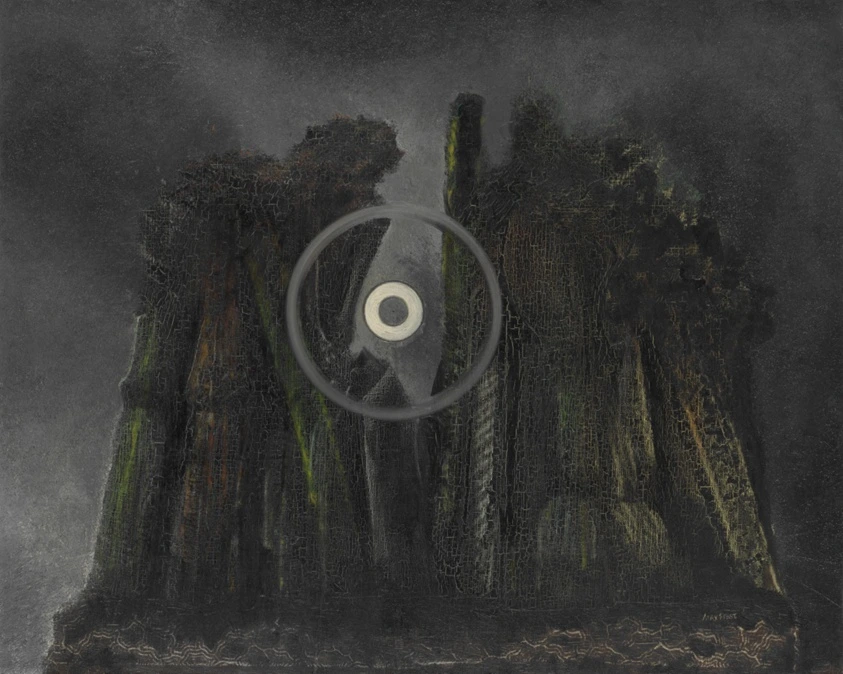
This dark and mysterious forest scene dates to one of the most creative periods of Ernst’s career. Spurred by the Surrealist leader André Breton’s proclamation of “pure psychic automatism” as an artistic ideal, he developed the innovative technique of frottage, his term for the method of reproducing a relief design (like the surface of a piece of wood) by laying paper or canvas over it and rubbing it with a pencil, charcoal, or another medium. In Forest and Sun Ernst used this technique to create a petrified forest, which he imbued with a sense of primordial otherworldliness. By scraping away almost-dry paint on the canvas (a process he called grattage), the artist produced the encircled sun at the center of the composition. Ernst painted six variations of the forest and sun theme. As in the other five canvases, the tree trunks suggest a letter in the artist’s name: in this case, a capital M.

Provenance

Baron Elie de Rothschild [Feigen receipt in curatorial file]. Richard L. Feigen, New York, by February 7, 1959; sold to Richard Zeisler, New York, February 7, 1959 [receipt in curatorial file].

Forest and Sun

Max Ernst

1927

Accession Number

185760

Medium

Oil on canvas

Dimensions

66 × 82.5 cm (26 × 32 1/2 in.)

Classification

Painting

Museum

The Art Institute of Chicago

Chicago, United States

Credit Line

Bequest of Richard S. Zeisler
Background & Context

Background Story

"Forest and Sun" is one of Max Ernst's most haunting early Surrealist landscapes, painted in 1927 during his first great Paris period when he was inventing the techniques of frottage and grattage that would transform his approach to paint and meaning. The image shows a dense forest of bare trees under a pale sun, the trunks and branches rendered with the automatic impulse that Surrealism had borrowed from psychoanalytic theory. Ernst was obsessed with forests; they appear throughout his work as symbols of the unconscious, the Germanic past, and the anxiety that Freud had traced to the primal scene. The painting technique here combines traditional oil handling with the new methods of scraping and rubbing that Ernst developed to bypass conscious control: the textures of the bark and undergrowth were produced by dragging paint across rough surfaces, then selectively revealing the undertones. The sun itself is a pale disc that provides little warmth, its light swallowed by the vertical density of the trees. This emptiness at the center is characteristic of Ernst's landscapes; nature is not redemptive but threatening, a labyrinth without exit. The painting also reflects Ernst's biography: born in the Rhineland, exiled to France after the First World War, he was simultaneously drawn to and terrified by the German forests of his childhood. Art historians have connected this work to the Romantic tradition of Caspar David Friedrich, though Ernst's forest offers no spiritual transcendence, only the endless repetition of identical trunks. The canvas influenced later Surrealist and Expressionist landscape painters, particularly the American West Coast artists who encountered Ernst after his emigration to the United States in 1941.

Cultural Impact

This early Surrealist landscape invented grattage technique while channeling Rhineland anxiety into a forest without exit, influencing American postwar painters after Ernst's wartime emigration.

Why It Matters

It matters because Ernst painted his childhood fear as a forest where the sun couldn't reach—proving that homesickness could look like a trap made of trees.