Provenance
By descent to the artist’s sister-in-law, Mme. Johanna Cohen van Gogh-Bonger, Amsterdam. Given by the van Gogh family to Dr. Jan Pieter Veth (died 1925), Amsterdam [according to a letter from Ay-Whang Hsia of Wildenstein, dated May 17, 2001 in curatorial file]; by descent to his daughter-in-law, Mrs. Christine Veth, San Francisco, by 1935 [New York 1935 and Hsia letter]; consigned to Wildenstein and Company, New York, 1945 [according to Hsia letter]; sold to the Art Institute of Chicago, 1945.
Accession Number
52733
Medium
Reed pen and black-brown ink, with black chalk on off-white wove paper
Dimensions
49.3 × 61.3 cm (19 7/16 × 24 3/16 in.)
Classification
pen and ink drawings
Credit Line
Gift of Tiffany and Margaret Blake
Background & Context
Background Story
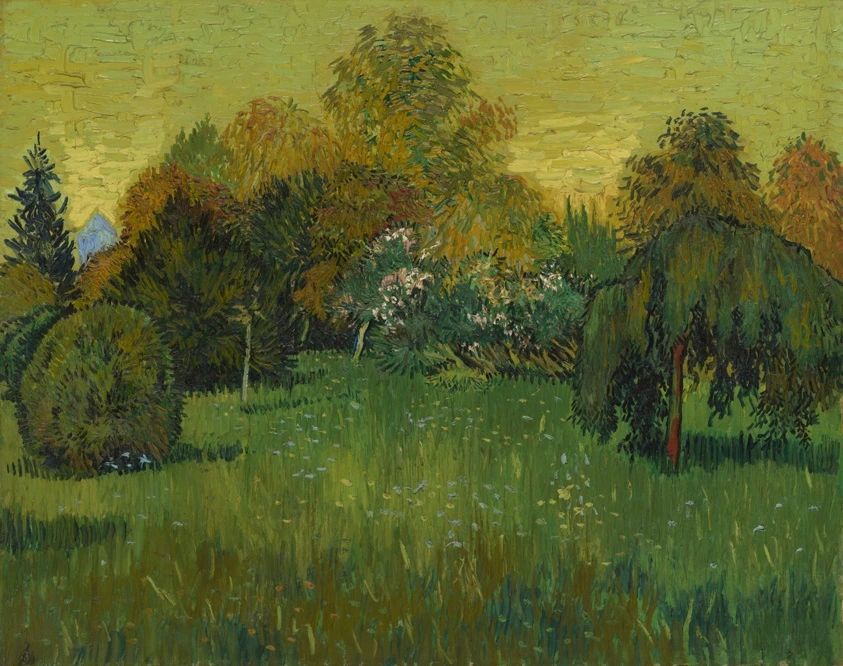
"Weeping Tree" is one of van Gogh's most emotionally expressive drawings from his Arles period, executed in 1889 during the period when he was producing the extraordinary series of landscapes, portraits, and still lifes that would make him the most influential painter of the modern era. The composition shows a tree—probably a willow or cypress—rendered with the reed pen and black-brown ink that van Gogh used with increasing freedom in his Provence drawings, the lines swirling and looping in patterns that suggest both the organic growth of the tree and the turbulent emotional state of the artist. The black chalk underdrawing visible in places reveals van Gogh's working method: he first established the basic structure with broad, searching chalk lines, then reinforced and elaborated with the more precise ink strokes, creating a layered image that records the process of its own making. The off-white wove paper provides a cool, neutral ground that makes the dark ink appear to vibrate, creating an optical energy that makes the static image feel alive. The title "Weeping Tree" suggests anthropomorphism: the tree is not merely observed but felt, its drooping branches interpreted as an expression of sorrow that mirrors the artist's own psychological struggles. The 1889 date places this work in the same year as the famous "Starry Night" and the self-portrait with a bandaged ear, suggesting that van Gogh's emotional intensity was finding expression in both paint and ink. Art historians have connected this drawing to the broader tradition of the "pathetic fallacy" in art and literature, in which nature is interpreted as reflecting human emotion, from the melancholy landscapes of Friedrich to the storm scenes of Constable. The work also demonstrates van Gogh's influence on later drawing: the expressive line, the emotional charge, and the refusal of academic restraint would inspire generations of modern artists from Expressionists to Abstract Expressionists.
Cultural Impact
This 1889 Provence drawing channeled pathetic fallacy through swirling reed-pen emotional turbulence, using layered chalk-and-ink process visibility to make a static willow vibrate with psychological intensity.
Why It Matters
It matters because van Gogh drew a tree weeping and made the paper feel wet—proving that even ink could cry if the hand was sad enough.