Provenance
The artist’s sister-in-law, Johanna van Gogh-Bonger (died 1925) [see Nordenfalk 1946 and Supinen 1990]. Galerie d’Art Odenzeel, Rotterdam [La Faille 1928, 131]. Galerie d’Art d’Audretsch, The Hague, Netherlands [according to information on Registrar archival card, copy in curatorial object file]. M. Gieseler, The Hague, Netherlands, by 1925; Sale, A. Mak, Amsterdam, Oct. 1925, lot 33. Howard Young Galleries, New York [stock no. 2486, according to Registrar archival card]. Mrs. Lewis Larned (Annie Swan) Coburn (died 1932), Chicago, by at least 1928 [see Registrar receipt dated May 28, 1928, copy in curatorial object file]; bequeathed to the Art Institute, 1933.
Accession Number
14586
Medium
Oil on canvas
Dimensions
73 × 92.1 cm (28 3/4 × 36 1/4 in.); Framed: 96.6 × 116.9 cm (38 × 46 in.)
Classification
oil on canvas
Credit Line
Mr. and Mrs. Lewis Larned Coburn Memorial Collection
Background & Context
Background Story
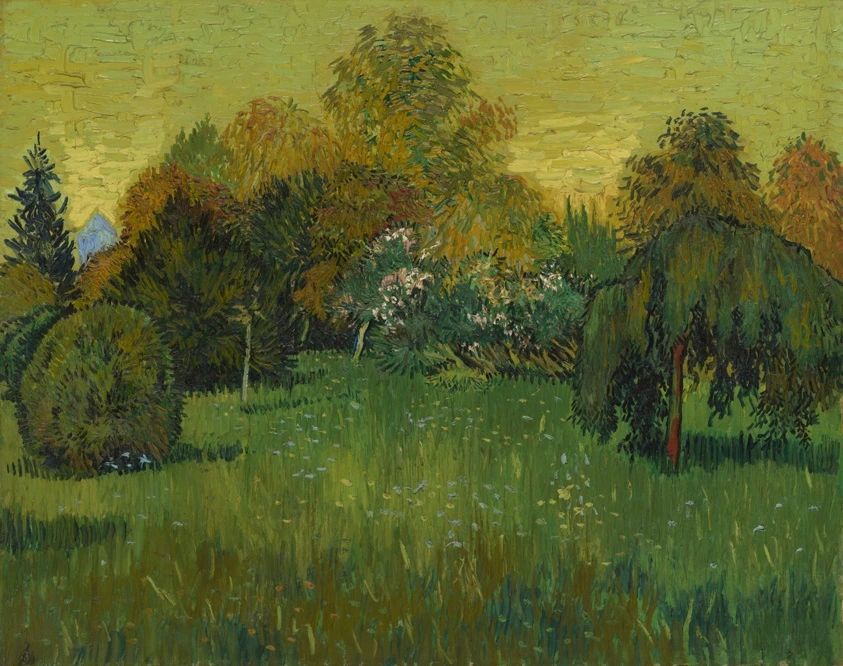
Vincent van Gogh's "The Poet's Garden" (1888) is one of a series of paintings that van Gogh made during the summer of 1888 in Arles, depicting the public garden near the Yellow House where he lived. The painting shows a sun-drenched garden walkway lined with trees and bushes, with couples strolling along the path, rendered in the brilliant yellows, blues, and greens that characterize van Gogh's Arles period — the most explosively colorful phase of his career.
The title "The Poet's Garden" was not van Gogh's invention. It referred to a section of the public garden in Arles that was known by this name, presumably because it had been a gathering place for poets and writers. Van Gogh, who had come to Arles with dreams of founding an artists' colony — his "Studio of the South" — was drawn to the romantic associations of the name, and he described the painting to his brother Theo as one of a series intended to decorate the Yellow House in anticipation of Paul Gauguin's arrival.
The painting was conceived as part of a decorative scheme — a set of paintings that would transform the Yellow House into a harmonious artistic environment where van Gogh and Gauguin could live and work together. Van Gogh wrote to Theo that he envisioned the series as 'poems in color,' each painting expressing a different mood or time of day through its chromatic scheme. "The Poet's Garden" was the 'sunny' painting in the series — a celebration of the Mediterranean light that had so transformed van Gogh's palette since his arrival in Arles.
The composition is built around the diagonal line of the garden path, which leads the eye from the lower left to the upper right, creating a dynamic sense of movement that draws the viewer into the scene. The trees and bushes are painted with the thick, swirling brushstrokes that van Gogh developed in Arles — a technique that transforms the garden into an animated, almost vibrating field of color. The couples on the path are small, sketchy figures, less individual characters than elements in the overall design — bright accents of red and blue that punctuate the dominant greens and yellows.
The dream of the Studio of the South would end in disaster. Gauguin arrived in Arles in October 1888, and the two artists lived and worked together for nine tempestuous weeks before the crisis that led to van Gogh's ear-mutilation and Gauguin's departure. "The Poet's Garden," painted during the hopeful period before Gauguin's arrival, remains a document of that hope — a painting made to welcome a friend and to create a home for art.
Cultural Impact
Van Gogh's Arles paintings — with their blazing color and decorative ambition — represent the most productive and optimistic period of his career, a brief flowering of hope for an artistic community that was never fully realized.
Why It Matters
This sun-drenched garden painting was created as part of van Gogh's dream to decorate the Yellow House for Gauguin's arrival — a 'poem in color' that captures the hope and ambition of his Arles period before its tragic collapse.


