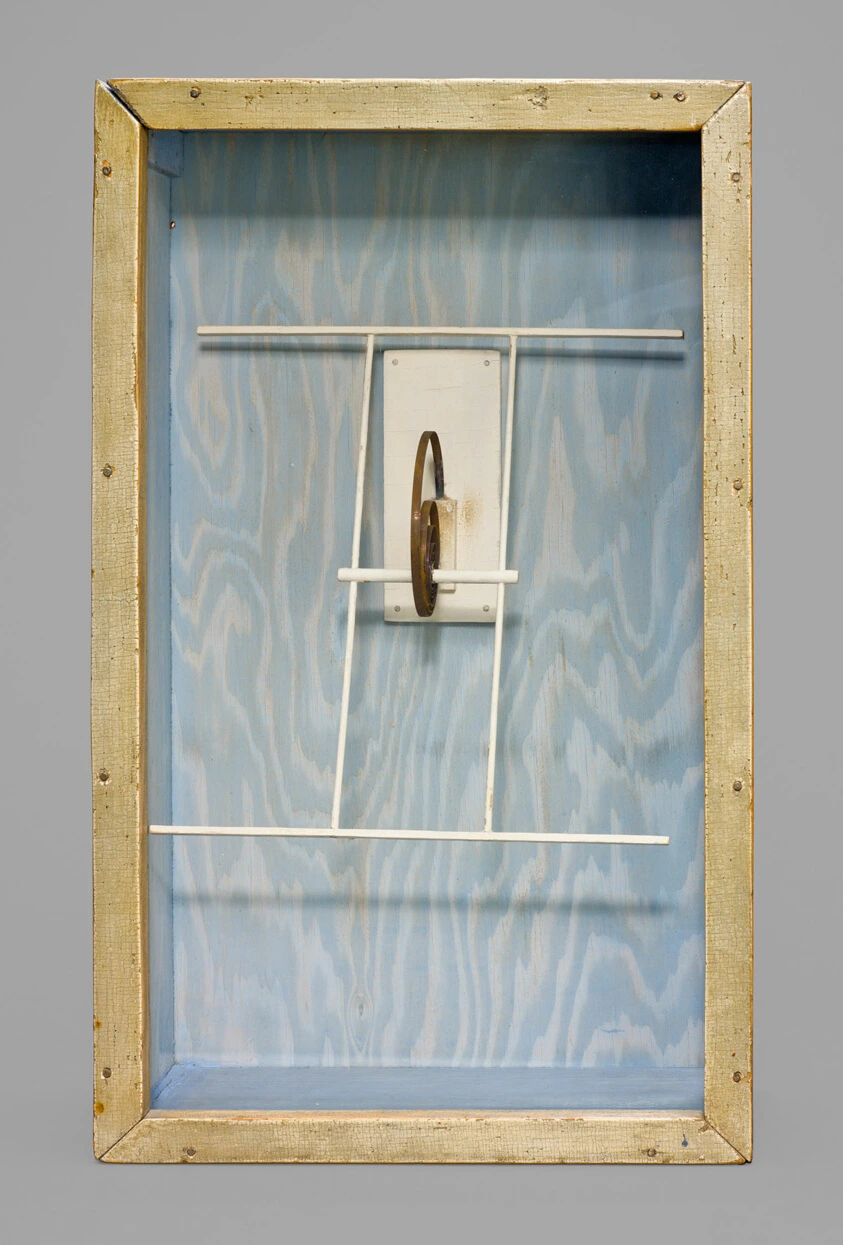
Untitled (Homage to Blériot)

Description

This box is an example of Cornell‘s ability to convey ideas and associations by minimal means. A construction of thin pieces of wood is delicately balanced from the center of the metal spring coil, on which it bounces freely. The arrangement hints at the wings and propeller of a biplane, thus relating to the title, which in earlier exhibitions was listed simply as Bleriot. Louis Bleriot (1872-1936) was a pioneering French aviator, the first to fly across the English Channel in 1909. The strongly marked wood grain, stained pale blue, of the inner wall of the box evokes both the waves of the sea, over which early planes flew low, as well as perhaps clouds in the sky. Cornell papered the back of the box with a French newspaper, L’Economiste francais (June 15, 1893). Given the subject of this box, the choice of paper backing—always an integral part of a box’s construction for the artist—seems not entirely fortuitous. Another, closely related box, referred to as Bleriot # 2, has been dated around 1956 (estate of Joseph Cornell; New York 1980–82, no. 115, ill.). It differs from this one primarily in the relationship of the components within the box.

— Entry, Dawn Ades, Surrealist Art: The Lindy and Edwin Bergman Collection at the Art Institute of Chicago, 1997, p. 84.

Provenance

Eleanor Ward, New York, by 1961; Stable Gallery, New York; sold to Lindy and Edwin Bergman, Chicago, 1966; given to the Art Institute, 1982.

Untitled (Homage to Blériot)

Joseph Cornell

1956

Accession Number

99774

Medium

Box construction

Dimensions

47 × 28.6 × 12.1 cm (18 1/2 × 11 1/4 × 4 3/4 in.)

Classification

sculpture

Museum

The Art Institute of Chicago

Chicago, United States

Credit Line

Lindy and Edwin Bergman Joseph Cornell Collection

Background & Context

Background Story

"Untitled (Homage to Blériot)" is a 1956 box construction by Joseph Cornell that demonstrates the American assemblage artist's continued engagement with the themes of flight, exploration, and the heroic age of aviation during the period of his most mature and refined box constructions. The composition is a large box—47 × 28.6 × 12.1 centimeters—showing a collection of objects and images related to Louis Blériot and the early history of aviation arranged in a box with the same poetic suggestion and historical reverence that characterized all of Cornell's aviation-themed works. The box construction creates a shrine to the heroic imagination, the glass front protecting the delicate assemblage while inviting the viewer to contemplate the human dreams of flight and the machines that made them possible. The 1956 date places this work in the period of Cornell's continued production of box constructions, when he was refining the vocabulary of his assemblages and exploring new thematic territory. Art historians have connected this box to the broader tradition of the aviation image in modern art, from the Futurist paintings of flight to the astronaut photographs of the mid-century, noting that Cornell's treatment is more focused on the poetic suggestion and the childlike wonder, the transformation of historical event into fairy tale narrative, than the technological celebration or the political propaganda of these other traditions.

Cultural Impact

This 1956 box construction made aviation heroism poetically reverent through large 47cm Blériot-object assemblage glass-fronted shrine and historical-imagination wonder, using mature assemblage vocabulary to transform flight dreams into fairy-tale narrative beyond Futurist technological celebration.

Why It Matters

It matters because Cornell built a box for a pilot and made the wood feel like it was still soaring—proving that even a machine could be a poem if the arrangement was dreamy enough.