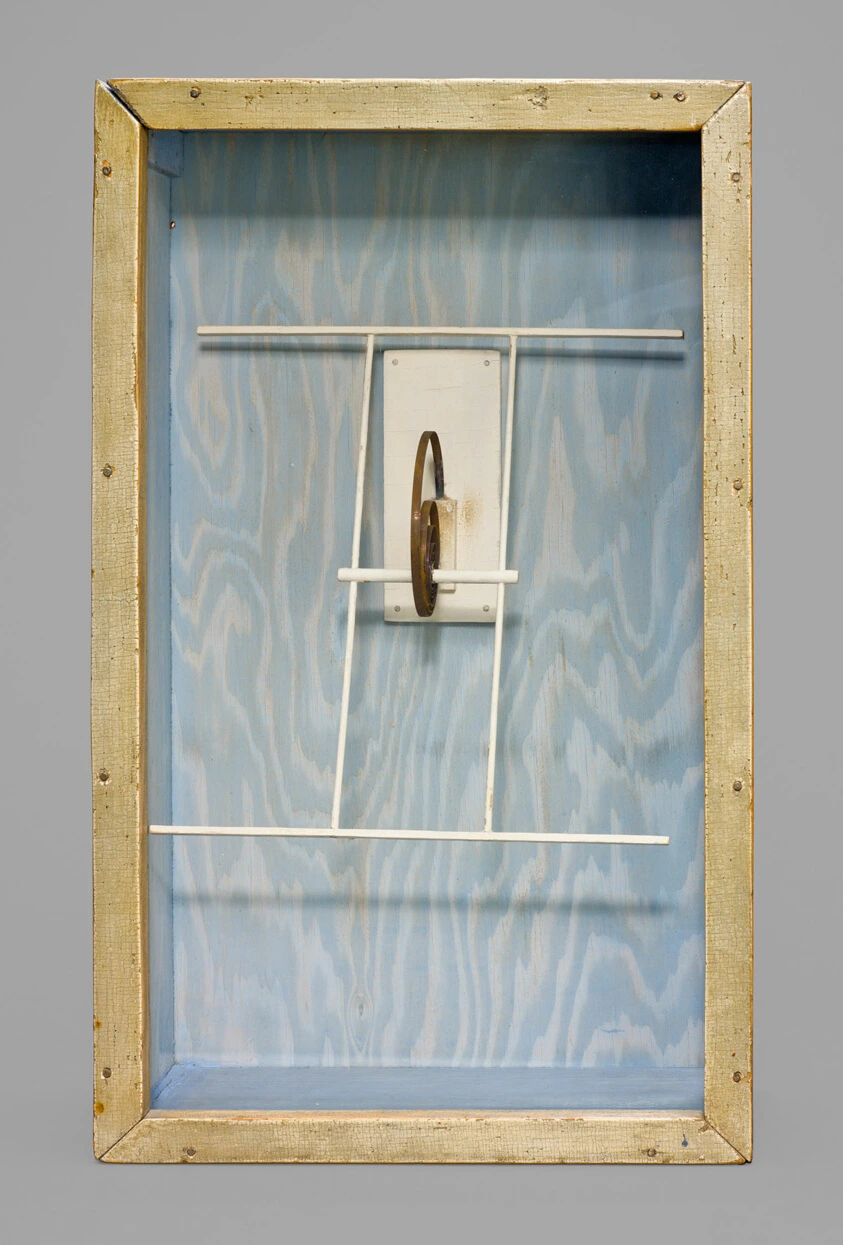
Soap Bubble Set

Description

Joseph Cornell’s box constructions present highly personal reflections on art, nature, history, and memory through the unexpected juxtaposition of found objects and printed material. Here he included glasses, pipes, and round disks to recollect the youthful activity of blowing soap bubbles. Their placement in front of a diagram of the Copernican planetary system, however, suggests a more universal significance. Cornell produced other Soap Bubble Set boxes, and he later recalled about them that “Shadow boxes become poetic theatres or settings wherein are metamorphosed the elements of a childhood pastime. The fragile shimmering globules become the shimmering but more enduring planets—a connotation of moon and tides.”

Soap Bubble Set

Joseph Cornell

1940 (reworked 1953)

Accession Number

79390

Medium

Wood, glass, paper, metal, and shell

Dimensions

34.3 × 48.3 × 7.6 cm (13 1/2 × 19 × 3 in.)

Classification

sculpture

Museum

The Art Institute of Chicago

Chicago, United States

Credit Line

Simeon B. Williams Fund

Background & Context

Background Story

"Soap Bubble Set" is a 1940 box construction (reworked 1953) by Joseph Cornell that captures the American assemblage artist in his most poetically evocative and scientifically curious mode, the image showing a box filled with objects related to the scientific demonstration of soap bubbles and the optical effects of light. The composition is a medium-sized box—34.3 × 48.3 × 7.6 centimeters—showing a collection of found objects including wood, glass, paper, metal, and shell arranged with the same meticulous care and poetic suggestion that characterized all of Cornell's box constructions. The box construction creates a miniature laboratory of wonder, the glass front protecting the delicate assemblage while inviting the viewer to contemplate the mysteries of light, color, and surface tension. The 1940 date with 1953 reworking places this work in the period of Cornell's most intensive production of box constructions and his continued refinement of the assemblage vocabulary. Art historians have connected this box to the broader tradition of the scientific curiosity in European culture, from the cabinets of curiosities of the Enlightenment to the science museums of the modern period, noting that Cornell's treatment is more focused on the poetic suggestion and the childlike wonder, the transformation of scientific demonstration into fairy tale narrative, than the educational function or the empirical observation of these other traditions.

Cultural Impact

This 1940-1953 box construction made scientific wonder poetically curious through medium 34cm wood-glass-paper-metal-shell assemblage and glass-fronted miniature light-laboratory, using reworked assemblage to transform optical-science demonstration into fairy-tale beyond Enlightenment empirical education.

Why It Matters

It matters because Cornell put soap bubbles in a box and made the glass feel like it was refracting childhood—proving that even science could be a dream if the shells were arranged with wonder.