Description
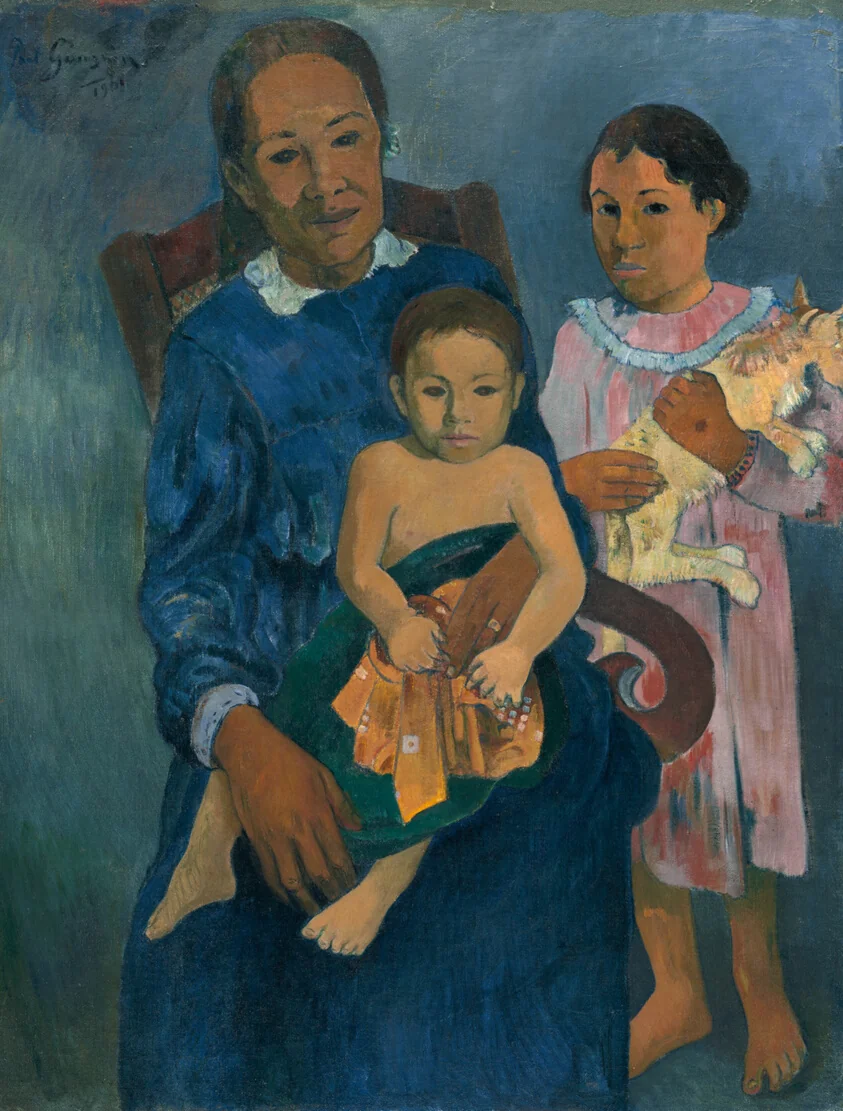
The three figures in this work have never been identified. Their familial pose and other details, such as the woman’s gold ring and the red mark on the girl’s hand, invite speculation as to their relationship to each other and to the artist. Technical analysis has revealed that Paul Gauguin reworked the position of the woman’s hands to align diagonally with those of the young girl standing behind her. Together, they form an upward axis reinforced by the cat, also a later addition.
Provenance
Ambroise Vollard [according to Meyer-Riefstahl 1910-1911, it was lent by him to Dresden 1910 and Munich 1910]. Moderne Galerie Heinrich Thannhauser, Munich, by 1927 [included in Berlin 1927]; purchased by Frederic C. Bartlett, Chicago, February 1927 from Berlin 1927 [according to a letter from Frederic C. Bartlett to Heinrich Thannhauser dated May 21, 1927, Art Institute archives, copy in curatorial file]; given to the Art Institute, 1927.
Accession Number
34461
Medium
Oil on linen canvas
Dimensions
97 × 74 cm (38 3/16 × 29 1/8 in.); Framed: 111.2 × 88.3 × 5.8 cm (43 3/4 × 34 3/4 × 2 1/4 in.)
Classification
oil on canvas
Credit Line
Helen Birch Bartlett Memorial Collection
Background & Context
Background Story
Paul Gauguin's Polynesian Woman with Children (1901) is an oil on linen canvas from Gauguin's final years in the Marquesas Islands. The painting shows a Polynesian woman with children, the subject reflecting Gauguin's fascination with the lives of the indigenous people. The palette is warm and rich, the forms simplified and monumental. Gauguin's late works achieved a new level of synthesis between European painting and the art of the cultures he encountered.
Cultural Impact
Gauguin's depictions of Polynesian women and children are among his most celebrated works, combining ethnographic interest with artistic innovation.
Why It Matters
This painting of a Polynesian woman with children captures the warmth and dignity of its subjects with Gauguin's characteristic style.