Provenance
Probably on deposit at Goupil, Boussard and Valadon by March 1893 and then sent to George Daniel de Monfreid [according to a letter from Joyant to Monfreid, March 24, 1893 as quoted in Jean Loize, Les amities du peintre Georges Daniel de Monfreid et ses reliques de Gauguin (Paris, 1951), pp. 93–4, no. 138, “I toile: nature morte, pot et cafeterie.”]. Possibly Émile Schuffenecker (1851-1934), Paris [‘Schuffenecker’ as the owner without first name is quoted in G. Wildenstein, 1964 and D. Wildenstein, 2001 as information given to G. Wildenstein by Jeanne Schuffenecker, Émile Schuffenecker’s daughter]; possibly Amédée Schuffenecker (1854-1935), Émile’s brother, after 1903. Private collection, Paris by 1947 [according to Cogniat 1947]. Dr B., ca. 1949 [according to exhibition catalogue, 1949]. Mr. and Mrs. Robert E. Ricksen, Palm Beach, Florida; sold Parke-Bernet, New York, October 21, 1971, lot 93 (ill.); Nathan Cummings (died 1985), Chicago and New York; acquired by the Sara Lee Corporation, Chicago, 1985 [memorandum of Norma Farrell dated April 4, 1985 concerning conservation]; given to the Art Institute in 1999.
Accession Number
153797
Medium
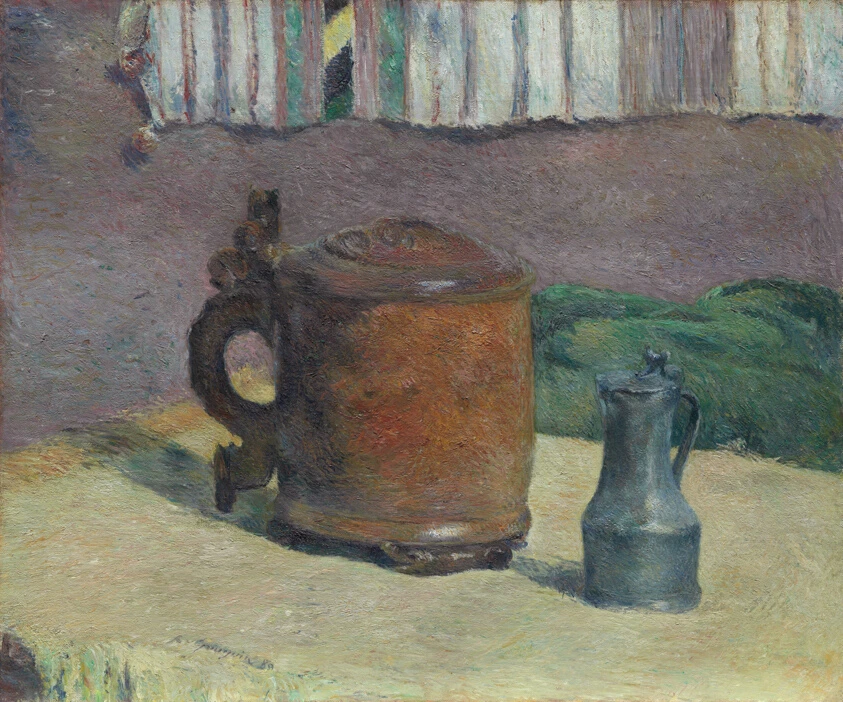
Oil on linen canvas
Dimensions
54 × 65 cm (21 1/4 × 25 9/16 in.); Framed: 71.2 × 82 × 7 cm (28 × 32 1/4 × 2 3/4 in.)
Classification
oil on canvas
Credit Line
A Millennium Gift of Sara Lee Corporation
Background & Context
Background Story
Still Life: Wood Tankard and Metal Pitcher from 1880 is one of Gauguin's earliest surviving paintings, executed in the Impressionist manner that he adopted before his radical simplification of form and color in Tahiti. The 1880 date places this in the period when Gauguin was still working as a stockbroker and painting on Sundays as an amateur, before his decision to devote himself full-time to art in 1883. The still life subject and the Impressionist handling—visible brushwork, attention to the effects of light on surfaces—are characteristic of Gauguin's earliest work, before the Pont-Aven Synthetism and Tahitian symbolism that would define his mature style.
Cultural Impact
Gauguin's early still lifes are important in understanding his development because they demonstrate the Impressionist manner from which his radical simplification of form and color would depart. Still Life: Wood Tankard and Metal Pitcher from 1880 shows Gauguin working within the Impressionist tradition before his encounter with Pont-Aven Synthetism and Tahitian culture transformed his art, making it an invaluable document of the beginning of one of the most radical departures in the history of modern painting.
Why It Matters
Still Life: Wood Tankard and Metal Pitcher is Gauguin before Tahiti: an Impressionist still life from 1880, when he was still a stockbroker painting on Sundays, before the radical simplification of form and color that would define his mature work. The painting is an invaluable document of the beginning from which his revolutionary departure would come.