Arlésiennes (Mistral)

Description

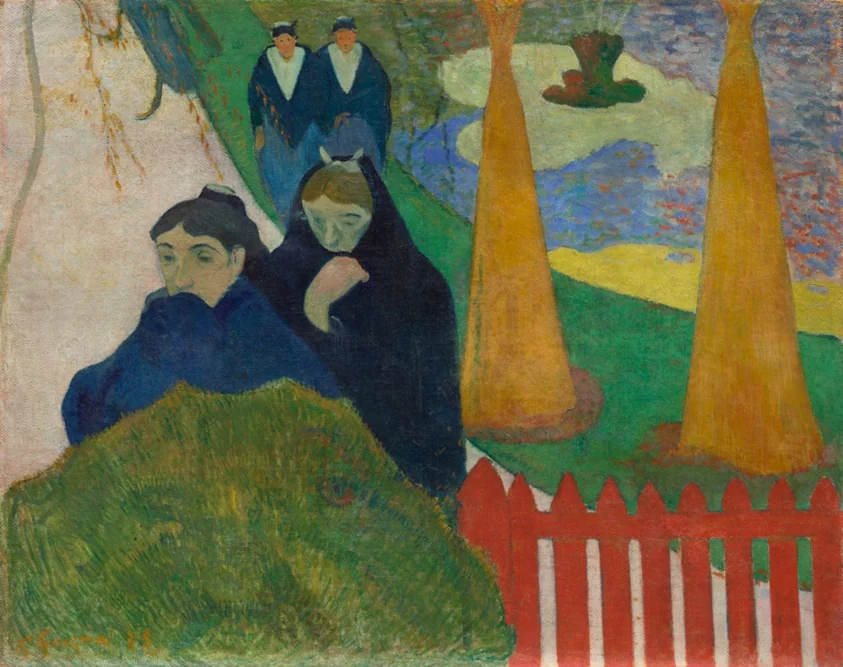
One of seventeen canvases that Paul Gauguin completed during a brief and tumultuous visit with Vincent van Gogh in Arles, this powerful and enigmatic painting depicts the public garden directly across from Van Gogh’s residence, the “Yellow House.” Not only is the careful planning of the composition in marked contrast to the spontaneity seen in Van Gogh’s depiction of the same scene (State Hermitage Museum, Saint Petersburg), but everything about the painting—its large, flat areas of color; arbitrary handling of space; and enigmatic silhouettes—also exemplifies the deliberateness with which Gauguin sought pictorial harmony and symbolic content in his work. Here four women wrapped in shawls slowly stroll through the garden. The two closest to the viewer avert their gazes and curiously cover their mouths. Their somber outlines echo the two orange cones, which probably represent shrubs wrapped against the frost. The bench along the upper-left path rises steeply, defying logical perspective. Equally puzzling is the mysterious bush on the left, in which Gauguin consciously embedded forms that suggest eyes and a nose, creating the impression of a strange, watchful presence. With its aura of repressed emotion and elusive meaning, Arlésiennes (Mistral) explores the ambiguities, mysteries, and emotions that Gauguin believed underlie appearances.

Provenance

Sold by the artist to Théo van Gogh for 300 Francs probably in the first half of 1889 [according to "carnet de l'artiste," 1888-1889, see Huyghe 1952, p. 223]; Émile Schuffenecker [according to Jeanne Schuffenecker, see Wildenstein 2001]; Thannhauser Galerie, Lucerne, c. 1923, stock no. 1167 [according to Wildenstein 2001]. James W. Barney, New York, c. 1929 [according to New York 1929 exh. cat.]. De Hauke and Co., New York, 1930 [according to Providence, R. I. 1930 exh. cat.]. Jacques Seligmann and Co., New York by 1931 [according to St. Louis 1931 exh. cat.; De Hauke and Seligmann may have owned the picture together since they were partners until about 1931]; sold to the Art Institute, October 26, 1934, using funds from the Mr. and Mrs. Lewis Larned Coburn Fund.

Arlésiennes (Mistral)

Paul Gauguin

1888

Accession Number

19339

Medium

Oil on jute canvas

Dimensions

73 × 92 cm (28 3/4 × 36 3/16 in.); Framed: 97.5 × 116.6 × 8 cm (38 3/8 × 45 7/8 × 3 1/8 in.)

Classification

Painting

Museum

The Art Institute of Chicago

Chicago, United States

Credit Line

Mr. and Mrs. Lewis Larned Coburn Memorial Collection
Tags

Color: Gold Color: Green

Background & Context

Background Story

"Arlésiennes (Mistral)" is one of Gauguin's most important Provençal canvases, painted in 1888 during the pivotal stay in Arles that he shared with Vincent van Gogh for nine turbulent weeks. The painting shows two women in traditional Arles costume against a background of cypress trees and wind-bent vegetation, the mistral wind itself implied by the rhythmic distortion of forms. Gauguin's treatment is far more stylized than van Gogh's contemporary Arles landscapes: the colors are flat and unmodulated, the outlines are bold and decorative, and the figures are reduced to essential shapes that suggest Japanese woodblock prints more than observed reality. This deliberate artifice was Gauguin's response to van Gogh's impassioned naturalism; where his companion sought to capture the emotional truth of a place, Gauguin sought its decorative essence. The jute canvas support is significant: it was cheaper than linen and provided a rough texture that absorbed paint in distinctive ways, contributing to the matte, mural-like surface that Gauguin preferred. The work also documents the artist's fascination with regional costume and folklore; the Arlésiennes were famous throughout France for their archaic dress, and Gauguin was drawn to them as living symbols of a pre-industrial culture. Art historians have compared this canvas to the contemporary work of Émile Bernard and the Pont-Aven School, with whom Gauguin was developing the theory of Synthetism—the reduction of observed forms to essential shapes and colors. The painting influenced van Gogh directly: the Dutchman adopted some of Gauguin's decorative flatness in his portrait of Madame Ginoux, painted shortly after Gauguin's departure. In the broader history of Post-Impressionism, the work stands as evidence that the movement was not unified but divided between competing visions of how painting should relate to the visible world.

Cultural Impact

This Arles canvas contrasted Synthetist stylization with van Gogh's naturalism during their legendary nine-week cohabitation, establishing jute support and decorative flatness as Post-Impressionist alternatives.

Why It Matters

It matters because Gauguin painted wind as decoration while van Gogh painted it as screaming—two men in the same mistral, seeing two different worlds.