Woman in Front of a Still Life by Cezanne

Description

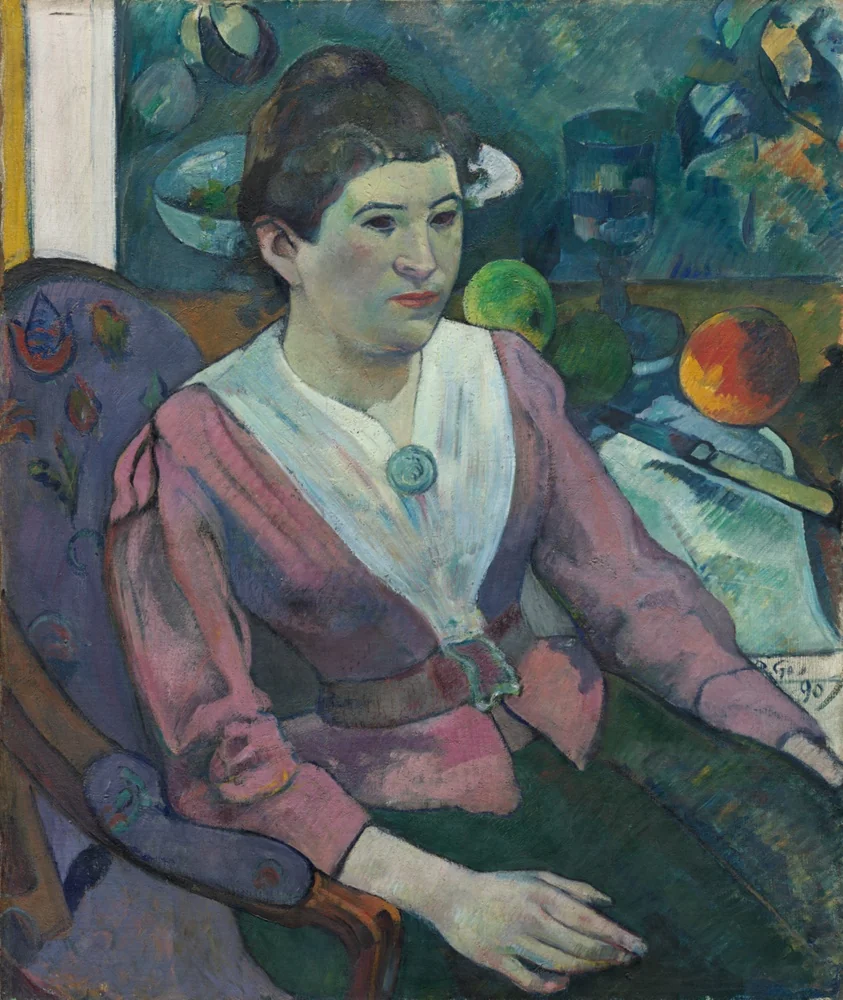
In this work, an unidentified woman sits in front of Paul Cézanne’s 1879–80 Still Life with Fruit Dish, now at the Museum of Modern Art, New York. The painting was part of Paul Gauguin’s own collection, and here he proprietarily signed his name over its white frame. Of the five or six Cézannes that he acquired while still a banker, this was the one he claimed he would never part with, “except in a case of direst necessity.” (He would eventually sell it to pay for medical treatment in Tahiti.) Although the version in this painting is nearly to scale with the original, it is more a translation than a copy, with rhythmical arabesques that are characteristic of Gauguin’s painting style rather than Cézanne’s.

This is one of thirty-five works that comprise the Winterbotham Collection. Click here to learn more about the collection.

Provenance

Bernheim-Jeune Galerie, Paris [according to Wildenstein 1964]. Ernest Brown and Phillips, Leicester Galleries, London by 1924 [see London 1924 and Wildenstein 1964]. Chester H. Johnson Gallery, Chicago, by 1925; sold to the Art Institute, 1925.

Woman in Front of a Still Life by Cezanne

Paul Gauguin

1890

Accession Number

16648

Medium

Oil on linen canvas

Dimensions

65.3 × 54.9 cm (25 11/16 × 21 5/8 in.); Framed: 82.9 × 73.4 × 10.5 cm (32 5/8 × 28 7/8 × 4 1/8 in.)

Classification

Painting

Museum

The Art Institute of Chicago

Chicago, United States

Credit Line

Joseph Winterbotham Collection
Background & Context

Background Story

Painted in 1890, this complex meta-painting shows a female figure standing before a still life that is recognizably in the style of Paul Cézanne, Gauguin's homage to the master whose structural investigations had prepared the ground for Post-Impressionist abstraction. The canvas is a rare example of an artwork explicitly acknowledging another artist's influence: rather than hiding his debts, Gauguin monumentalizes them, making Cézanne's still life the subject of his own composition. The standing woman—probably a Breton peasant or a model in Gauguin's Paris studio—functions as a spectator within the painting, her gaze directed toward the Cézanne with an absorption that invites the viewer to share her contemplation. This doubling of spectatorship is conceptually sophisticated: we look at a woman looking at a painting, creating a mise en abyme that anticipates twentieth-century meta-painting from Magritte to Richter. The technique is transitional between Gauguin's Pont-Aven Synthetism and the more austere Tahitian works that would follow; the colors are flat and decorative, but the composition is more structurally rigorous than his earlier Breton scenes. The linen canvas support was unusual for Gauguin at this period—he typically preferred jute—and the smoother surface allows finer detail in the depicted Cézanne, as if he wanted to honor the master's texture as well as his composition. Art historians have connected this work to the broader Post-Impressionist anxiety of influence, in which younger artists struggled to assert their individuality while acknowledging their debts to Cézanne, van Gogh, and Seurat.

Cultural Impact

This meta-painting created a Post-Impressionist mise en abyme, acknowledging Cézanne's influence while pioneering the artwork-within-artwork trope that would define twentieth-century meta-painting.

Why It Matters

It matters because Gauguin painted a woman admiring Cézanne—proving that even revolutionaries needed to genuflect before the right master.