Description
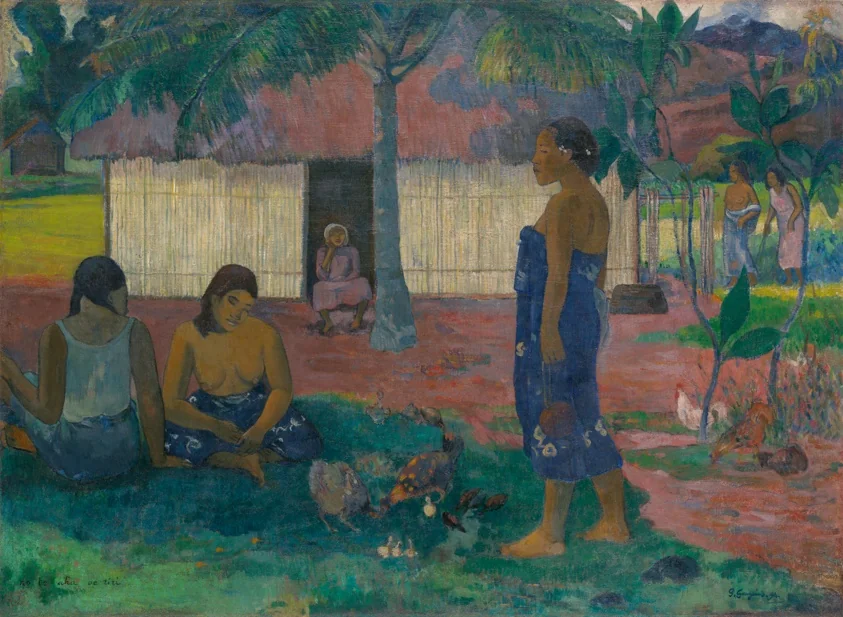
In this large-scale canvas, one of several Paul Gauguin sent back to France in 1897, women of varying ages appear to go about daily life within a colorful, stylized outdoor environment. Like much of the artist’s work, this painting combines observed detail with artistic fantasy to create a dreamlike scene whose narrative resists simple interpretation. The work’s deliberately provocative title enhances this effect, leaving us to wonder if the “you” refers to someone in the painting or to the viewer.
Provenance
Mme. Ernest Chausson, Paris by 1904 [see Brussels 1904 and Wildenstein 1964]. Durand-Ruel Galleries, New York by 1923 [see New York 1923]; sold to Martin A. Ryerson (died 1932), Chicago on February 20, 1925 [see purchase receipt dated February 20, 1925, copy in curatorial file]; bequeathed to the Art Institute, 1933.
Accession Number
16496
Medium
Oil on jute canvas
Dimensions
95.3 × 130.6 cm (37 1/2 × 51 3/8 in.); Framed: 116.6 × 153.1 × 6.7 cm (45 7/8 × 60 1/4 × 2 5/8 in.)
Classification
Painting
Credit Line
Mr. and Mrs. Martin A. Ryerson Collection
Background & Context
Background Story
"No te aha oe riri (Why Are You Angry?)" is one of the most psychologically complex of Gauguin's Tahitian paintings, created in 1896 during his second and final Polynesian sojourn when he was increasingly isolated, ill, and dependent on morphine. The title is a direct question in Tahitian, one of the few phrases Gauguin could speak, and it animates the canvas with a narrative uncertainty: who is angry, and why? The composition shows two women in a landscape that simultaneously suggests a Tahitian village and a classical Arcadia, their postures and expressions conveying tension rather than the idyllic relaxation of Gauguin's earlier South Seas images. The colors are darker and more saturated than his Pont-Aven period—deep greens, earthy browns, and ochres that suggest the tropical density of a landscape untamed by European agriculture. The jute canvas support creates a rough, absorbent surface that intensifies the matte quality of the paint, making the image appear more like a mural or fresco than an easel painting. This work reflects the growing darkness of Gauguin's final years: the Tahitian idyll had failed to cure his syphilis or his depression, and the paintings increasingly show anxiety, conflict, and the gap between European fantasy and colonial reality. The Tahitian women in his paintings were often partners or servants rather than companions, and the question in the title may reflect Gauguin's own guilt about these asymmetrical relationships. Art historians have connected this work to the broader literature of colonial disillusionment, particularly Pierre Loti's "Le Mariage de Loti" and the travel narratives that had initially inspired Gauguin's Pacific voyage. In the history of primitivism, the painting is a crucial document of the moment when the dream of escape became indistinguishable from the nightmare of exploitation.
Cultural Impact
This late Tahitian canvas exposed the colonial nightmare beneath primitivist fantasy, its Tahitian-title directly questioning the asymmetrical relationships that funded Gauguin's tropical escape.
Why It Matters
It matters because Gauguin finally asked his models what he didn't want to hear—proving that even paradise could curdle when built on someone else's anger.