Provenance
The artist (d. 1903); by descent to his son, Ludovic-Rodolph (Rodo) Pissarro, Paris, 1904 [this and the two following per Pissarro and Snollaerts, 2005]; sold to Sam Saltz, New York, by December 1950; sold to Mrs. Mary Block (née Lasker), Chicago, December 1950; given to the Art Institute of Chicago, beginning in 1959 [in undivided fractional interests, receiving final fractional interest for one hundred percent ownership in 1961].
Accession Number
11312
Medium
Oil on canvas
Dimensions
65.4 × 54.4 cm (25 5/8 × 21 3/8 in.); Framed: 87.7 × 75 × 10.2 cm (34 1/2 × 29 1/2 × 4 in.)
Classification
oil on canvas
Credit Line
Gift of Mrs. Leigh B. Block
Background & Context
Background Story
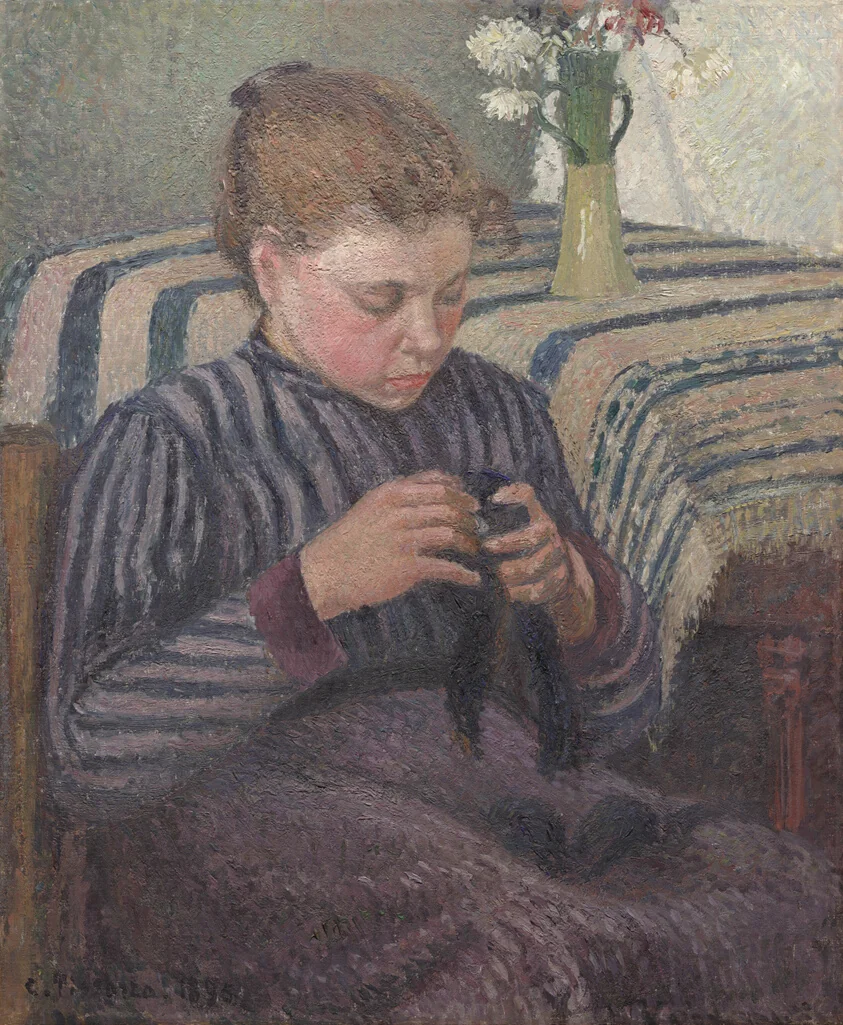
Camille Pissarro's "Woman Mending" (1895) is an oil on canvas from the artist's later period, when his style had evolved from pure Impressionism toward a more structured approach influenced by Neo-Impressionism. The painting shows a peasant woman engaged in the humble task of mending clothes, seated perhaps in a garden or rural interior. Pissarro had a lifelong commitment to depicting rural life and the dignity of labor, and this painting continues that tradition. The woman's absorbed concentration on her work is rendered with respect and empathy. The brushwork is more deliberate than in Pissarro's high Impressionist works, with touches of color built up in a systematic way that reflects his experiments with divisionism in the late 1880s. The palette is warm and harmonious—perhaps earth tones, with accents of brighter color. This painting belongs to the final phase of Pissarro's career, when he had synthesized the lessons of Impressionism and Neo-Impressionism into a personal style of great refinement.
Cultural Impact
Pissarro's late paintings of rural life represent the culmination of his lifelong commitment to depicting the dignity of peasant labor, a subject he approached with the same seriousness as his landscapes.
Why It Matters
This painting of a woman mending elevates a humble domestic task to the level of fine art through Pissarro's respectful observation and refined technique, the quiet concentration of the figure rendered with genuine empathy.


