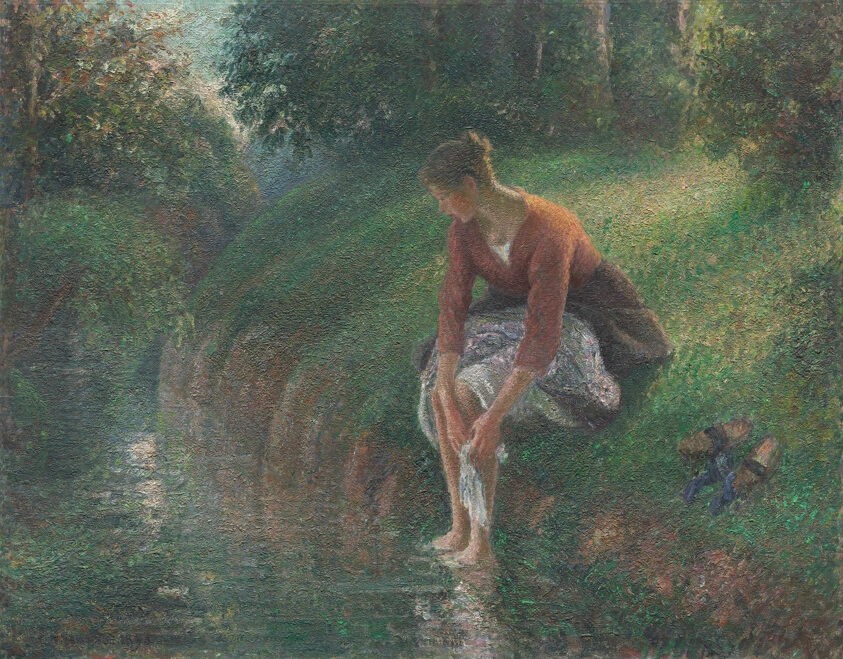
Woman Bathing Her Feet in a Brook

Description

Camille Pissarro referred to this painting in a letter of November 1894, when he wrote to his son Lucien that he wanted to send him a picture of “a little peasant girl dipping her feet in the water.” At the time, he considered the work almost finished but still lacking “that little something,” exclaiming optimistically, “I think I will get it, I feel it!” His continued ruminations on the composition may explain its heavily encrusted surface. After finishing it, he painted a variation featuring a nude (a rarity for the artist) in the same pose and setting (1895; Metropolitan Museum of Art, New York).

Provenance

Albert Pontremoli, Paris, by April, 1904 [per Pissarro and Snollaerts, 2005]; sold Albert Pontremoli Sale, Hôtel Drouot, Paris, June 11, 1924, lot 136 (ill.) to Dr. Janos Plesch, Berlin, for 37,700 francs [per Hôtel Drouot sale cat. 1924]; Paul Rosenberg and Co., New York, by 1939 [this and the three following per material prepared by Richard-Raymond Alasko, May 1985, curatorial object file and Pissarro and Snollaerts, 2005]; sold to Mrs. John Astor, New York. E and A. Silberman Gallery, New York, by 1951; sold to Nathan Cummings, Chicago, January 25, 1952; transferred to Consolidated Foods Nathan Cummings Collection (Sara Lee Corporation), 1980; given to the Art Institute of Chicago, 1999.

Woman Bathing Her Feet in a Brook

Camille Pissarro

1895

Accession Number

153799

Medium

Oil on canvas

Dimensions

73 × 92 cm (28 1/2 × 36 in.); Framed: 95 × 113.1 × 12.4 cm (37 3/8 × 44 1/2 × 4 7/8 in.)

Classification

oil on canvas

Museum

The Art Institute of Chicago

Chicago, United States

Credit Line

A Millennium Gift of Sara Lee Corporation

Background & Context

Background Story

Camille Pissarro's "Woman Bathing Her Feet in a Brook" (1895) is an oil on canvas that depicts a peasant woman pausing in her labors to cool her feet in a stream. This subject—the figure in a landscape, engaged in a simple, intimate act—was a recurring theme in Pissarro's later work and connects his art to the tradition of the pastoral from Giorgione to Millet. The setting is the countryside around Éragny, where Pissarro spent the final years of his life. The woman's pose is natural and unselfconscious, her attention focused on the sensation of the cool water. Pissarro's handling in this painting combines the broken color of Impressionism with a greater solidity of form that reflects his continued evolution as a painter. The subject allowed him to combine two of his deepest interests: the landscape of rural France and the human figure within that landscape, engaged in the timeless rhythms of rural life.

Cultural Impact

Pissarro's late pastoral scenes represent a synthesis of Impressionist color and classical composition, creating a vision of rural life that is both modern and timeless.

Why It Matters

This painting of a woman bathing her feet captures the pastoral ideal at the heart of Pissarro's later work: the human figure in harmony with nature, engaged in simple, timeless acts of physical refreshment.