The Crystal Palace

Description

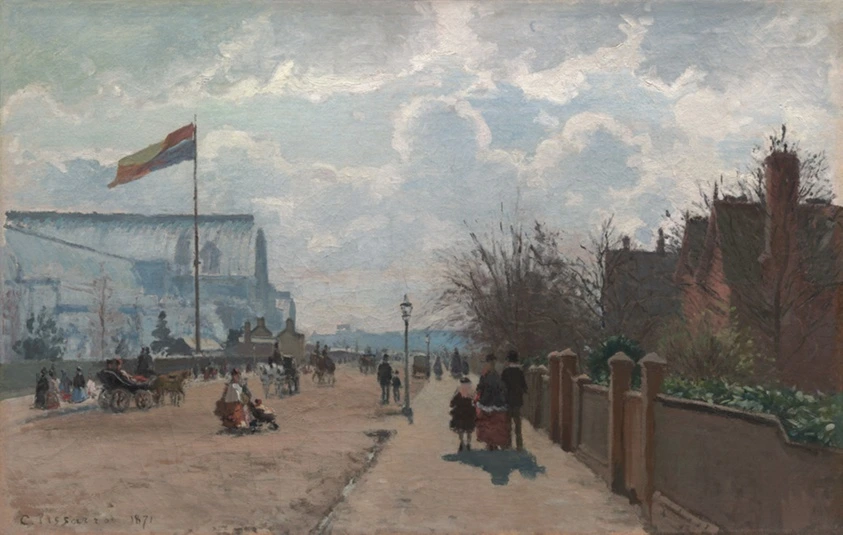
Camille Pissarro and his family left France in 1870–71 to escape the Prussian invasion and subsequent civil uprising (known as the Commune). They spent these years in Lower Norwood, outside London. In the neighboring town of Sydenham, Pissarro painted the glass-and-iron Crystal Palace, which was originally designed by Joseph Paxton in 1851 for London’s Hyde Park. Although it was immediately acclaimed for its modern architecture, only two years later the building was dismantled and reassembled in Sydenham. (It was destroyed by fire in 1936.) In this small oil painting, Pissarro relegated what was considered the world’s largest building to the left side of the canvas, as if to give equal space to the “modern-life” scene of families and carriages parading by Sydenham’s more recently constructed middle-class homes.

Provenance

Charles J. Galloway, Thorneyholme, Kunstford, Cheshire, by 1892 [per Galloway 1892]; sold Sold at the Charles J. Galloway estate sale, Christie’s, London, June 26, 1905, lot 279, to Bernheim–Jeune, Paris, for £68.5 [per Christie’s sale cat. 1905]; sold to Durand-Ruel, Paris, July 4, 1905 [this and the three following per Durand-Ruel Archives, as confirmed by Caroline Durand-Ruel Godfroy, Durand-Ruel Archives, to the Art Institute, Mar. 30, 2000, curatorial object file]; transferred to Durand-Ruel, New York, by January 1931; sold to Henry Johnson Fisher (d. 1965), Greenwich, Conn., June 19, 1941; by descent to his family [per Phillips Academy, Addison Gallery, 1967]; sold to Hirschl & Adler, New York, Apr. 6, 1970 [this and the following per Greg Hedberg, Hirschl and Adler, to Gloria Groom, e-mail correspondence, Dec. 1, 2014, curatorial object file]; sold to Mr. B. E. Bensinger, Chicago, June 14, 1971; given to the Art Institute of Chicago, beginning in 1972 [The painting was given to the Art Institute of Chicago in undivided fractional interests beginning in 1972. The Art Institute received the final fractional interest for one hundred percent ownership in 1974].

The Crystal Palace

Camille Pissarro

1871

Accession Number

110541

Medium

Oil on canvas

Dimensions

47.2 × 73.5 cm (19 × 29 in.); Framed: 72.3 × 98.4 cm (28 1/2 × 38 3/4 in.)

Classification

oil on canvas

Museum

The Art Institute of Chicago

Chicago, United States

Credit Line

Gift of Mr. and Mrs. B. E. Bensinger

Background & Context

Background Story

Camille Pissarro's "The Crystal Palace" (1871) is an oil on canvas that documents a historically significant moment: the artist's exile in London during the Franco-Prussian War. In 1870, Pissarro fled France for England, leaving behind his home in Louveciennes which was destroyed by Prussian soldiers, along with many of his early paintings. In London, he painted several views of the Crystal Palace, the great iron-and-glass structure that had been relocated to Sydenham after the 1851 Great Exhibition. This painting shows the Crystal Palace from a distance, its gleaming structure rising above the surrounding parkland. Pissarro's treatment is characteristically fresh and observant, the English light captured with a palette that differs from his French landscapes. This period in London was crucial for Pissarro's development, as he studied English landscape painting, particularly the work of Turner and Constable, whose influence can be felt in his subsequent work.

Cultural Impact

Pissarro's London paintings document a crucial period of exile that exposed him to English landscape painting and influenced the development of his Impressionist technique.

Why It Matters

This view of the Crystal Palace captures Pissarro's response to English landscape and light, the iconic glass structure rendered with the freshness and immediacy that would define Impressionism.