Provenance
The artist (d. 1903); sold to Durand-Ruel, Paris, December 3, 1892 [per Durand-Ruel Archives to the Art Institute of Chicago, Mar. 30, 2000, curatorial object file]; sold to Mrs. Harriet Borland (née Blair), Chicago, October 19, 1899 [per Durand-Ruel New York (stock 1119), Durand-Ruel Archives to the Art Institute of Chicago, Mar. 30, 2000, curatorial object file]; by descent to Bruce Borland (son), Chicago; given to the Art Institute of Chicago, beginning in 1961 [undivided fractional interests, receiving the final fractional interested for one hundred percent ownership in 1963].
Accession Number
87000
Medium
Oil on canvas
Dimensions
65.5 × 81.3 cm (25 3/4 × 32 in.); Framed: 85.1 × 101.6 × 8.9 cm (33 1/2 × 40 × 3 1/2 in.)
Classification
oil on canvas
Credit Line
Gift of Bruce Borland
Background & Context
Background Story
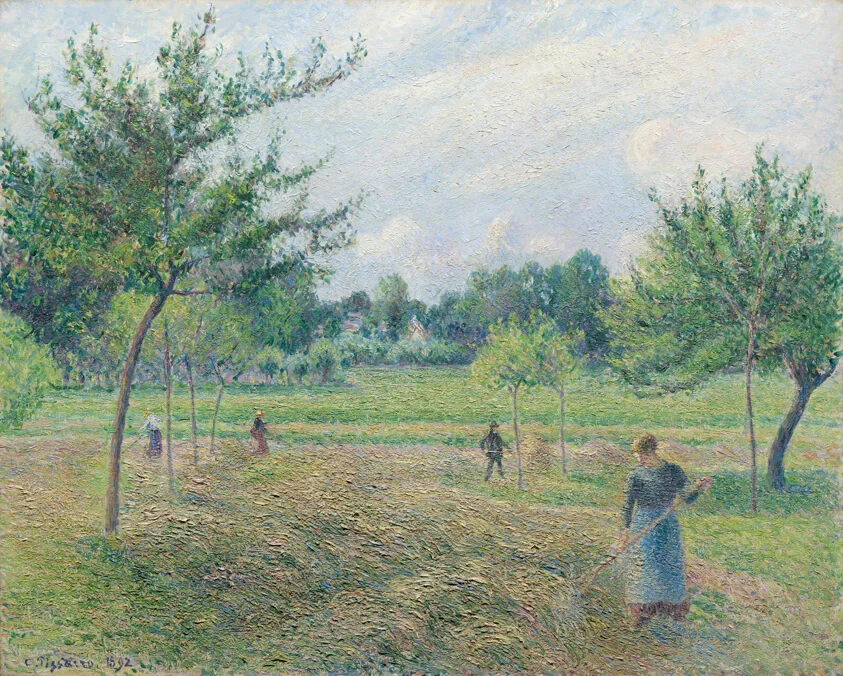
Camille Pissarro's "Haymaking at Éragny" (1892) is an oil on canvas depicting the summer harvest in the village where Pissarro spent the final years of his life. Éragny, northwest of Paris, became Pissarro's home in 1884, and the landscape around it provided endless material for his art. Haymaking—the cutting and gathering of hay—was a traditional rural activity that Pissarro painted throughout his career, finding in its rhythms a subject worthy of sustained artistic attention. This painting shows workers in the fields, the hay piled in mounds, the summer light flooding the landscape. Pissarro's technique in this work is fully mature: the brushwork is varied and expressive, the color is rich and harmonious, the composition is balanced but not rigid. The subject of rural labor was politically significant for Pissarro, who was an anarchist and believed in the dignity of working people. His paintings of peasants and farmers are never sentimental or picturesque; they are honest records of the hard work that sustained rural life.
Cultural Impact
Pissarro's haymaking scenes represent the intersection of his artistic and political commitments, finding beauty and dignity in the labor of rural workers.
Why It Matters
This sunlit haymaking scene captures the warmth and abundance of summer in the French countryside, Pissarro's varied brushwork and rich color conveying both the beauty of the landscape and the dignity of agricultural labor.


