Woman and Child at the Well

Description

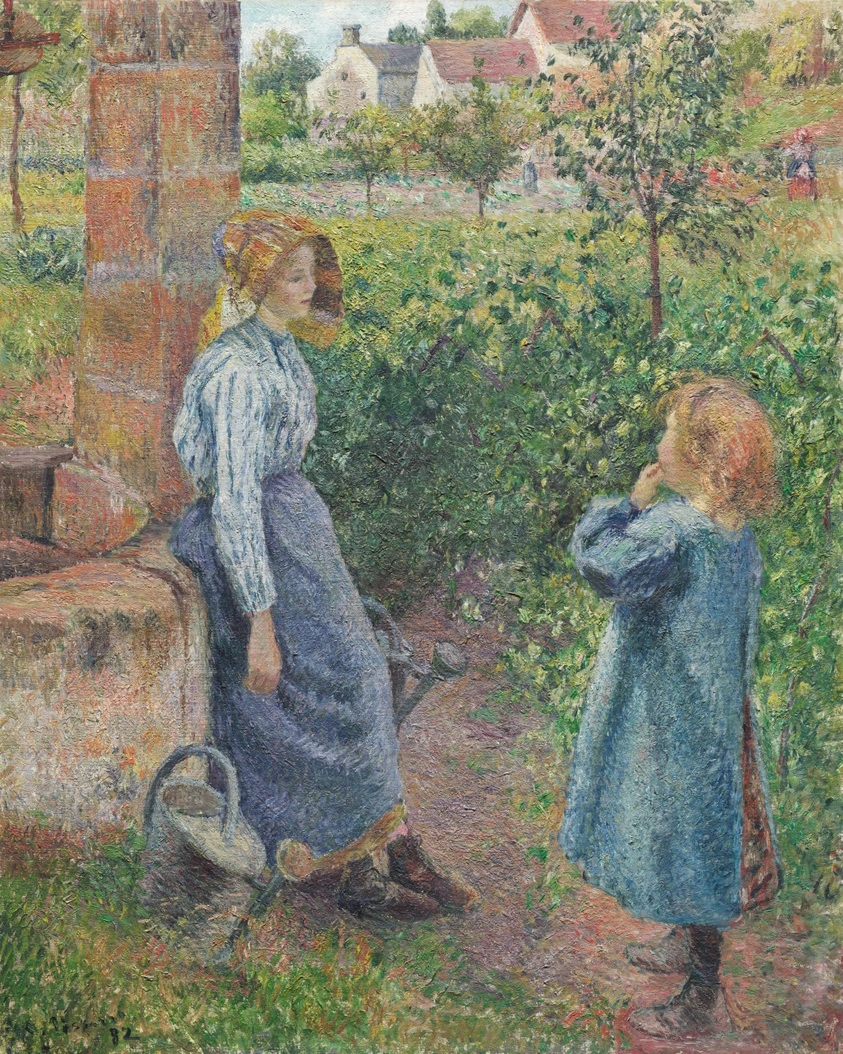
By the 1880s, Camille Pissarro, like most of his Impressionist colleagues, sought an alternative to the style he had employed over the previous decade, deciding to focus on figures rather than landscapes. Of the 36 paintings he showed at the seventh Impressionist exhibition, in the spring of 1882, 27 were figural. Woman and Child at the Well is one of a series of works depicting peasant girls taking a break from their chores, their poses and gestures suggesting narratives that remain ambiguous. As the model for the boy in this composition, Pissarro used his fourth son, Ludovic-Rodolphe, who was four years old at the time.

Provenance

The artist (d. 1903); sold to Durand-Ruel, Paris, August 5, 1882 [this and the five following per Pissarro and Snollaerts 2005]. Durand-Ruel, New York, by August 5, 1882; sold to William Loring Andrews, New York, February 27, 1888; sold back to Durand-Ruel, New York, May 21, 1891; sold to Cyrus J. Lawrence, New York, December 19, 1891; sold back to Durand-Ruel, New York, January 2, 1892; sold to Potter Palmer (d. 1902), Chicago, March 2, 1892, for $750 [per Durand-Ruel Archives, New York stock book 1888-1892, no. 860, as Femme au puits, as confirmed by Caroline Durand-Ruel Godfroy, Durand-Ruel Archives, to the Art Institute of Chicago, Dec. 13, 1994, curatorial object file]; by descent to the Potter family, Chicago; given to the Art Institute of Chicago, 1922.

Woman and Child at the Well

Camille Pissarro

1882

Accession Number

81552

Medium

Oil on canvas

Dimensions

81.5 × 66.4 cm (32 1/8 × 26 1/8 in.); Framed: 98.5 × 81.6 × 6.1 cm (38 3/4 × 32 1/8 × 2 3/8 in.)

Classification

Painting

Museum

The Art Institute of Chicago

Chicago, United States

Credit Line

Potter Palmer Collection

Background & Context

Background Story

"Woman and Child at the Well" is one of Camille Pissarro's most accomplished rural genre scenes, painted in 1882 during his period of experimentation with the pointillist techniques of Seurat and Signac, though the brushwork here remains more fluid and less systematically divided than pure Neo-Impressionism. The composition shows a peasant woman drawing water while a child stands nearby, the two figures integrated into a landscape that suggests the agricultural rhythms of Pissarro's native Normandy or the Île-de-France. The well itself is a traditional symbol of domestic labor and female responsibility in European art, and Pissarro's treatment preserves this symbolism while avoiding the sentimental idealization common in academic genre painting. The woman is rendered with the same attention to gesture and posture that Pissarro devoted to his haystack and orchard scenes; her body is slightly bent under the weight of the task, her hands engaged in the physical work of drawing water. The child is shown in profile, watching the adult with the mixture of dependence and independence that characterizes rural childhood. The palette is typical of Pissarro's 1880s work—warm earth tones punctuated by the blues and greens of vegetation and sky, all rendered with the broken brushwork that suggests light filtering through leaves. The painting also reflects Pissarro's political commitments: an anarchist sympathizer, he consistently portrayed rural laborers with dignity rather than condescension, presenting their work as worthy of the same aesthetic attention as urban leisure. Art historians have compared this work to the rural scenes of Millet and Bastien-Lepage, though Pissarro's treatment is less heroic, more attentive to the daily rhythms of agricultural life.

Cultural Impact

This rural genre scene applied Impressionist broken brushwork and anarchist sympathy to peasant labor, elevating the daily water-drawing ritual to the same aesthetic plane as urban leisure.

Why It Matters

It matters because Pissarro painted a woman at a well like she was picking apples—proving that the hardest work deserved the prettiest light.