Description
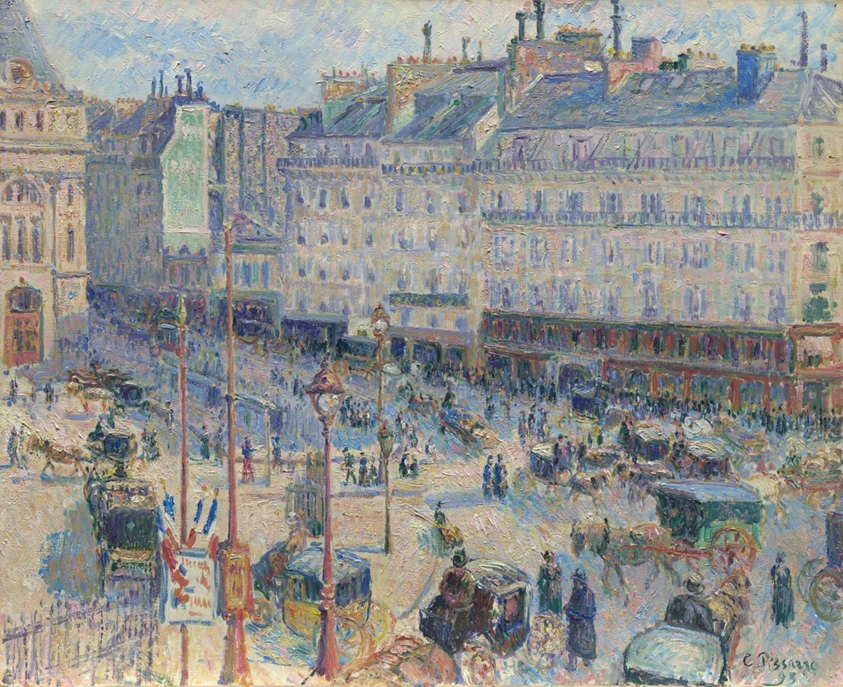
After a period of experimentation with the Neo-Impressionist style developed by Georges Seurat, Camille Pissarro returned to the loose, multidirectional brushstrokes that he had used in his earlier Impressionist works. He also revisited an Impressionist subject that his colleagues had all but abandoned by the 1890s—the modern city. This bustling scene, alive with the noise and movement of traffic and pedestrians, was the view from his window at the Hôtel Garnier in Paris, where he stayed for a few weeks early in 1893. The building at the left edge of the canvas is the Gare Saint-Lazare.
Provenance
The artist (d. 1903); sold to Durand-Ruel, Paris, March 17, 1893 [per Pissarro and Snollaerts 2005]; sold to Potter Palmer (d. 1902), Chicago, June 28, 1894, for $1,200 [per Durand-Ruel Archives, New York Stock no. 1168 and Paris Stock no. 2707, as Place du Hârve, as confirmed by Caroline Durand-Ruel Godfroy, Durand-Ruel Archives, to the Art Institute of Chicago, Dec. 13, 1994, curatorial object file]; by descent to the Potter family, Chicago; given to the Art Institute of Chicago, 1922.
Accession Number
81551
Medium
Oil on canvas
Dimensions
60.1 × 73.5 cm (23 5/8 × 28 13/16 in.); Framed: 83.2 × 97.8 × 12.1 cm (32 3/4 × 38 1/2 × 4 3/4 in.)
Classification
Painting
Credit Line
Potter Palmer Collection
Background & Context
Background Story
Painted in 1893, "The Place du Havre, Paris" is one of Pissarro's most sophisticated urban scenes, showing a busy Paris intersection from a high vantage point that reveals the city's transformation under Haussmann's nineteenth-century urban renewal. The composition is dominated by the geometric clarity of the new boulevards, their straight lines and uniform façades providing a structural armature around which the human and vehicular traffic flows with apparent randomness. Pissarro's treatment of the modern city is notable for its lack of nostalgia: unlike Monet, who sought the remnants of old Paris in his cathedral and boulevard series, Pissarro embraces the new urban order, finding in its regularity a visual harmony that compensates for the loss of historical character. The palette is high-keyed and luminous, the gray stone of the buildings warmed by the late afternoon sun and animated by the bright clothing of the pedestrians. The brushwork is more controlled than in Pissarro's rural scenes: the city demands precision, and the artist responds with shorter, more discrete strokes that suggest the modular regularity of Haussmann's architecture. This painting also reflects Pissarro's personal circumstances: by 1893 he was living in Paris year-round, his failing eyesight making rural plein-air work increasingly difficult. The urban scenes of his final decade are thus not merely aesthetic choices but adaptations to physical limitation, transforming necessity into opportunity. Art historians have connected this work to the broader project of modernist urban representation, from the flâneur literature of Baudelaire to the street photography of Atget.
Cultural Impact
This urban view embraced Haussmann's geometric Paris without nostalgia, transforming necessity into opportunity as failing eyesight drove Pissarro from rural fields to high-vantage city observation.
Why It Matters
It matters because Pissarro looked at Haussmann's straight lines and saw music—proving that even a traffic intersection could be beautiful if the sun was low enough.


