Description
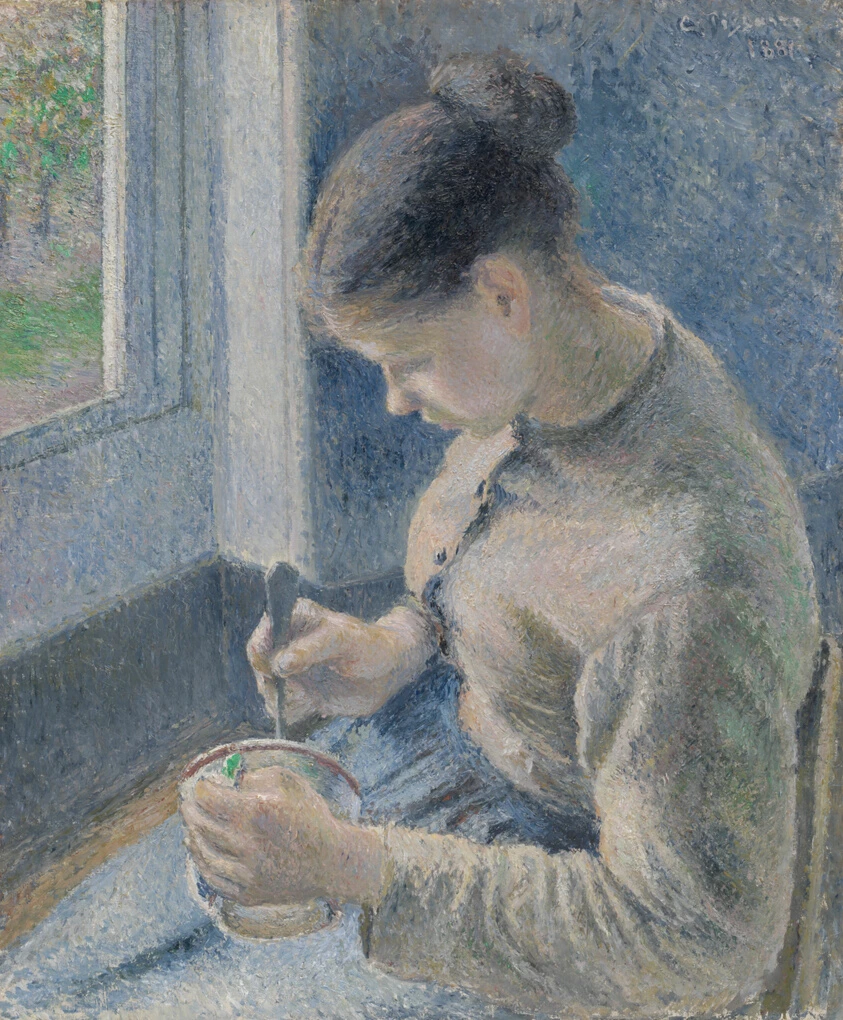
In the 1880s, at a time when many of the original Impressionist painters had begun to pursue independent styles, Camille Pissarro actively worked to keep the group together. He persuaded Gustave Caillebotte and Claude Monet to take part in the seventh Impressionist exhibition, in 1882, and also displayed a number of his own paintings of peasant girls. Here the small brushstrokes, applied one next to the other and sometimes overlaid with dabs of thicker paint, result in an irregularly built-up surface, serving to integrate figure and setting and evoke the textures of the young woman’s wool clothing.
Provenance
The artist (d. 1903); sold to Durand-Ruel, Paris, December 19, 1881 [this and the two following per Pissarro and Snollaerts 2005]; sold to Georges Petit, Paris, August 9, 1883; sold back to Durand-Ruel, Paris, April 17, 1891, for 1,000 francs; sold to Potter Palmer (d. 1902), Chicago, April 29, 1892, for 3,000 francs [per Durand-Ruel Archives, Paris stock no. 912, as Le Café au lait, as confirmed by Caroline Durand-Ruel Godfroy, Durand-Ruel Archives, to the Art Institute of Chicago, Dec. 13, 1994, curatorial object file]; by descent to the Palmer family; given to the Art Institute of Chicago, 1922.
Accession Number
81548
Medium
Oil on canvas
Dimensions
65.3 × 54.8 cm (25 11/16 × 21 9/16 in.)
Classification
Painting
Credit Line
Potter Palmer Collection
Background & Context
Background Story
"Young Peasant Having Her Coffee" is a quiet masterpiece from 1881, one of Pissarro's most intimate depictions of rural domestic life, showing a young woman seated at a table in a modest interior, engaged in the universal ritual of morning coffee. The composition is informal and cropped, as if the viewer has entered the room unnoticed and is observing a private moment of rest. The woman's posture is relaxed but not languid; she holds the cup with both hands, her gaze directed downward in contemplation rather than outward toward the viewer. This unavailability is characteristic of Pissarro's best genre scenes: he respects the subject's interiority, refusing to turn her into an object of picturesque charm or moral instruction. The palette is warm and muted—browns, creams, and soft greens that suggest the earthy simplicity of peasant life without romanticizing its poverty. The brushwork is notably free for this period, with broad strokes that describe the wooden furniture, the ceramic cup, and the woman's clothing without excessive detail. This restraint allows the viewer to focus on the essential: the human presence in a modest setting, the dignity of ordinary routine. The painting also reflects Pissarro's anarchist sympathies: by presenting a peasant at rest rather than at labor, he asserts that the working class is entitled to leisure and comfort, not merely to exploitation. Art historians have compared this work to the domestic scenes of Chardin and the Vermeer tradition, though Pissarro's treatment is more informal, less geometrically composed. In the history of Impressionist genre painting, the canvas stands as evidence that the movement's democratic impulses extended beyond urban leisure to encompass rural life in all its quiet variety.
Cultural Impact
This intimate genre scene asserted anarchist dignity for rural leisure, presenting peasant coffee as worthy of the same pictorial attention as aristocratic salon gatherings.
Why It Matters
It matters because Pissarro let a peasant woman drink coffee in peace—proving that rest could be as revolutionary as work if someone bothered to paint it.


