Provenance
Alphonse Legrand, Paris, by Feb. 21, 1890 [this and the following per Durand-Ruel, Paris, stock book for 1884–90 (no. 2637), as confirmed by Paul-Louis Durand-Ruel and Flavie Durand-Ruel, Durand-Ruel Archives, Oct. 5, 2010, curatorial object file]; sold to Durand-Ruel, Paris, Feb. 21, 1890; transferred to Durand-Ruel, New York, by April 19, 1892 [this and the following per the Durand-Ruel, New York, stock book for 1888–93 (no. 900, as Marine or Stormy sea on the coast near Dieppe), as confirmed by Paul-Louis Durand-Ruel and Flavie Durand-Ruel, Durand-Ruel Archives, Oct. 5, 2010, curatorial object file]; sold to W. C. Van Horne, Montreal, April 19, 1892, for $1,000. Acquired by Eugene Glaenzer, New York, by Dec. 14, 1892. [this and the two following per Durand-Ruel, New York, stock book for 1888–93 (no. 1011, Marine), as confirmed by Paul-Louis Durand-Ruel and Flavie Durand-Ruel, Durand-Ruel Archives, Oct. 5, 2010, curatorial object file]; Durand-Ruel, New York, Dec. 14, 1892; sold to Potter Palmer (d. 1902), Chicago, Dec. 14, 1892, for $1,250; by descent to the Potter family; given to the Art Institute of Chicago, 1922.
Accession Number
81557
Medium
Oil on canvas
Dimensions
72.6 × 91.6 cm (28 1/2 × 36 in.); Framed: 97.8 × 116.9 × 8 cm (38 1/2 × 46 × 3 1/8 in.)
Classification
Painting
Credit Line
Potter Palmer Collection
Background & Context
Background Story
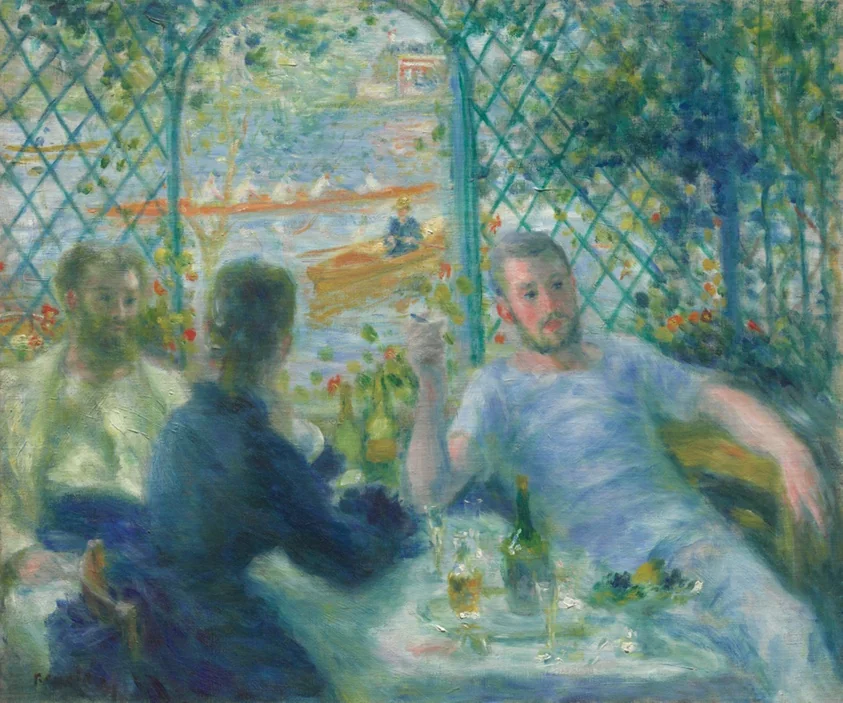
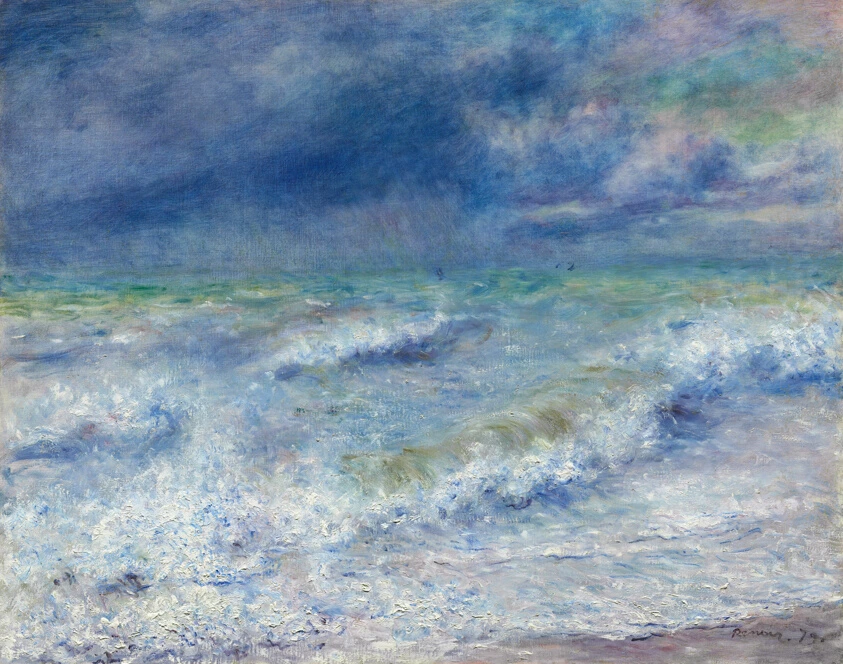
"Seascape" is one of Renoir's most atmospheric marine paintings, executed in 1879 during the period when he was exploring the effects of open-air light on water with the same sensuous attention to surface texture that he brought to portraits and still lifes. The composition shows a view of the sea from the shore, the horizon line placed high to emphasize the expanse of water and sky, with perhaps a suggestion of boats or figures in the distance. The palette is dominated by blues, grays, and the pale greens of shallow water, with touches of white that suggest the sparkle of sunlight on wave crests. Renoir's brushwork is notably free in this canvas: broad, sweeping strokes suggest the movement of the water without describing individual waves, creating an overall effect of shimmering luminosity that anticipates the more abstract treatment of his late seascapes. The 1879 date places the work in the same year as the "Luncheon of the Boating Party," when Renoir was at the height of his Impressionist powers and producing some of his most chromatically adventurous work. The seascape genre had not been central to his earlier career, but his exposure to the Normandy and Mediterranean coasts in the late 1870s introduced a new subject that would sustain him through his final decades. Art historians have compared this painting to the seascapes of Monet and Boudin, noting that Renoir's treatment is warmer, more sensuous than Monet's analytical approach to light on water. The canvas also demonstrates Renoir's willingness to sacrifice topographical accuracy for chromatic harmony: the sea is not a specific location but an optical experience, a field of color that changes with every shift of light and weather. In the history of marine painting, the work stands as evidence that Impressionism's color principles could transform even the most traditional of genres.
Cultural Impact
This 1879 marine painting transformed Impressionist color principles into sensuous seascape luminosity, using broad sweeping strokes to make the sea an optical experience rather than a specific location.
Why It Matters
It matters because Renoir looked at the sea and saw a mirror of paint—proving that water could be any color if the light was dancing.