Provenance
The artist (d. 1919); probably sold to Durand-Ruel, Paris, May 23, 1882, for 600 francs [per Daulte 1971]. Possibly sold at Moore’s Art Galleries, New York, May 6, 1887, lot 92 [per Moore’s Art Gallery sale catalogue 1887, although the Durand-Ruel Archive states “la vente à la ‘Moore’s Art Galleries’: il s’agissait d’une vente fictive (aucun tableau n’a été vendu) destinée à faire de la publicité pour les tableaux apportés par Durand-Ruel à New York,” Paul-Louis Durand-Ruel and Flavie Durand-Ruel, Durand-Ruel Archives, Oct. 5, 2010, curatorial object file]. Durand-Ruel, New York, by Nov. 14, 1908 [per Durand-Ruel, New York, Exhibition of Paintings by Pierre Auguste Renoir, exh. cat. (Durand-Ruel, New York, 1908), no. 8. For the identification of no. 8 as the Art Institute’s painting, see Dauberville and Dauberville 2007. It is possible that Durand-Ruel acquired the painting by April 1900; see Durand-Ruel, New York, Exhibition of Paintings by Claude Monet and Pierre Auguste Renoir, exh. cat. (Durand-Ruel, New York, 1900), no. 29]; sold to Martin A. Ryerson (d. 1932), Chicago, Dec. 18, 1915, for $10,200 [per Durand-Ruel Archives, Renoir’s “Fruits du Midi, 1881” (New York Stock no. 115—New York Photo No. A 915), as confirmed by Caroline Durand-Ruel Godfroy, Durand-Ruel Archives, to the Art Institute of Chicago, Dec. 13, 1994, curatorial object file, Art Institute of Chicago. A purchase receipt on Durand-Ruel letterhead, dated Dec. 21, 1915, includes this painting as one of a number sold by Durand-Ruel, New York, to M. A. Ryerson, photocopy in curatorial object file, Art Institute of Chicago’]; bequeathed to the Art Institute of Chicago, 1933.
Accession Number
16629
Medium
Oil on canvas
Dimensions
51 × 65 cm (20 1/16 × 25 5/8 in.); Framed: 70.1 × 85 cm (27 5/8 × 33 1/2 in.)
Classification
Painting
Credit Line
Mr. and Mrs. Martin A. Ryerson Collection
Background & Context
Background Story
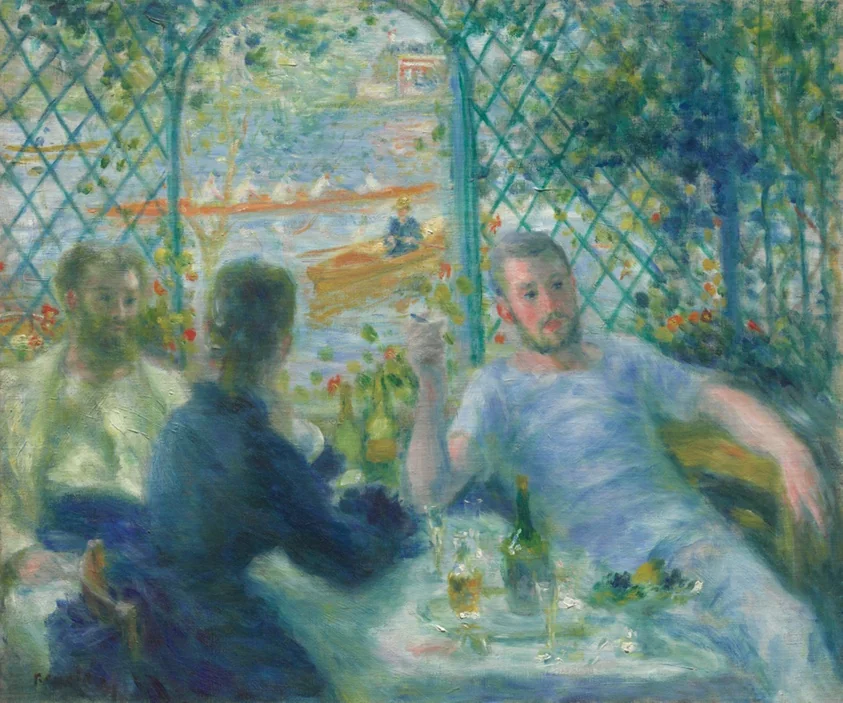
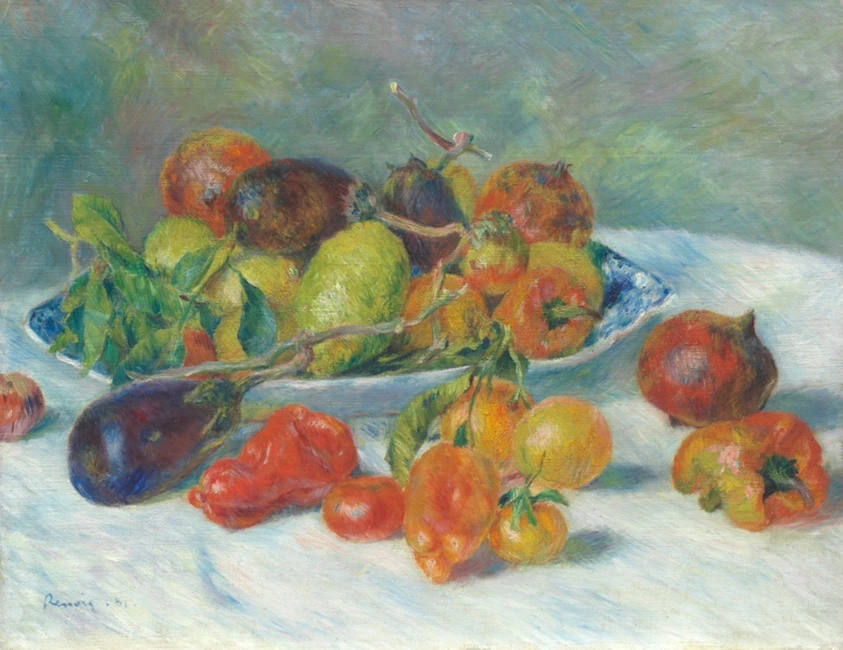
"Fruits of the Midi" is one of Renoir's most sumptuous still lifes, painted in 1881 during a trip to the South of France when the Provençal sunlight and Mediterranean abundance were transforming his palette from the muted tones of the Île-de-France to the golden warmth that would define his late style. The composition shows a heap of southern fruits—peaches, grapes, perhaps a melon—arranged in a casual profusion that suggests harvest rather than formal display. The palette is dominated by warm yellows, oranges, and muted greens that glow with the saturation of high-summer light. Renoir's brushwork is thick and confident, the paint applied with a loaded brush that leaves visible ridges and impasto highlights where the light catches the rounded forms. This tactile quality is what distinguishes his still lifes from the more delicate treatment of flowers or porcelain; fruit demanded physical weight, and Renoir responded with a palpable density that makes the viewer want to reach into the canvas. The title's reference to the Midi places the work in a specific geography—the South of France as opposed to the North—and reflects the nineteenth-century French belief that the Mediterranean region was the natural home of pleasure and sensory abundance. The painting also belongs to the same period as Renoir's famous "Luncheon of the Boating Party," when he was at the height of his Impressionist powers and producing work of extraordinary chromatic richness. Art historians have compared this still life to Cézanne's contemporaneous fruit paintings, noting that where Cézanne sought geometric structure, Renoir pursued optical pleasure. In the history of the still life genre, the work stands as evidence that Impressionism's color principles could be applied to traditional subjects with transformative results.
Cultural Impact
This Provençal still life marked Renoir's chromatic shift toward Mediterranean warmth, using thick impasto and tactile weight to transform harvest abundance into optical pleasure.
Why It Matters
It matters because Renoir painted southern fruit like it was gold on a plate—proving that the Midi could taste like color if the brush was generous enough.