Provenance
Durand-Ruel, Paris, Sept. 24, 1886 [per Durand-Ruel, Paris, stock book for 1884–90 (no. 1340, Au bord du lac), as confirmed by Paul-Louis Durand-Ruel and Flavie Durand-Ruel, Durand-Ruel Archives, Oct. 5, 2010, curatorial object file]; acquired by Durand-Ruel, New York, about 1888 [per Durand-Ruel, New York, stock book for 1888–91 (no. 141, Au bord du lac), as confirmed by Paul-Louis Durand-Ruel and Flavie Durand-Ruel, Durand-Ruel Archives, Oct. 5, 2010, curatorial object file]; sold to Potter Palmer (d. 1902), Chicago, Mar. 2, 1892, for $900. [per Durand-Ruel, New York, stock book for 1888–93 (no. 197, Au bord du lac), as confirmed by Paul-Louis Durand-Ruel and Flavie Durand-Ruel, Durand-Ruel Archives, Oct. 5, 2010, curatorial object file]; by decent to the Palmer family; given to the Art Institute of Chicago, 1922.
Accession Number
95654
Medium
Oil on canvas
Dimensions
47.5 × 56.4 cm (18 11/16 × 22 3/16 in.); Framed: 65.8 × 74.3 × 8.6 cm (25 7/8 × 29 1/4 × 3 3/8 in.)
Classification
Painting
Credit Line
Potter Palmer Collection
Background & Context
Background Story
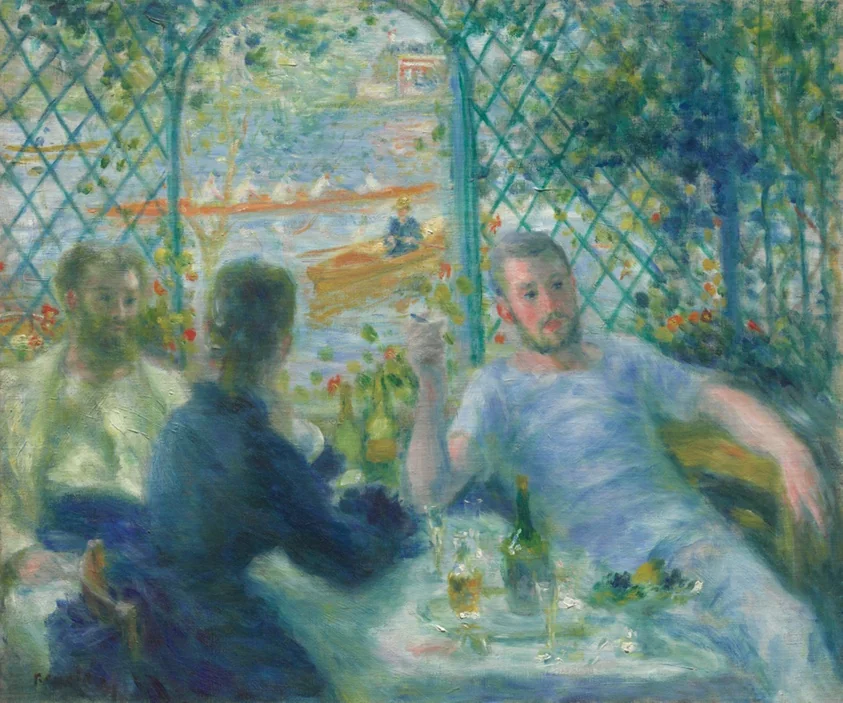
"Near the Lake" is a landscape painting from 1879–80 that captures Renoir in a transitional moment, moving from the outdoor brightness of high Impressionism toward the more structured, classical approach that would define his work of the mid-1880s. The composition shows a view of a lake—probably in the Île-de-France region near Paris—with figures or boats suggested in the middle distance and trees framing the foreground. The palette is softer and more muted than in Renoir's most exuberant canvases: pale blues, muted greens, and warm earth tones create an atmosphere of tranquil contemplation rather than the sparkling high-keyed brilliance of his earlier period. The brushwork shows the same transition: some passages retain the loose, broken touch of Impressionism, while others are more smoothly blended, anticipating the "silkiness" that critics would praise and mock in his later work. This stylistic evolution reflects Renoir's growing dissatisfaction with what he perceived as the decorative limitations of pure Impressionism: he wanted to recover the solid modeling and compositional stability of the Old Masters without sacrificing the color discoveries of his generation. The lake setting itself carries symbolic weight in nineteenth-century French art: water had been associated with reflection, memory, and the passage of time since the romantic landscapes of Corot, and Renoir's treatment participates in this tradition while modernizing it through his brighter palette. Art historians have connected this work to the broader "crisis of Impressionism" that affected all the major painters of the movement around 1880, when the initial revolutionary energy had been exhausted and new directions were being sought.
Cultural Impact
This 1879–80 landscape documented Renoir's transition from high Impressionism toward classical structure, using muted lake atmosphere to explore the broader generational crisis of Impressionist decorative limitations.
Why It Matters
It matters because Renoir painted a lake as if it were a mirror of his own doubt—proving that even bright colors could grow quiet when an artist wondered what came next.