Provenance
The artist to John Ross Key [Chicago Times Herald 1896]. Charles Deering (1852–1927), Chicago [stamp (Lugt 516) verso, lower right, in blue]; by descent to his daughters, Mrs. Chauncey McCormick (née Marion Deering; 1886–1965), Chicago and Mrs. Richard Ely Danielson (née Barbara Deering; 1885–1957), Chicago; given to the Art Institute of Chicago, 1927.
Accession Number
50735
Medium
Graphite on cream wove paper
Dimensions
14.3 × 10 cm (5 11/16 × 3 15/16 in.)
Classification
graphite
Credit Line
The Charles Deering Collection
Background & Context
Background Story
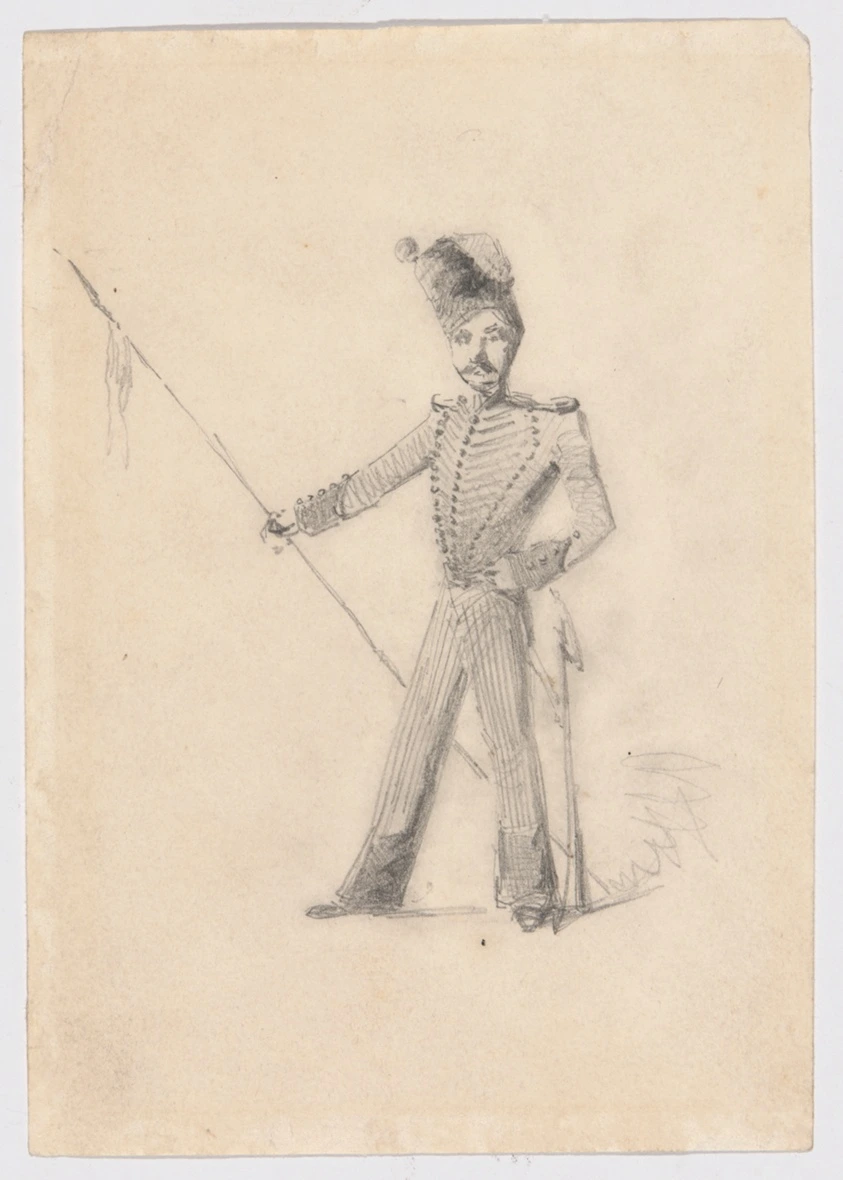
James McNeill Whistler's Soldier with Lance (1854/55) is a graphite drawing on cream wove paper from the artist's youth. Whistler (1834-1903) was one of the most original and influential artists of the 19th century, known for his portraits, landscapes, and the revolutionary aesthetic philosophy of Art for Art's Sake. This early drawing, made when Whistler was about 20, shows a soldier with a lance, perhaps a study from life or from a model in uniform. The graphite technique is precise and controlled, the figure rendered with careful attention to the details of the uniform and the weapon. The cream wove paper provides a warm ground. This drawing belongs to the period when Whistler was studying in Paris and beginning his artistic career, before he developed the more refined and atmospheric style that would make him famous. It shows the solid foundation of draftsmanship that underlay his later innovations.
Cultural Impact
Whistler's early drawings document his artistic formation, showing the academic discipline that underlay his revolutionary later work.
Why It Matters
This early study of a soldier with a lance shows the young Whistler mastering the basics of figure drawing, the precise graphite technique revealing the foundation of his later genius.