Nocturne: Blue and Gold—Southampton Water

Description

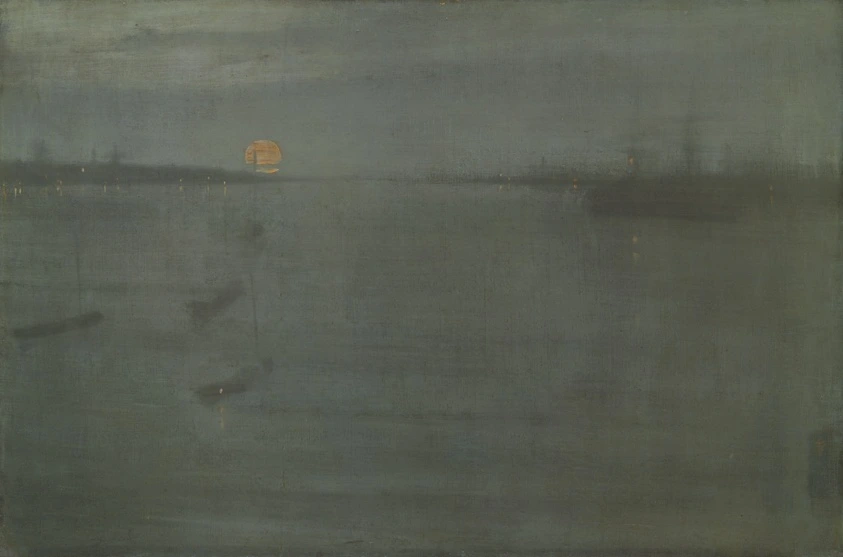
In the early 1870s James McNeill Whistler took a radical step toward abstraction with his Nocturnes series. In keeping with his art-for-art’s-sake creed, these works capture the stillness of evening while evoking a connection to music. Unlike his earlier marine paintings, the subject of this work—an inlet along the English Channel near Southampton—is obscured by the approaching night. Large shipping vessels appear as ghostly shapes, reduced to shadowy forms by the deepening twilight, while the only points of brightness come from the subtle reflections of lights and the fragmented orb of the moon. The setting thus serves primarily as a vehicle for Whistler’s interest in the harmonies of muted color amid darkness.

Provenance

The artist, 1872; Alfred Chapman (1839–1917), London, June 1874 [letter from James McNeill Whistler to James Alfred Chapman, June 22, 1874, GUW 11251]. H. Wunderlich and Co., New York, by January 1900 [letter from James McNeill Whistler to John James Cowan, January 6, 1900, GUW 00739]; sold to the Art Institute of Chicago, 1900.

Nocturne: Blue and Gold—Southampton Water

James McNeill Whistler

1872

Accession Number

56905

Medium

Oil on canvas

Dimensions

51 × 76.7 cm (20 1/16 × 30 3/16 in.)

Classification

Painting

Museum

The Art Institute of Chicago

Chicago, United States

Credit Line

Stickney Fund

Background & Context

Background Story

James McNeill Whistler (1834-1903) painted Nocturne: Blue and Gold - Southampton Water in 1872, creating one of the atmospheric nocturnes that are his most distinctive contribution to painting. The nocturnes—Whistler's term for his paintings of night scenes—reduce the landscape to a few broad areas of tone and color, creating the atmospheric, misty effects that anticipate 20th-century abstraction. The 1872 date places this in the period when Whistler was producing the nocturnes that would make him the subject of the most famous art trial of the 19th century—Ruskin's accusation that Whistler was 'flinging a pot of paint in the public's face' and Whistler's successful defense of his artistic practice.

Cultural Impact

Nocturne: Blue and Gold is important in the history of painting because it represents Whistler's reduction of landscape to broad areas of tone and color—an innovation that anticipated 20th-century abstraction and provoked the most famous art trial of the 19th century. Whistler's nocturnes strip the landscape of its traditional details and reduce it to atmospheric effects, creating a type of painting that is simultaneously atmospheric and abstract—a combination that was revolutionary in 1872 and remains radical today.

Why It Matters

Nocturne: Blue and Gold - Southampton Water is Whistler's revolutionary reduction of landscape to tone and color: the night scene reduced to broad areas of atmospheric blue and gold that anticipate 20th-century abstraction. The 1872 painting is one of the nocturnes that provoked the most famous art trial of the 19th century—Ruskin versus Whistler—over the question of whether atmospheric painting was art.