Provenance
Carmen Rossi, probably acquired from Whistler's studio, 1903 [MacDonald 1995; Stratis and Tedeschi 1998]. Sold, Drouot, Paris, November 25, 1903, lot 7, as "La Sieste." Sold, Drouot, Paris, May 27, 1924, lot 137, as "Sommeil." Sold by Marcel Guiot, Paris, to Walter S. Brewster (1872-1954), Chicago, June 25, 1924 [Macdonald 1995; stamp (Lugt 2651 a-b), mount, lower left, in blue]; given to the Art Institute, 1933.
Accession Number
14318
Medium
Lithographic crayon, with traces of scraping and stumping, on fine-grained transfer paper laid down on cream wove paper
Dimensions
Primary support: 16.1 × 24.5 cm (6 3/8 × 9 11/16 in.); Secondary support: 23.9 × 32.3 cm (9 7/16 × 12 3/4 in.)
Classification
drawings (visual works)
Credit Line
Gift of Walter S. Brewster
Background & Context
Background Story
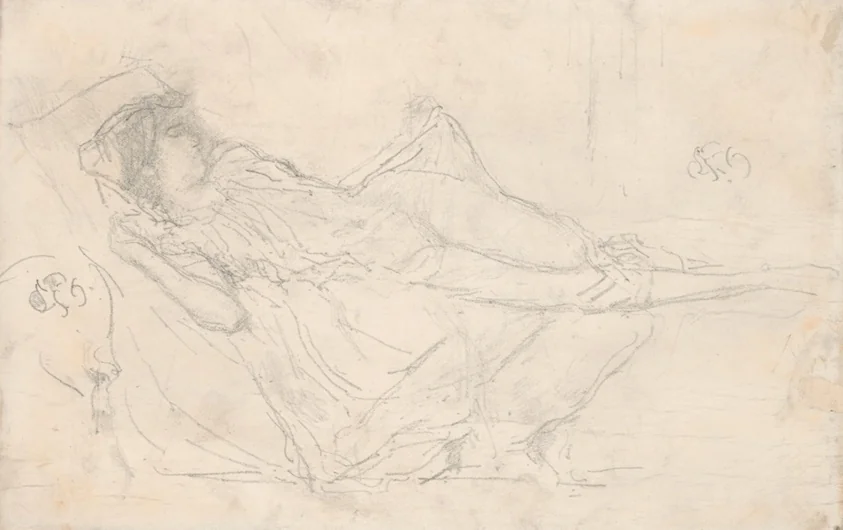
James McNeill Whistler's Reclining Draped Figure (1893) is a drawing in lithographic crayon on fine-grained transfer paper laid down on cream wove paper. This late drawing shows a figure reclining, wrapped in drapery that falls in graceful folds. The lithographic crayon technique allows for rich, dense blacks and subtle gradations of tone. Whistler's handling is confident and economical, the lines capturing the essential form of the figure and the fall of the drapery with a few strokes. This drawing likely relates to Whistler's interest in the classical tradition of the draped figure, which he explored through both his prints and his paintings. The year 1893 places this work in the later part of Whistler's career, when he was recognized as one of the most important living artists and his style had achieved its fullest refinement. The reclining draped figure is a subject with a long history in Western art, and Whistler's treatment brings to it the economy and sensitivity that distinguish his work.
Cultural Impact
Whistler's late drawings demonstrate the continued evolution of his style, moving toward even greater economy and refinement while maintaining his sensitivity to grace and beauty.
Why It Matters
This lithographic crayon drawing of a reclining draped figure captures the grace of the human form with remarkable economy, Whistler's refined line conveying both the body and the fabric with a few essential strokes.