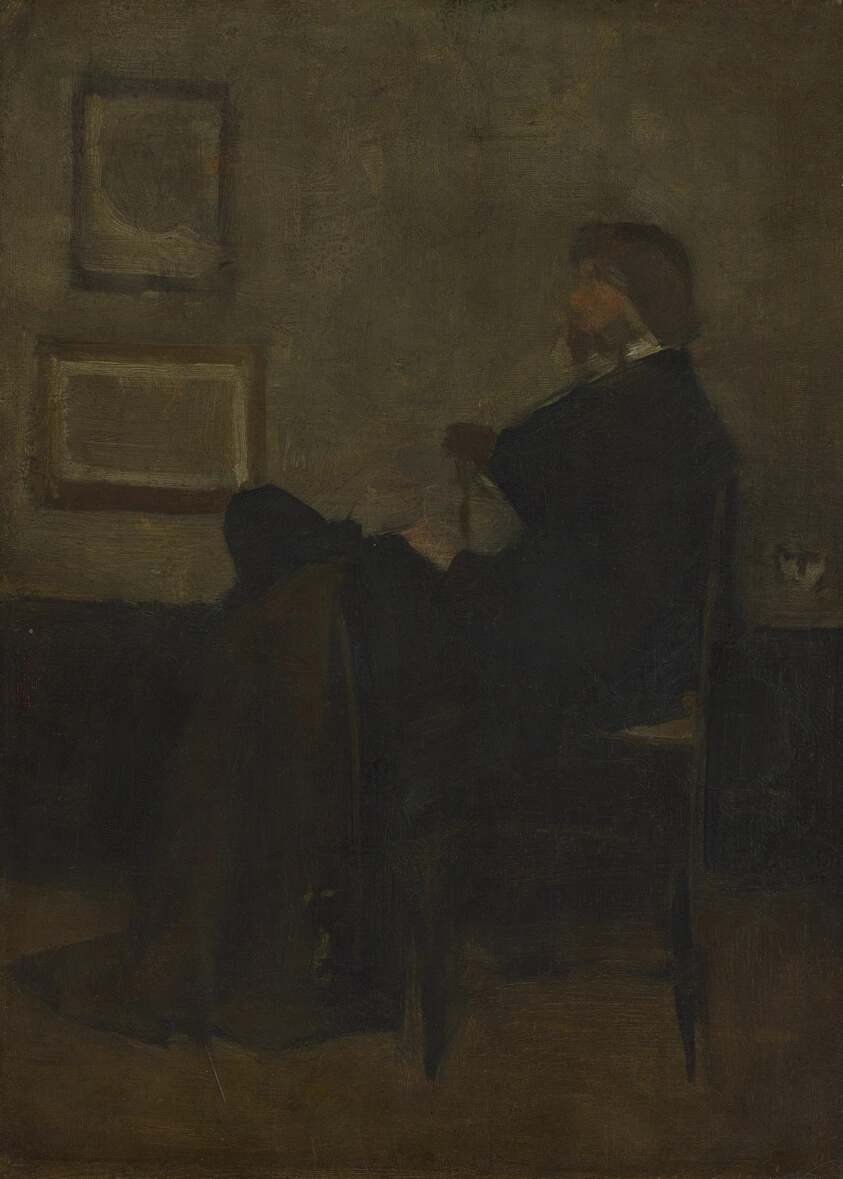
Study for "Arrangement in Grey and Black, No. 2: Portrait of Thomas Carlyle"

Description

In 1872, James McNeill Whistler began a large-scale portrait of Scottish historian and philosopher Thomas Carlyle, who lived near the artist in London. Whistler executed several studies, including this one, which strongly resembles the finished painting. Carlyle endured numerous sittings, as Whistler labored over the portrait with particular emphasis on the aesthetics of the sitter’s black coat. Concerned with harmonious arrangements of color and form, the artist was less interested in depicting the details of Carlyle’s face. The composition is strikingly similar to Whistler’s Arrangement in Grey and Black: Portrait of the Artist’s Mother (1871; Musée d’Orsay), also known as Whistler’s Mother.

Provenance

Emily Crane Chadbourne (1871–1964; born Emily Crane; also Mrs. Thomas Chadbourne), Chicago and Stone Ridge, NY, by 1956; given to the Art Institute of Chicago, 1956.

Study for "Arrangement in Grey and Black, No. 2: Portrait of Thomas Carlyle"

James McNeill Whistler

1872–73

Accession Number

3551

Medium

Oil on canvas

Dimensions

28.6 × 21 cm (11 1/4 × 8 1/4 in.)

Classification

Painting

Museum

The Art Institute of Chicago

Chicago, United States

Credit Line

Gift of Emily Crane Chadbourne
Background & Context

Background Story

"Study for 'Arrangement in Grey and Black, No. 2: Portrait of Thomas Carlyle'" is one of Whistler's most revealing preparatory works, a small oil canvas from 1872–73 that documents the process by which the artist transformed a living subject into the abstract tonal harmony that he considered the true purpose of portraiture. The sitter was the Scottish historian and philosopher Thomas Carlyle, one of the most celebrated intellectuals of the Victorian age, and Whistler's decision to paint him represented both a commercial calculation and an artistic challenge: could the portraitist of fashionable women capture the rugged authority of a male thinker? The study is remarkably small—barely 29 × 21 centimeters—yet it contains the essential compositional decisions of the finished portrait: the seated figure, the dark clothing, the concentrated gaze, and the tonal balance between figure and ground. Whistler's brushwork in the study is looser and more searching than in the final canvas: the strokes are visible, the forms slightly tentative, revealing the artist's process of discovery rather than the polished conclusion. This transparency is what makes preparatory studies valuable to art history: they show the mind at work, the decisions that precede the apparent inevitability of the finished image. The study also reflects Whistler's ambition to rival the great portrait traditions of the past: the title "Arrangement in Grey and Black" places Carlyle in the same category as his mother, suggesting that both subjects were merely pretexts for the true subject, which was tonal composition. Art historians have connected this study to the broader nineteenth-century revival of the "philosopher portrait," from David's "Death of Socrates" to Courbet's "Meeting," noting that Whistler's treatment is more abstract, less narrative than these predecessors.

Cultural Impact

This 1872–73 preparatory study revealed Whistler's philosopher-portrait discovery process, using visible searching brushwork to document the transformation of Carlyle from intellectual celebrity into grey-black tonal arrangement.

Why It Matters

It matters because Whistler sketched a famous thinker and made the sketch look like a question—proving that even preparation could be art if the greys were already decided.