Provenance
Estate of the artist, 1903; by descent to his executrix, Miss Rosalind Birnie Philip (1873-1958), the artist’s sister-in-law, 1903; sold to P.& D. Colnaghi, London, Nov. 20, 1956 [MacDonald 1995 and London 1960 exh. cat.]; sold to Mrs. Richard Warde, London, 1956 [MacDonald 1995]; sold, Christie’s, London, Mar. 5, 1965, lot. 141A, to Agnew’s, for Dorothy Braude Edinburg, Brookline, MA.; given to the Art Institute of Chicago, 2012.
Accession Number
149537
Medium
Watercolor and opaque watercolor over charcoal on brown wove paper
Dimensions
27.8 × 18.2 cm (11 × 7 3/16 in.)
Classification
watercolor
Credit Line
Gift of Dorothy Braude Edinburg to the Harry B. and Bessie K. Braude Memorial Collection
Background & Context
Background Story
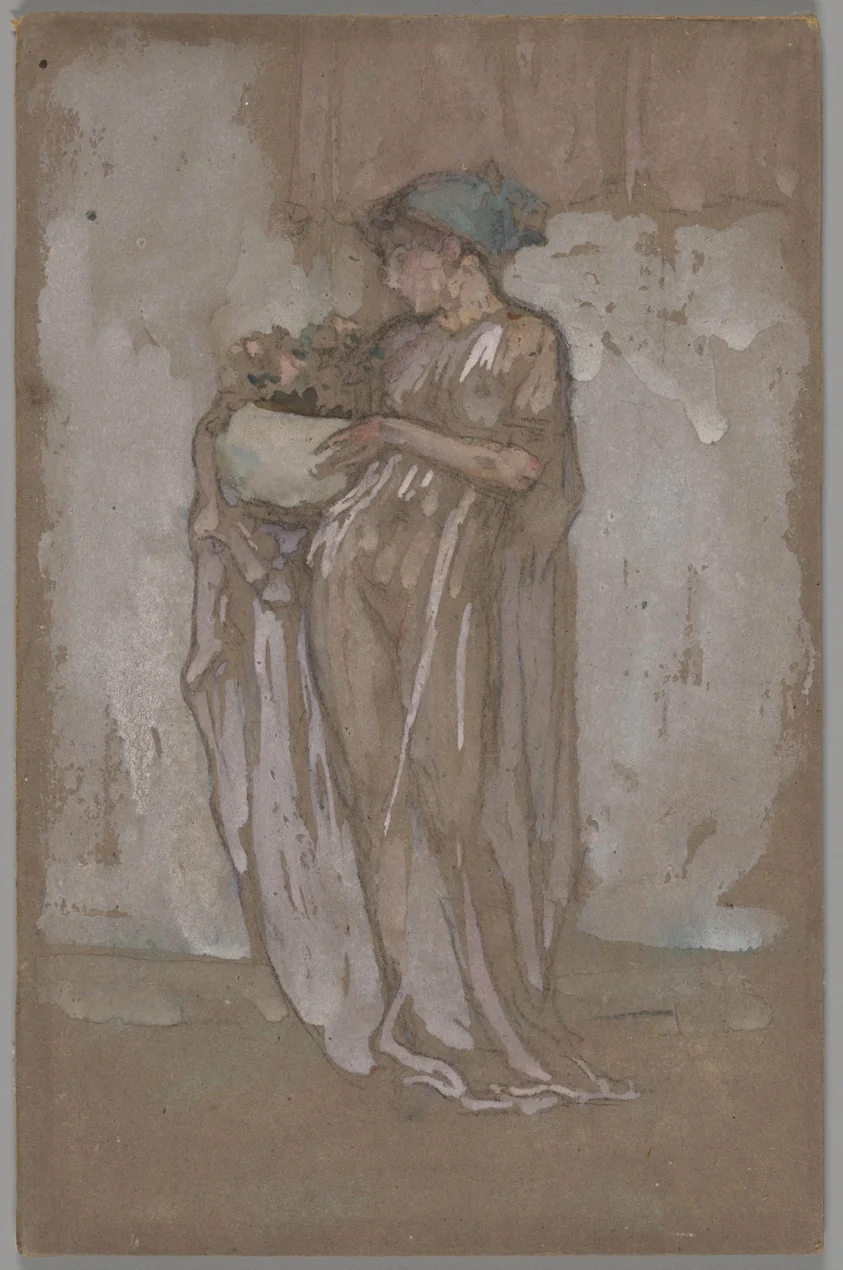
"The Little Blue Cap" is one of Whistler's most exquisite late watercolors, executed around 1893–95 during his final years in Paris when he was exploring the medium with a freedom that belied the austerity of his earlier, more famous tonal compositions. The image shows a small figure—probably a child or young woman—wearing a blue cap, rendered in watercolor and opaque watercolor over charcoal on brown wove paper with a delicacy that makes the modest sheet feel precious. The blue cap itself is the compositional focus: a spot of color in an otherwise muted image, it draws the eye and creates a focal point that contradicts the dispersed, atmospheric treatment of the surrounding space. This use of color as accent rather than dominant element is characteristic of Whistler's late work: he had moved away from the strict tonalism of his Nocturnes toward a more chromatic approach that suggested Impressionist influence without abandoning his personal aesthetic. The brown wove paper provides a warm middle tone that unifies the composition and prevents the blue from appearing isolated or arbitrary. The figure is barely described: the face is a few strokes, the body suggested rather than modeled, the whole image dissolving into the paper's texture at the edges. This dissolution is deliberate: Whistler was exploring the boundary between representation and abstraction, the point at which a recognizable subject becomes pure color and form. Art historians have connected this watercolor to the broader tradition of the "cropped" or "incomplete" image in modern art, from Japanese prints to Degas's bathers, noting that Whistler's treatment is more atmospheric, less structurally rigorous than these precedents. The work also reflects the artist's physical condition in the 1890s: his health was failing, his eyesight deteriorating, and the watercolors may represent a medium better suited to his diminished energy than the large canvases of his prime.
Cultural Impact
This 1893–95 watercolor explored representation-abstraction boundaries through blue-cap chromatic accent, using brown-paper warmth and atmospheric dissolution to bridge late-career physical limitation with Impressionist color freedom.
Why It Matters
It matters because Whistler painted a blue hat and let everything else disappear—proving that even a small cap could hold a whole world of color if the paper was warm enough.