Provenance
Possibly sold, Sotheby's, London, May 27, 1919, lot 169, to Colnaghi [MacDonald 1995]; sold to Scott and Fowles, New York, June 1921 [MacDonald 1995]. Charles Sessler, Philadelphia. Ronald Rey, Baltimore, from c. 1965. Mansfield-Whittemore-Crown collection, from 1990; given to the Art Institute, 2004.
Accession Number
147853
Medium
Graphite on ivory wove paper
Dimensions
20.1 × 12.8 cm (7 15/16 × 5 1/16 in.)
Classification
graphite
Credit Line
Gift of the Crown Family in honor of James N. Wood
Background & Context
Background Story
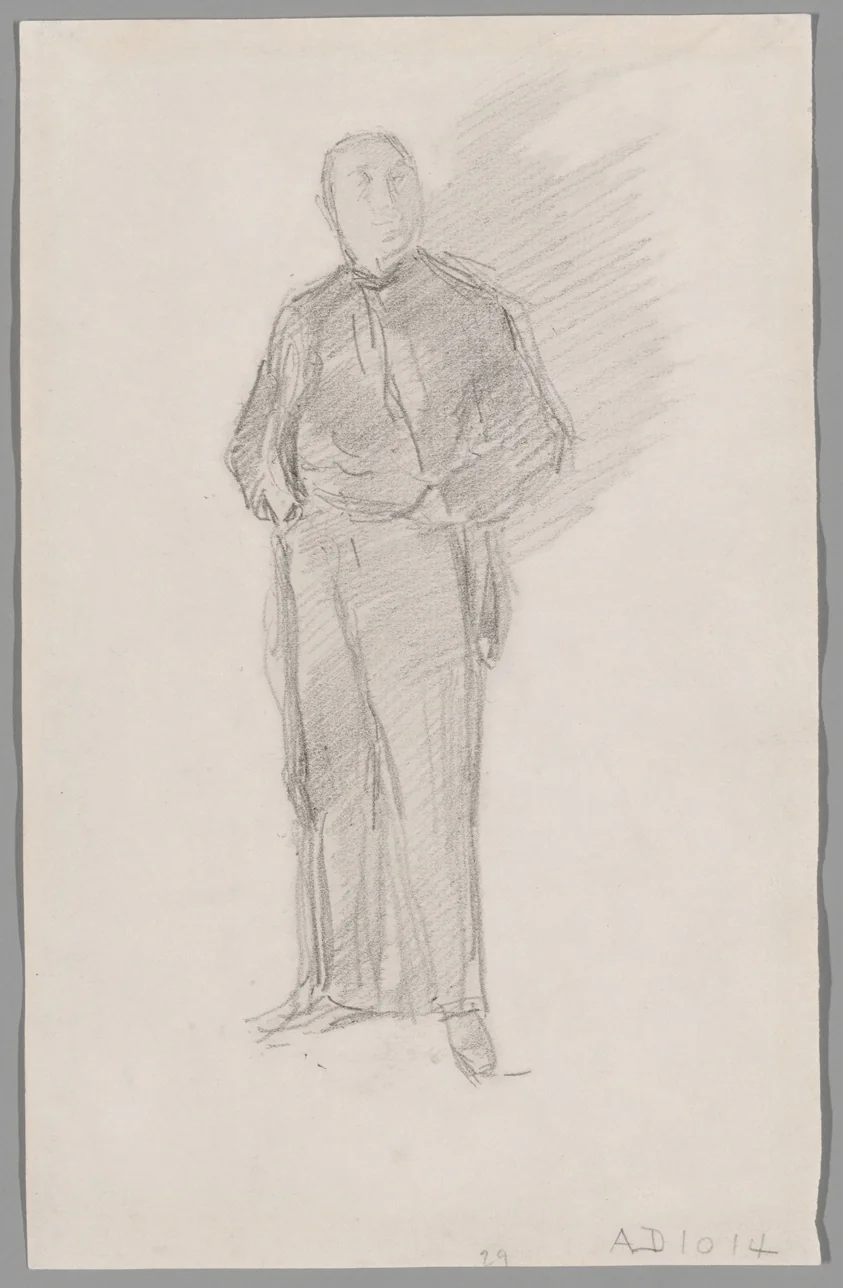
James McNeill Whistler's Study for Portrait of Thomas Way (1896) is a graphite drawing on ivory wove paper, a preparatory study for a portrait of the English lithographic printer Thomas Way. Way was a key figure in the revival of lithography in late 19th-century England, and he published many of Whistler's lithographs. This study shows Whistler working out the composition and the pose for the finished portrait. The graphite technique is precise and searching, the lines exploring the features of the sitter and the details of the composition. The ivory wove paper provides a warm, smooth ground. This study offers a valuable glimpse into Whistler's working method, showing how he prepared a portrait through careful drawing before executing the final work. The finished portrait of Thomas Way is one of Whistler's most accomplished late works, and this study shows the care and attention that went into its creation.
Cultural Impact
Whistler's preparatory studies are essential to understanding his working method, revealing the careful planning that underlay his apparently effortless finished works.
Why It Matters
This graphite study for the portrait of Thomas Way reveals Whistler's preparatory process, the careful lines exploring the features and composition that would be refined in the finished portrait.