Provenance
Georges Petit-Didier (1865-1952) [old label; MacDonald 1995]. Sold by Marcel Guiot, Paris, to Walter S. Brewster (1872-1954), Chicago, April 1924 [old label; MacDonald 1995]; given to the Art Institute, 1933.
Accession Number
14313
Medium
Watercolor with touches of opaque watercolor on cream wove paper
Dimensions
12.6 × 21 cm (5 × 8 5/16 in.)
Classification
watercolor
Credit Line
Gift of Kate L. Brewster
Background & Context
Background Story
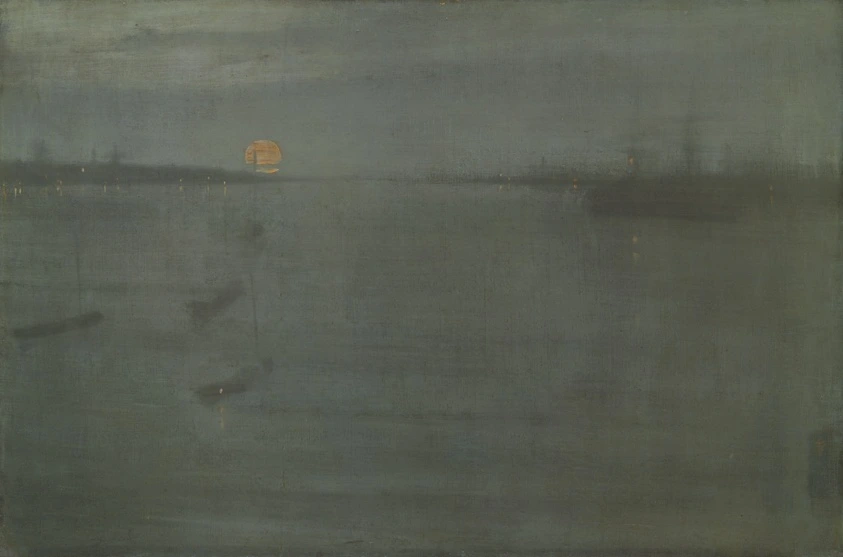
"Chelsea Shop" is an 1897/1900 watercolor by James McNeill Whistler that captures the American-born artist in his most topographically specific and atmospherically sensitive mode, the image showing a London shop front rendered with the same attention to subtle tonal variation and elegant composition that characterized his most refined works. The composition is a small watercolor—12.6 × 21 centimeters—showing a Chelsea shop with the watercolor and touches of opaque watercolor on cream wove paper creating a surface of extraordinary delicacy and atmospheric depth. The cream wove paper provides a warm, luminous ground that makes the watercolor tones appear rich and inviting, enhancing the sense of London fog and urban charm. The 1897/1900 date places this work in the final years of Whistler's life, when he was producing the watercolors that documented his beloved Chelsea neighborhood and established his reputation as a master of the watercolor medium. Art historians have connected this watercolor to the broader tradition of the urban view in British art, from the watercolors of Turner to the etchings of the period, noting that Whistler's treatment is more focused on the tonal harmony and the elegant suggestion, the transformation of observed reality into aesthetic poise, than the topographical accuracy or the social observation of these other traditions.
Cultural Impact
This 1897/1900 watercolor made Chelsea shop atmospherically delicate through small 12cm transparent-opaque watercolor and cream-paper London-fog warmth, using final-years neighborhood documentation to transform urban front into elegant tonal poise beyond Turner topographical atmospheric observation.
Why It Matters
It matters because Whistler painted a shop and made the paper feel like it was wrapped in London fog and quiet pride—proving that even a storefront could be a nocturne if the watercolor was subtle enough.