Provenance
Emily Crane Chadbourne, Chicago, by 1913 [New York 1913]; given to the Art Institute, 1922.
Accession Number
192263
Medium
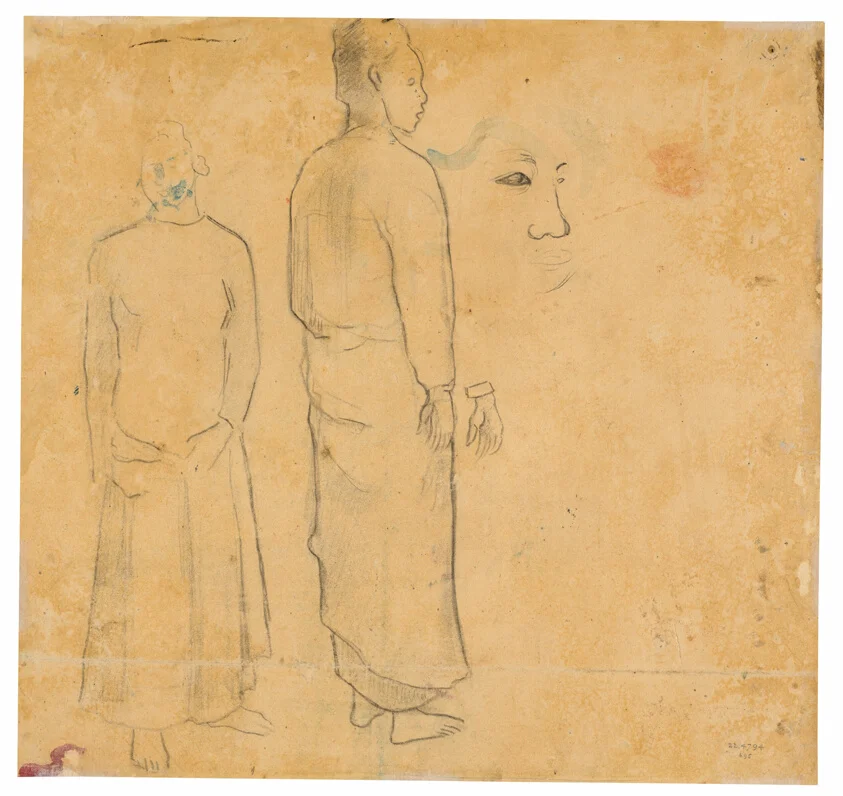
Black chalk, with touches of watercolor and watercolor offset on cream wove paper
Dimensions
35.2 × 36.9 cm (13 7/8 × 14 9/16 in.)
Classification
prints and drawing
Credit Line
Gift of Emily Crane Chadbourne
Background & Context
Background Story
"Two Figures (related to the painting Tahitian Landscape)" is an 1891/93 black chalk drawing with touches of watercolor on cream wove paper by Paul Gauguin that captures the French Post-Impressionist master in one of his most intimate and exploratory works from his first Tahitian period, the image showing two figures in a landscape setting with the same bold simplification and exotic suggestion that characterized his most famous paintings of Polynesia. The composition is a medium-sized drawing—35.2 × 36.9 centimeters—showing two figures in a tropical landscape rendered with the bold, expressive lines of black chalk and the subtle, luminous touches of watercolor on cream wove paper, the technique creating a surface of extraordinary immediacy and poetic suggestion. The black chalk creates strong, simplified forms that suggest both the physical presence of the figures and the dreamlike quality of the tropical setting, while the watercolor adds touches of color that suggest the lush vegetation and the warm light of the Pacific. Art historians have connected this drawing to the broader tradition of the exotic landscape in modern art, from the Orientalist paintings of Delacroix to the primitivist dreams of the early twentieth century, noting that Gauguin's treatment is more focused on the personal vision and the symbolic suggestion, the transformation of observed reality into a meditation on color and form, than the ethnographic accuracy or the colonial fantasy of these other traditions.
Cultural Impact
This 1891/93 chalk drawing made Tahitian figures intimately exploratory through medium 35cm bold simplified tropical forms and cream-paper watercolor lush-immediacy, using first-Tahiti-period personal vision to transform exotic landscape into color-form meditation beyond Delacroix Orientalist colonial fantasy.
Why It Matters
It matters because Gauguin drew two people in Tahiti and made the paper feel like it was still warm from the sun—proving that even a sketch could hold a paradise if the chalk was bold enough.