Provenance
Emily Crane Chadbourne (1871–1964), London, by 1910 [Robins, “‘Manet and the Post-Impressionists’: A Checklist of Exhibits,” Burlington Magazine 152, no. 1293 (Dec. 2010), p. 788]; given to the Art Institute of Chicago, 1922.
Accession Number
86308
Medium
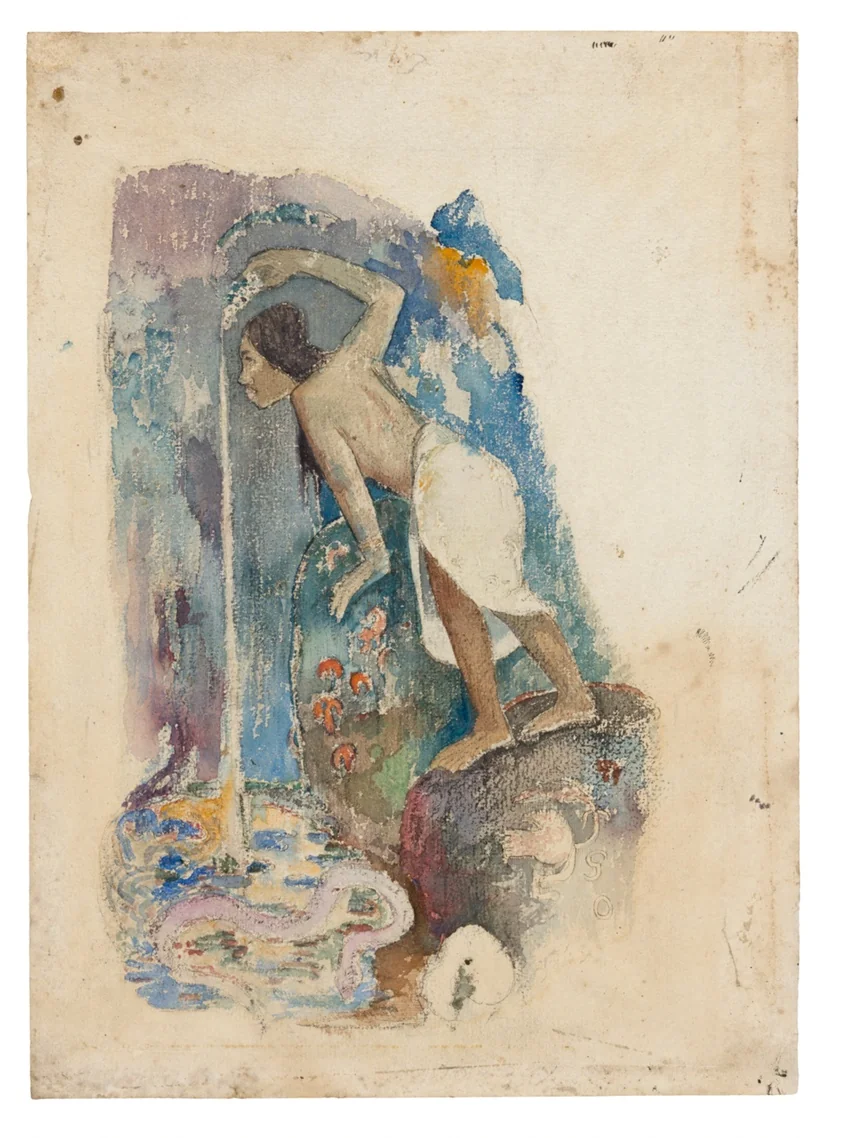
Watercolor, with black fabricated chalk, pen and brown ink (originally purple) and touches of brush and black ink on heavily textured ivory wove paper
Dimensions
35.4 × 25.5 cm (13 15/16 × 10 1/16 in.)
Classification
pen and ink drawings
Credit Line
Gift of Emily Crane Chadbourne
Background & Context
Background Story
"Pape moe" is an 1893/94 watercolor by Paul Gauguin that captures the French Post-Impressionist master in his most poetically suggestive and technically experimental mode, the image showing a reclining or sleeping figure rendered with the combination of watercolor, fabricated chalk, pen and brown ink on heavily textured ivory wove paper that creates a surface of extraordinary delicacy and atmospheric depth. The composition is a medium-sized work—35.4 × 25.5 centimeters—showing a figure in repose with the simplified forms and the exotic suggestion that characterized Gauguin's entire Tahitian period, the title suggesting both the physical state of sleep and the spiritual condition of dream. The heavily textured paper creates a surface that suggests both the physical reality of the tropical environment and the dreamlike quality of the artist's vision, the texture enhancing the sense of atmosphere and the poetic suggestion of the scene. Art historians have connected this work to the broader tradition of the reclining figure in modern art, from the odalisques of Ingres to the sleeping figures of Picasso, noting that Gauguin's treatment is more focused on the symbolic suggestion and the coloristic harmony, the transformation of the observed figure into a visual poem about the exotic and the primitive, than the anatomical precision or the erotic content of these other traditions.
Cultural Impact
This 1893/94 watercolor made Tahitian repose poetically atmospheric through medium 35cm textured ivory-paper delicate fabricated-chalk ink depth, using sleep-dream title symbolism to transform reclining figure into exotic primitive visual poem beyond Ingres anatomical odalisque precision.
Why It Matters
It matters because Gauguin painted someone sleeping in Tahiti and made the paper feel like it was dreaming in colors—proving that even a nap could be a poem if the watercolor was right.