Provenance
Francisco "Paco" Durrio (1868-1940), Paris. Emily Crane Chadbourne, Chicago, by 1913 [New York 1913]; given to the Art Institute, 1922.
Accession Number
5515
Medium
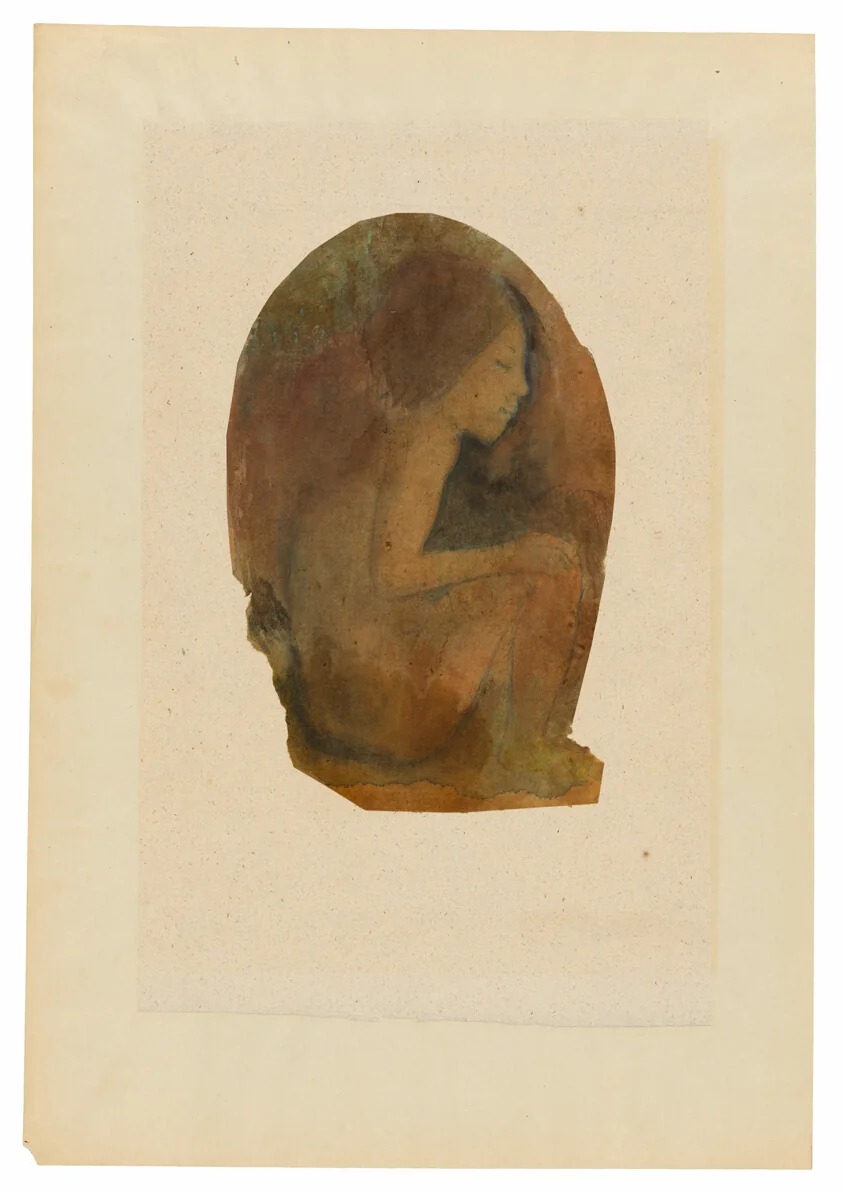
Watercolor and graphite on irregularly shaped cream wove Japanese paper, laid down on ivory laid paper with brown and blue fibers, laid down on cream wove paper
Dimensions
237 × 157 mm (primary support); 352 × 227 (secondary support); 451 × 312 (tertiary support)
Classification
watercolor
Credit Line
Gift of Emily Crane Chadbourne
Background & Context
Background Story
Paul Gauguins Seated Tahitian Youth from 1894-1903 is a watercolor and graphite drawing on irregularly shaped Japanese paper that exemplifies the artists approach to the figure of the Polynesian youth as a symbol of the unspoiled natural life that he had sought in his emigration to Tahiti. The youth, seated in a relaxed pose that combines the informality of Polynesian body language with the structural solidity of classical sculpture, exemplifies Gauguins ability to transform the specific individuals he encountered in Polynesia into archetypal figures who embody his vision of a life uncorrupted by European civilization. The watercolor medium, with its capacity for transparent washes and chromatic subtlety, allows Gauguin to model the figures form with a directness and immediacy that oil painting cannot match, while the graphite underdrawing provides the structural framework that prevents the watercolor from dissolving into pure sensation. The irregularly shaped Japanese paper on which the drawing is made is itself a significant choice, reflecting the influence of Japanese art on Gauguins compositional thinking and the broader Japonisme that influenced European artists of the period. The multiple layers of laid paper on which the Japanese paper is mounted, each with its distinctive fiber pattern, create a physical palimpsest that mirrors the cultural palimpsest of Gauguins work, in which European, Polynesian, and Japanese artistic traditions coexist on the same surface.
Cultural Impact
Gauguins Tahitian drawings are among the most significant works in the history of European colonial art, and their influence on the development of Primitivism and the broader tradition of European artists working in non-Western contexts extends through the 20th century. Seated Tahitian Youth exemplifies the combination of direct observation and archetypal vision that makes his Tahitian work significant.
Why It Matters
A watercolor and graphite drawing by Gauguin on Japanese paper depicting a seated Tahitian youth as an archetype of unspoiled natural life, combining Polynesian informality with classical solidity in a medium that embodies the cultural palimpsest of European, Polynesian, and Japanese traditions.