Provenance
Given by the artist to Charles Laval (1862–1894), Paris [inscription on recto]. Sold by the estate of André Teissier (died 1927), Mâcon, France, to Henri Cottereau, Galerie Choiseul, Paris, 1928 [Harrison collection notes]; sold to Carter H. Harrison (1860-1953), Chicago, 1928; given to the Art Institute, 1933.
Accession Number
15860
Medium
Black fabricated chalk with pastel on ivory laid paper
Dimensions
32.9 × 48.3 cm (13 × 19 1/16 in.)
Classification
charcoal
Credit Line
Mr. and Mrs. Carter H. Harrison Collection
Background & Context
Background Story
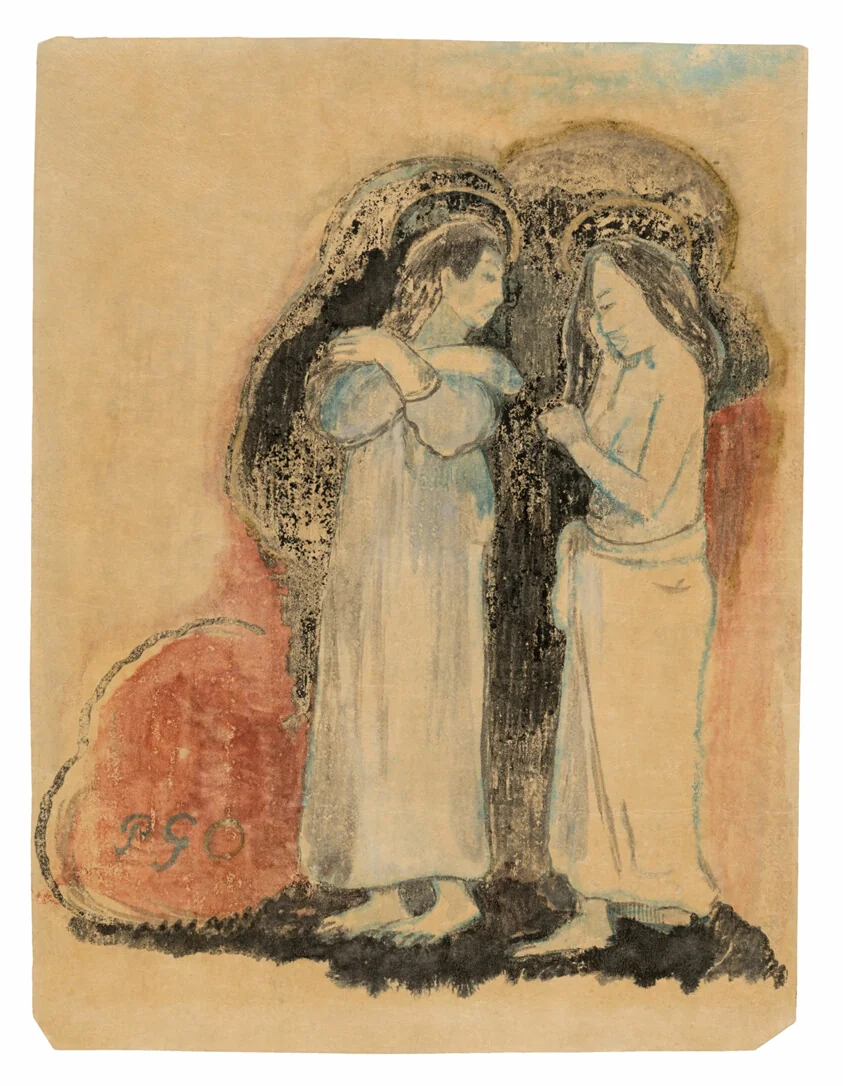
Paul Gauguin's Seated Breton Woman (1886) is a charcoal drawing with pastel on ivory laid paper from Gauguin's period in Brittany, France. Before his departure for Tahiti, Gauguin spent time in Pont-Aven, Brittany, where he developed his distinctive style. This drawing of a seated Breton woman shows his interest in the simple, traditional life of the Breton peasants. The charcoal with pastel technique creates a soft, atmospheric effect.
Cultural Impact
Gauguin's Breton period was crucial to the development of his mature style, including his experiments with Synthetism.
Why It Matters
This drawing of a seated Breton woman shows Gauguin's early engagement with traditional rural life before his departure for Tahiti.