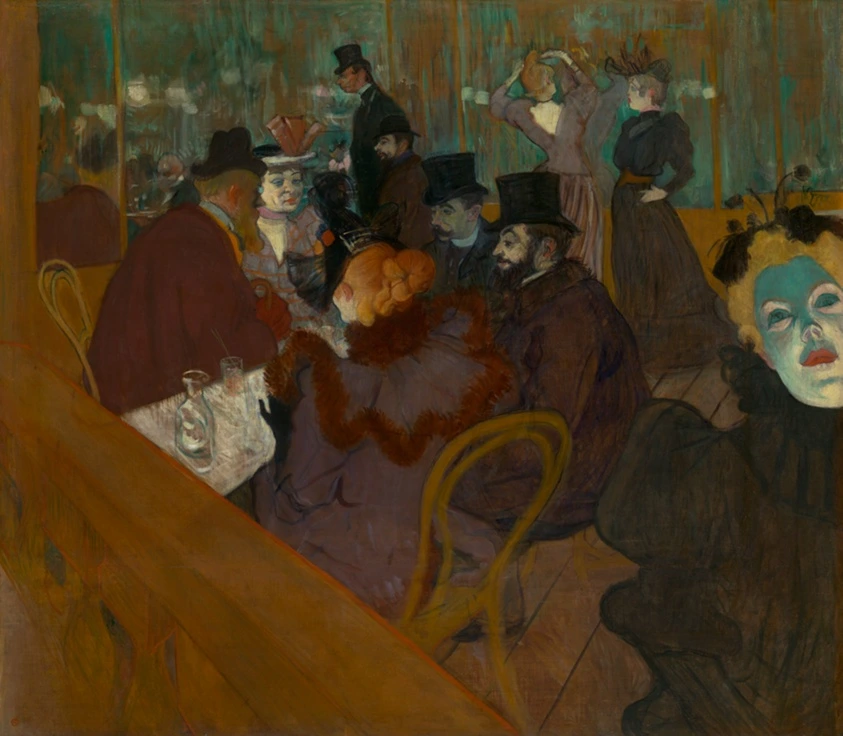
At the Moulin Rouge

Description

Henri de Toulouse-Lautrec has been associated with the Moulin Rouge since its opening in 1889: the owner of the legendary nightclub bought the artist’s Equestrienne as a decoration for the foyer. Toulouse-Lautrec populated At the Moulin Rouge with portraits of the legendary nightclub’s regulars, including himself—the diminutive figure in the center background—accompanied by his cousin, physician Gabriel Tapié de Céleyran. Dancer La Goulue arranges her hair behind the table where Jane Avril, another famous performer, socializes. Singer May Milton peers out from the right edge of the painting, her face harshly lit and acid green. At some point, the artist or his dealer cut down the canvas to remove Milton, perhaps because her strange appearance made the work hard to sell. Whatever the reason, by 1914 the cut section had been reattached to the painting.

Provenance

Maurice Joyant, executor of the artist's estate and co-director of Galerie Manzi-Joyant, Paris, by 1902 [according to Heller 1986]; sold to Manzi [according to Dortu 1971 and Heller 1986]. Jean Laroche, Paris, 1926. Paul Rosenberg [according to Dortu 1971]. Mssrs. Reid & Lefevre, London, June 1928. Frederick Clay Bartlett, Chicago; given to the Art Institute, 1928.

At the Moulin Rouge

Henri de Toulouse-Lautrec

1892–95

Accession Number

61128

Medium

Oil on canvas

Dimensions

123 × 141 cm (48 7/16 × 55 1/2 in.); Framed: 136.9 × 154.7 × 8.5 cm (53 7/8 × 60 7/8 × 3 5/16 in.)

Classification

oil on canvas

Museum

The Art Institute of Chicago

Chicago, United States

Credit Line

Helen Birch Bartlett Memorial Collection
Background & Context

Background Story

At the Moulin Rouge from 1892-95 is one of Toulouse-Lautrec's most celebrated paintings, depicting the interior of the Moulin Rouge cabaret with its characteristic mix of performers and patrons that defined Parisian nightlife in the 1890s. The painting includes several identifiable figures from Toulouse-Lautrec's social circle, including the dancer La Goulue and the photographer Sescau, arranged in the off-center composition and dramatic artificial lighting that distinguish his cabaret scenes. The greenish light of the cabaret casts unnatural shadows on the faces of the figures, creating a mood of uneasy gaiety that captures the essential character of the Moulin Rouge.

Cultural Impact

At the Moulin Rouge is one of the most important paintings of the 1890s because it defines the visual image of Parisian nightlife that has persisted to this day. Toulouse-Lautrec's off-center composition, dramatic artificial lighting, and unsentimental observation of the performers and patrons of the Moulin Rouge created a visual vocabulary for nightlife that influenced every subsequent depiction of cabarets, nightclubs, and bar scenes in painting, photography, and film.

Why It Matters

At the Moulin Rouge is Toulouse-Lautrec defining Parisian nightlife for all time: the interior of the Moulin Rouge with its performers and patrons rendered in off-center composition and dramatic artificial lighting that creates a mood of uneasy gaiety. The 1892-95 painting created the visual vocabulary for nightlife that influenced every subsequent depiction of cabarets and nightclubs.