Moulin de la Galette

Description

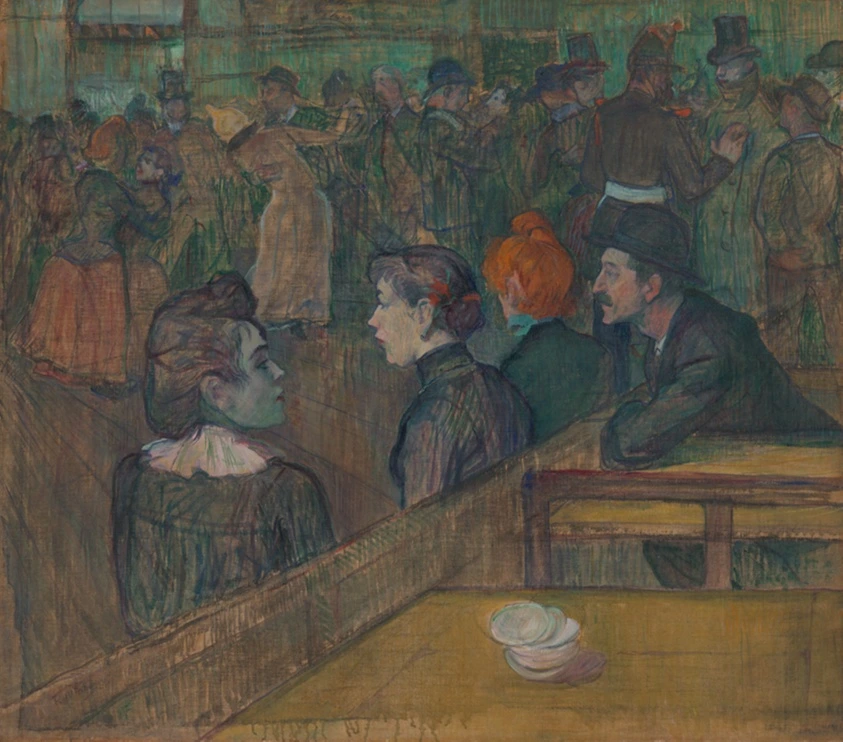
With this painting of the dance hall known as the Moulin de la Galette, Henri de Toulouse-Lautrec established his reputation as the chronicler of the Montmartre district’s famed nightlife. A wooden barrier bisects the composition, dividing the frenzied action of the dance floor in the background from the stillness of the women waiting in the foreground. Toulouse-Lautrec used turpentine to thin his paint and applied it in loose washes, a technique known as peinture à l’essence. The result is a sketchy style that conveys both the immediacy of the artist’s observations and the tawdry atmosphere of his subject.

Provenance

Joseph Albert. Mme Montandon, Paris, by February 1890. Paul Gallimard, Paris. Paul Rosenberg by 1924 [see Chicago 1924/5]; Annie Swan Coburn (Mrs. Lewis L. Coburn), Chicago; bequeathed to the Art Institute of Chicago, 1933

Moulin de la Galette

Henri de Toulouse-Lautrec

1889

Accession Number

14664

Medium

Oil on canvas

Dimensions

88.5 × 101.3 cm (35 7/8 × 39 5/8 in.); Framed: 109.3 × 123.2 × 12.1 cm (43 × 48 1/2 × 4 3/4 in.)

Classification

oil on canvas

Museum

The Art Institute of Chicago

Chicago, United States

Credit Line

Mr. and Mrs. Lewis Larned Coburn Memorial Collection

Background & Context

Background Story

Moulin de la Galette from 1889 depicts the famous Montmartre dance hall that was also painted by Renoir and other Impressionists, but Toulouse-Lautrec's treatment is entirely different from Renoir's sun-drenched celebration of working-class leisure. Toulouse-Lautrec's Moulin de la Galette is a nocturnal scene, lit by gas lamps rather than sunlight, and the dancers are rendered with the off-center composition, bold outlines, and unsentimental observation that distinguish his approach from the Impressionists' more cheerful vision. The 1889 date places this in the period when Toulouse-Lautrec was just beginning to develop the style that would make him the preeminent painter of Montmartre nightlife.

Cultural Impact

Toulouse-Lautrec's Moulin de la Galette is important because it demonstrates how differently the same subject could be treated by different artistic sensibilities. Where Renoir painted the Moulin de la Galette as a sun-drenched celebration of working-class leisure, Toulouse-Lautrec painted it as a nocturnal scene of gas-lit unease, with off-center composition and bold outlines that capture the artificial atmosphere of the dance hall rather than the natural atmosphere of the outdoors.

Why It Matters

Moulin de la Galette is Toulouse-Lautrec inverting Renoir: where Renoir painted the dance hall as sun-drenched celebration, Toulouse-Lautrec paints it as a gas-lit scene of nocturnal unease, with off-center composition and bold outlines that capture the artificial atmosphere of Montmartre nightlife. The 1889 painting defines Toulouse-Lautrec's approach as the antithesis of Impressionist cheerfulness.