American Collectors (Fred and Marcia Weisman)

Description

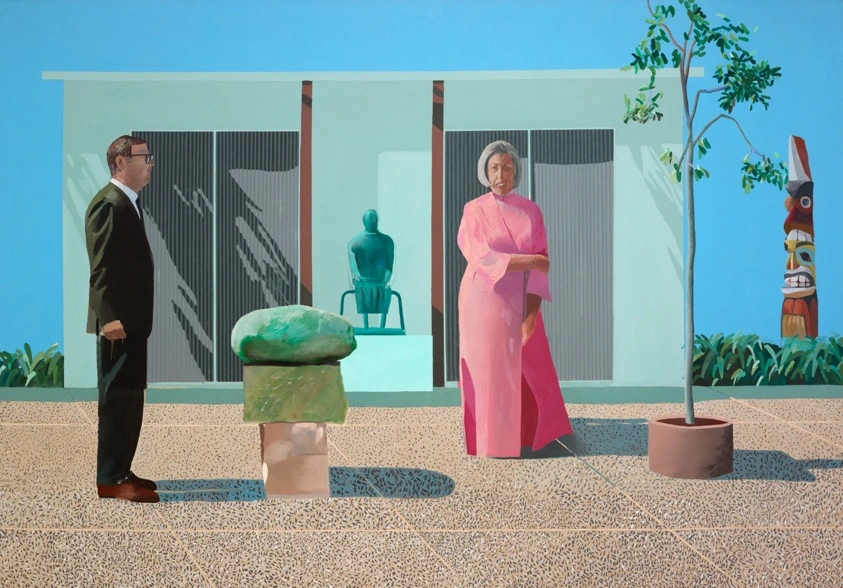
One of the most versatile and inventive English artists of the postwar era, David Hockney settled in Los Angeles in 1964. An especially iconic example from a group of double portraits of friends and associates from the 196os, this painting depicts the contemporary-art collectors Fred and Marcia Weisman in the sculpture garden of their Los Angeles home. As stiff and still as the objects surrounding them, the couple stands apart, his stance echoed in the totem pole to the right, hers in the Henry Moore sculpture behind her. Brilliant light flattens the scene and sets the couple in sharp relief; they seem oblivious to each other as well as to their art.

Provenance

The artist; sold through Andre Emmerich Gallery, New York, to Fred (1912–1994) and Marcia Simon Weisman (1918–1991), Los Angeles, Dec. 3, 1968 [invoice; copy in curatorial object file]; sold to Paul Kantor, Malibu, Feb. 8, 1971 [invoice; copy in curatorial object file]. Sold to Barthold von Ribbentrop (1940–2019), New York, Düsseldorf, later Ratingen, Germany, probably by 1981 [Glozer, 1981]; William Beadleston Inc., New York, by 1983 [email from Michael Findlay, Nov. 21, 2016; copy in curatorial object file]; sold to the Art Institute of Chicago, July 16, 1984.

American Collectors (Fred and Marcia Weisman)

David Hockney

1968

Accession Number

102234

Medium

Acrylic on canvas

Dimensions

213.4 × 304.8 cm (83 7/8 × 120 in.)

Classification

Painting

Museum

The Art Institute of Chicago

Chicago, United States

Credit Line

Purchased with funds provided by Mr. and Mrs. Frederic G. Pick
Background & Context

Background Story

"American Collectors (Fred and Marcia Weisman)" is a 1968 acrylic on canvas by David Hockney that captures the British artist at the height of his early American period, the painting showing the wealthy Los Angeles collectors in their modernist home with the bright, high-keyed palette and flattened perspective that made Hockney's California paintings the definitive images of the 1960s American dream. The composition is a large double portrait—213.4 × 304.8 centimeters—showing the Weismans surrounded by their art collection and their modernist furniture, the figures rendered with the same attention to detail and design that Hockney brought to the swimming pools and palm trees of his California landscapes. The acrylic paint creates a surface of extraordinary flatness and brilliance, the colors applied in broad, smooth areas that suggest both the artificiality of the Los Angeles environment and the glamour of the collector's lifestyle. The 1968 date places this work in the period of Hockney's first major American success, when he was producing the paintings that established his reputation as the leading British artist in America and the definitive chronicler of the California good life. Art historians have compared this painting to the society portraits of Sargent and the domestic interiors of Vuillard, noting that Hockney's treatment is more modern, more focused on the design and the color than the social observation or the painterly texture of these predecessors.

Cultural Impact

This 1968 large acrylic made 1960s California collector glamour brilliantly flat through double-portrait modernist surround, using broad smooth high-keyed color areas to define American dream lifestyle with design-consciousness beyond Sargent's society observation.

Why It Matters

It matters because Hockney painted two people surrounded by art and made the room feel like it was smiling—proving that even a portrait could be a swimming pool if the acrylic was bright enough.