Description
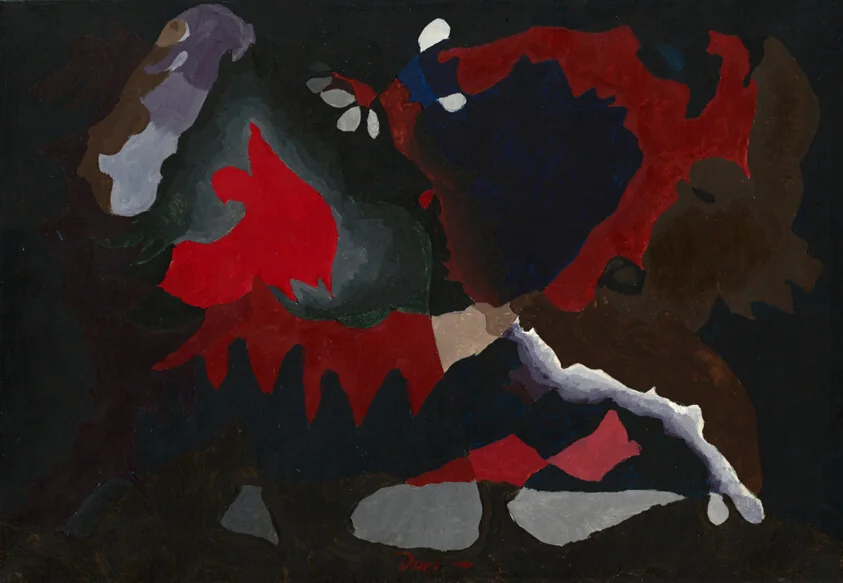
Arthur Dove used abstraction to interpret musical subjects in works such as Swing Music (Louis Armstrong). Louis Armstrong was renowned in the 1930s for his gravelvoiced singing and virtuosic trumpet playing. Dove, who often listened to popular music while he worked, translated the fast syncopation, joyous rhythms, and improvisational elements of Armstrong’s swing music into paint. Here, the artist rendered patches of red that erupt across the canvas, leaping out of darker areas as if to suggest the blare of a horn across a nightclub.
Provenance
Alfred Stieglitz Collection, New York; bequeathed through Georgia O'Keeffe to the Art Institute of Chicago, 1949.
Accession Number
65901
Medium
Emulsion, oil, and wax on canvas
Dimensions
44.8 × 65.7 cm (17 5/8 × 25 7/8 in.)
Classification
Painting
Credit Line
Alfred Stieglitz Collection
Tags
Color: Red
Background & Context
Background Story
"Swing Music (Louis Armstrong)" is a 1938 painting by Arthur Dove made with emulsion, oil, and wax on canvas that captures the American modernist pioneer in his most musically inspired and materially experimental mode, the image showing an abstract composition inspired by the jazz trumpet of Louis Armstrong rendered with the same rhythmic energy and organic abstraction that characterized his most powerful works. The composition is a medium-sized canvas—44.8 × 65.7 centimeters—showing an abstract composition with the emulsion, oil, and wax creating a surface of extraordinary material richness and musical suggestion. The combination of emulsion, oil, and wax creates a layered, tactile surface that suggests both the physical reality of sound waves and the emotional warmth of swing music. The 1938 date places this work in the period of Dove's mature abstraction and his exploration of music as a subject for visual expression. Art historians have connected this painting to the broader tradition of the musical subject in modern art, from the paintings of Kandinsky to the works of the American abstractionists, noting that Dove's treatment is more focused on the rhythmic abstraction and the organic suggestion, the transformation of heard music into visual rhythm, than the literal representation or the formal analysis of these other traditions.
Cultural Impact
This 1938 emulsion-oil-wax painting made Armstrong swing musically abstract through medium 44cm layered tactile material richness and rhythmic organic color suggestion, using mature abstraction to transform jazz trumpet into visual rhythmic energy beyond Kandinsky literal formal analysis.
Why It Matters
It matters because Dove painted Louis Armstrong's music and made the canvas feel like it was blowing a trumpet in colors that had never been heard before—proving that even silence could swing if the paint was groovy enough.