On a Balcony

Description

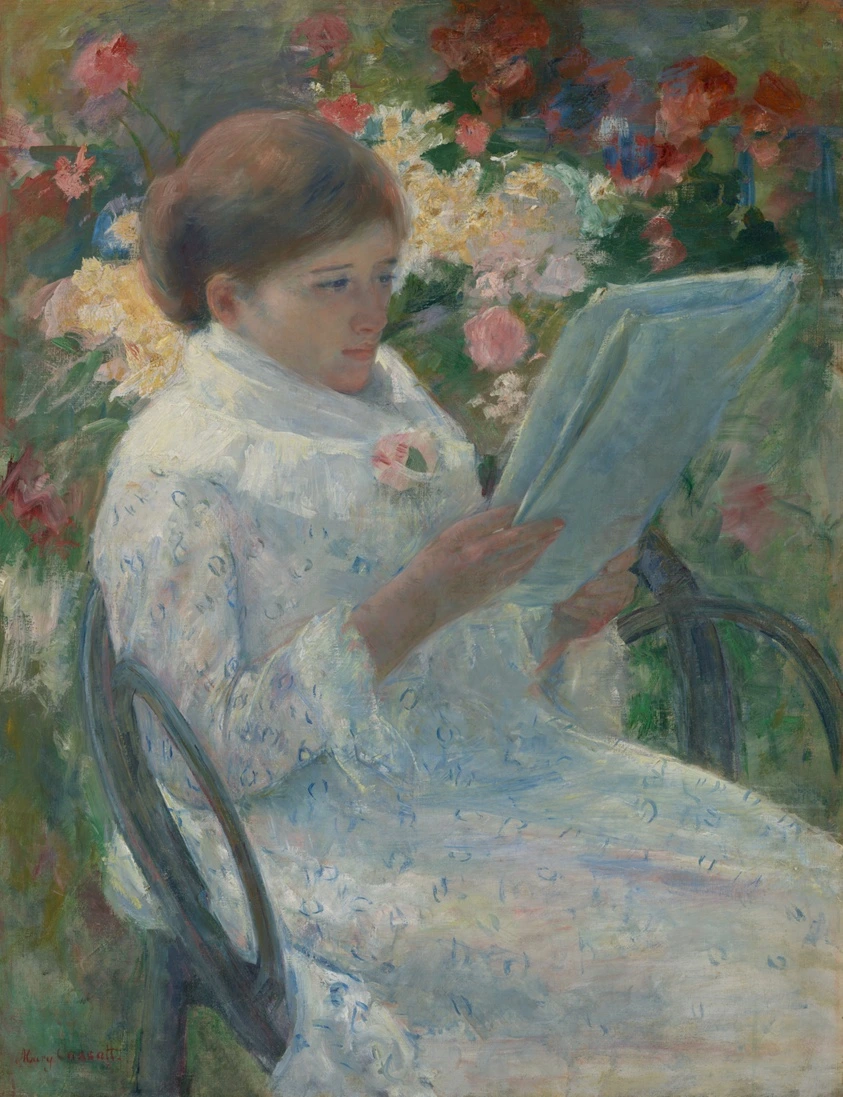
Shown at the 1880 Impressionist exhibition, On a Balcony depicts a woman in a private garden surrounded by flowers rendered in energetic brushstrokes of red, blue, yellow, and pink. Mary Cassatt focused on the activities of middle- and upper-class women in society—from public outings like the theater to domestic settings such as this one. Here, the blue rail of the balcony, visible near the top of the painting, defines the enclosed space of a garden, and the sitter’s morning dress further indicates the intimacy of the location. Cassatt signaled the modernity of her subject through the woman’s choice of reading material: she peruses a newspaper rather than a novel, demonstrating that even at home, Cassatt’s subjects are connected to the contemporary world.

Provenance

The artist; with Durand-Ruel Galleries, New York, by 1903 [New York 1903, cat. 10; letter from Charles Durand-Ruel to Mary Carton, Dec. 14, 1978; copies in curatorial object file; inscription on stretcher: D.R. N.Y 2707]; sold to Mrs. Delia Spencer Field (1853–1937; also Mrs. Arthur John Caton, Mrs. Marshall Field), Washington, DC, 1922 [notation in Catherine Beveridge’s catalogue according to letter from Albert J. Beveridge, III, Jan. 30, 1979; Bulletin of the Art Institute of Chicago 1938, 58; handwritten note on incoming permanent receipt R6498, Jan. 14, 1938; copies in curatorial object file]; by descent to her niece, Catherine Eddy Beveridge (also Mrs. Albert J. Beveridge), Washington, DC [letter from Robert B. Harshe to Mrs. Beveridge, Dec. 10, 1937; copy in curatorial object file]; given to the Art Institute of Chicago, 1938.

On a Balcony

Mary Cassatt

1878–79

Accession Number

26650

Medium

Oil on canvas

Dimensions

85.2 × 65.5 cm (33 9/16 × 25 13/16 in.)

Classification

Painting

Museum

The Art Institute of Chicago

Chicago, United States

Credit Line

Gift of Mrs. Albert J. Beveridge in memory of her aunt, Delia Spencer Field

Background & Context

Background Story

"On a Balcony" is an 1878–79 oil on canvas by Mary Cassatt that captures the American Impressionist at the height of her Parisian career, the image showing a woman—probably the artist's sister Lydia—on a balcony overlooking a Parisian street with the high-keyed palette and broken brushwork that Cassatt had learned from her study of Degas and Monet. The composition is daringly cropped: the figure is cut off at the waist, the balcony railing creates a strong diagonal, and the background is a blur of urban activity that suggests both the specificity of the Parisian setting and the Impressionist commitment to capturing fleeting moments of modern life. The palette is warm and sunlit—pinks, creams, and pale blues that suggest the southern exposure of the balcony and the cheerful domesticity of the Cassatt household. The 1878–79 date places this work in the period of Cassatt's first Impressionist exhibitions and her close collaboration with Degas, the painting demonstrating both her technical mastery and her independent vision. Art historians have compared this painting to the balcony scenes of Manet and Morisot, noting that Cassatt's treatment is more focused on the private, domestic experience of the balcony rather than the social observation of these French contemporaries. The work also demonstrates Cassatt's mastery of the figure in an outdoor setting: the light on the dress, the shadow of the railing, and the atmospheric background all reflect her skill in translating Impressionist color theory into the representation of modern women.

Cultural Impact

This 1878–79 oil canvas captured Parisian Impressionist domesticity through daringly cropped balcony diagonal and high-keyed broken brushwork, using warm sunlit pink-cream palette to make Lydia's private modern-life moment distinct from Manet's social observation.

Why It Matters

It matters because Cassatt painted a woman on a balcony and made the railing feel like a frame for a whole life—proving that even a small corner of Paris could hold a world of light if the brush was free enough.