Provenance
William H. Payne (1836–1907), Ann Arbor, MI, by 1907 [this and the following according to Hills, 32.0.8]; sold, American Art Association, New York, Jan. 6, 1919, lot 32, as Portrait of the Artist, to private collection. Grace Meeker (1869–1948; born Grace Murray, also Mrs. Arthur Meeker), Chicago, by 1923 [incoming receipt, R1345, Dec. 10, 1923; copy in curatorial object file]; given to the Art Institute of Chicago, 1924.
Accession Number
120170
Medium
Oil on millboard
Dimensions
39.4 × 30.5 cm (15 1/2 × 12 in.)
Classification
Painting
Credit Line
Gift of Mrs. Arthur Meeker
Background & Context
Background Story
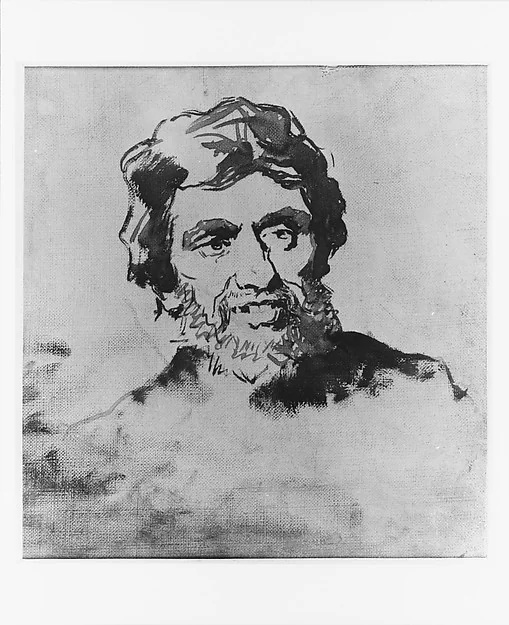
Eastman Johnsons Self-Portrait from 1863 depicts the artist at the age of thirty-nine, painted during the same year that his most famous work, Negro Life at the South, was generating controversy and acclaim at the National Academy of Design. Johnson portrays himself with the direct, unflinching gaze of a man confident in his artistic mission, his brown eyes meeting the viewers without either challenge or submission. The millboard support, a less expensive alternative to canvas that Johnson used for informal works, suggests that this self-portrait was made for private purposes rather than public display, a personal statement rather than an official image. The paint handling is vigorous and economical, with the features built up in relatively few strokes over a dark ground, a technique Johnson may have absorbed from his study of Rembrandts self-portraits during his years in The Hague. Johnson had just returned to America after extended study in Germany, France, and the Netherlands, and the self-portrait reflects the influence of European realist tradition filtered through an American sensibility that would make him the most important American genre painter of his generation and a founder of the Metropolitan Museum of Art.
Cultural Impact
Johnson is considered the father of American genre painting, and his self-portraits document the development of an American realist tradition that would influence Eakins, Homer, and the Ashcan School. His founding role in the Metropolitan Museum of Art established the institutional infrastructure that supported American art for the next century.
Why It Matters
An intimate self-portrait by Johnson painted on millboard during the pivotal year of 1863, revealing the direct gaze and vigorous brushwork of an artist who had absorbed European realist tradition and was about to transform American genre painting.