Description
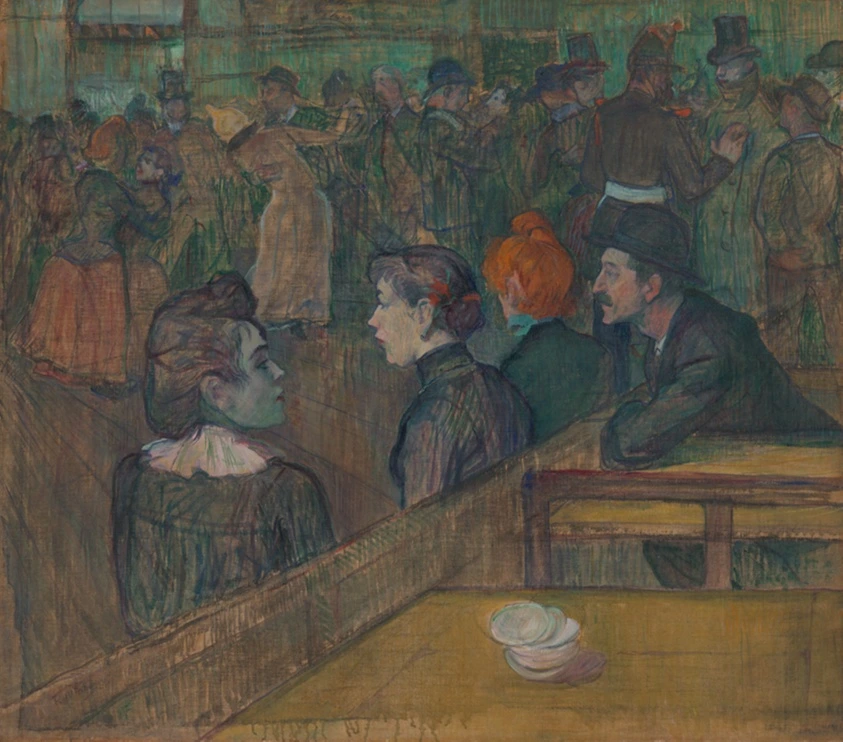
Henri de Toulouse-Lautrec painted this portrait when he was only 22 years old and still an art student. He used subtle coloring with accents of pink and green and showed his subject, Jeanne Wenz, in full profile, a compositional device often found in Renaissance portraiture. Wenz was the mistress of Frederic Wenz, Toulouse-Lautrec’s fellow student at the painter Fernand Cormon’s studio. She was also the friend of Suzanne Valadon, an artist in her own right and a frequent sitter for Toulouse-Lautrec.
Provenance
Given by the artist to Arthur-Paul Huc, Toulouse [see Roqué 1999]. Paul Rosenberg, Paris, by 1912 [see Dortu 1971]. Pierre Decourcelle, Paris, by at least 1914 [lent by him to Paris 1914]; sold, Hôtel Drouot, Paris, June 16, 1926, no. 78, for 63,000 francs, to Jerome Stonborough [according to annotated copy of the Decourcelle sale catalogue in the library of the National Gallery of Art, Washington, D.C.; copy in curatorial file]; Jerome Stonborough (died 1938), New York; his estate sale, Parke-Bernet Galleries, New York, October 17, 1940, no. 70; Paul Rosenberg and Co., New York, Nov. 17, 1940 [according to the Rosenberg ledger, no. 120, Museum of Modern Art, New York, copy in curatorial file and letter of May 5, 1977, from Alexandre Rosenberg, who stated that the firm acquired the painting on 17 November, 1940, from the estate of Stonborough]; sold to the Art Institute of Chicago, October 3, 1941.
Accession Number
42949
Medium
Oil on canvas
Dimensions
80.7 × 59.5 cm (32 × 23 1/4 in.); Framed: 106.7 × 86.4 cm (42 × 34 in.)
Classification
Painting
Credit Line
Mr. and Mrs. Lewis Larned Coburn Memorial Collection
Background & Context
Background Story
"Portrait of Jeanne Wenz" is one of Toulouse-Lautrec's most psychologically penetrating early portraits, painted in 1886 during the period when he was absorbing the influences of Impressionism and Post-Impressionism while developing the distinctive graphic style that would make him the definitive chronicler of Parisian nightlife. The sitter, Jeanne Wenz, was a friend or model from the artist's bohemian circle, and the portrait treats her with an unsparing directness that was rare in the more flattering conventions of contemporary portraiture. The composition is a three-quarter-length figure against a muted background, the palette restricted to earthy browns, muted greens, and the warm flesh tones that Toulouse-Lautrec rendered with a frankness that bordered on the clinical. The brushwork is already notably free, the forms built from broad, summary strokes that suggest rather than describe, creating an image that feels immediate and unposed. This rejection of academic finish was radical in 1886: even the Impressionists had maintained a certain elegance in their portraits that Toulouse-Lautrec abandoned in favor of raw observation. The painting also documents the artist's physical condition at this period: his congenital bone disorder had left him with stunted legs and a normal torso, and his portraits of others often reveal the compensatory intensity of his gaze, the need to see clearly what his body could not reach. Art historians have compared this portrait to the contemporaneous works of van Gogh and Gauguin, noting that Toulouse-Lautrec's treatment is more detached, less emotionally charged than these contemporaries, though no less penetrating. The canvas also anticipates the graphic simplification of his later posters: the figure is already reduced to essential forms, the background flattened to a single tone.
Cultural Impact
This 1886 portrait rejected Impressionist elegance for raw Post-Impressionist observation, documenting Toulouse-Lautrec's compensatory visual intensity while anticipating the graphic simplification of his later poster style.
Why It Matters
It matters because Toulouse-Lautrec painted a woman without flattery and made her look real—proving that even in Paris, honesty could be more interesting than charm.