Description
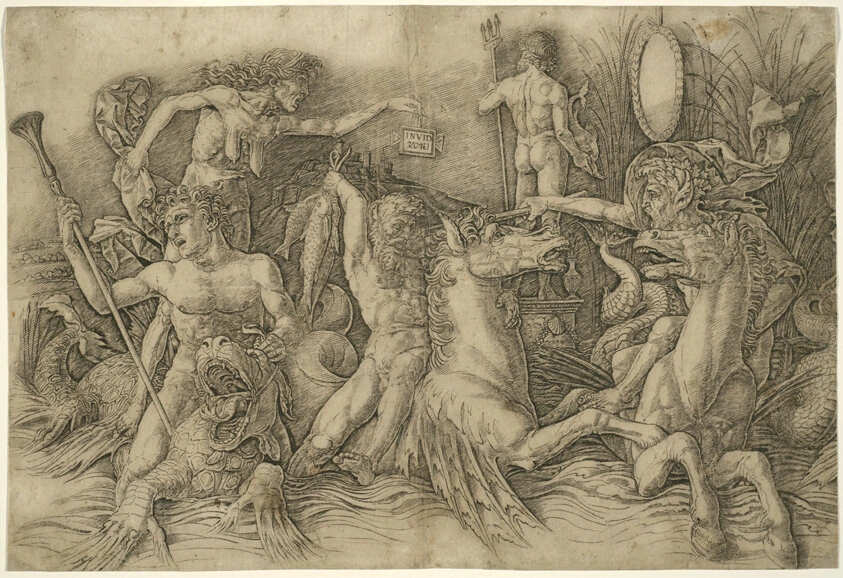
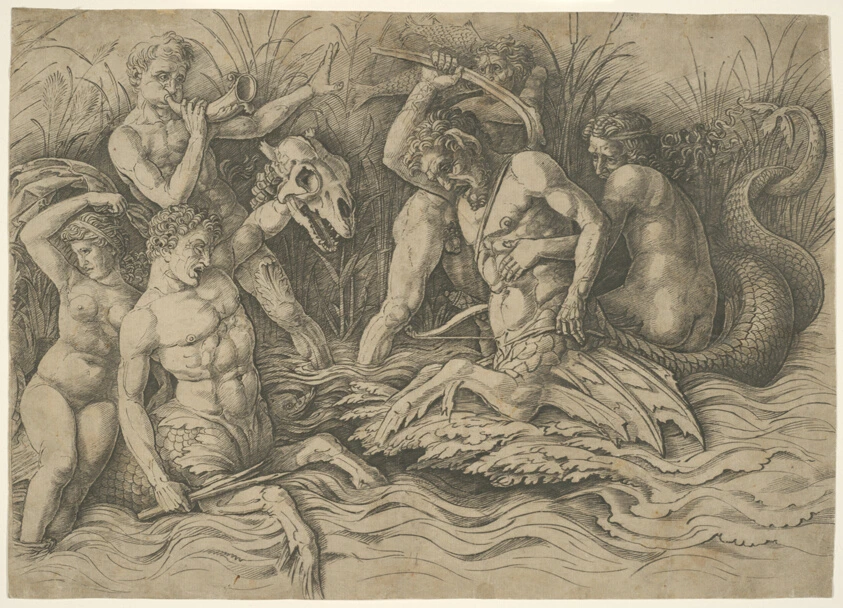
Andrea Mantegna’s Battle of the Sea Gods may be the first print with a unified composition occupying more than one sheet. Unlike the Andrea Andreani Triumph of Caesar (1926.452.2–9) and the engravings after the same Mantegna paintings by his own workshop, this mythological frieze has only one seam and no disguising columns. Albrecht Dürer drew a copy of the right half of the frieze in 1494, already establishing the seminal importance of the work in the Renaissance.
Accession Number
4288
Medium
Engraving in black on ivory laid paper, discolored to grayish brown
Dimensions
Image/sheet: 28.1 × 39.4 cm (11 1/8 × 15 9/16 in.); Composite approx: 28.3 × 80.9 cm (11 3/16 × 31 7/8 in.)
Classification
engraving
Credit Line
Bequest of Mrs. Potter Palmer, Jr.
Background & Context
Background Story
"Battle of the Sea Gods: Right Half of a Frieze" is a 1470/1500 engraving by Andrea Mantegna that belongs to one of the most celebrated series of prints in Renaissance art, the two-part frieze showing the battle of the sea gods with a violence and energy that transformed the classical subject into a dynamic narrative of mythological combat. The composition shows the right half of the frieze, the sea gods and marine creatures engaged in furious battle, their muscular bodies twisting and straining with the physical exertion of combat, the waves and spray adding to the sense of tumultuous movement. The engraving technique creates sharp contrasts of black and white that emphasize the dramatic action, the fine lines suggesting both the anatomical detail of the figures and the fluid motion of the water. The ivory laid paper, discolored over centuries to a warm grey-brown, adds a patina of age that enhances the sense of historical depth and archaeological authenticity. Art historians have connected this print to the broader tradition of the classical frieze, from the Parthenon marbles to the Renaissance reconstructions of Roman relief, noting that Mantegna's treatment is more dynamic, more focused on the violent energy of the narrative than the calm procession of these sculptural precedents. The work also demonstrates Mantegna's mastery of the nude in action: the twisting bodies, the straining muscles, and the complex foreshortening all reflect the artist's study of ancient sculpture and his own inventive genius in adapting classical forms to the demands of narrative drama.
Cultural Impact
This 1470/1500 engraving half-frieze transformed classical relief into violent dynamic narrative, using sharp black-white contrast and fine anatomical line to make sea-god combat patinatedly energetic rather than calmly processional.
Why It Matters
It matters because Mantegna drew gods fighting in the sea and made the paper feel like it was splashing—proving that even a myth could be a storm if the engraving was fierce enough.