Description
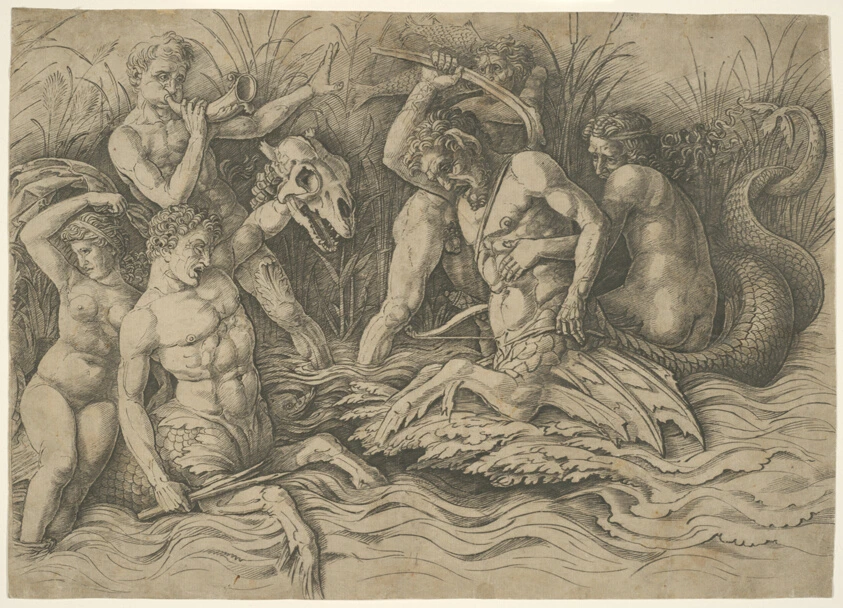
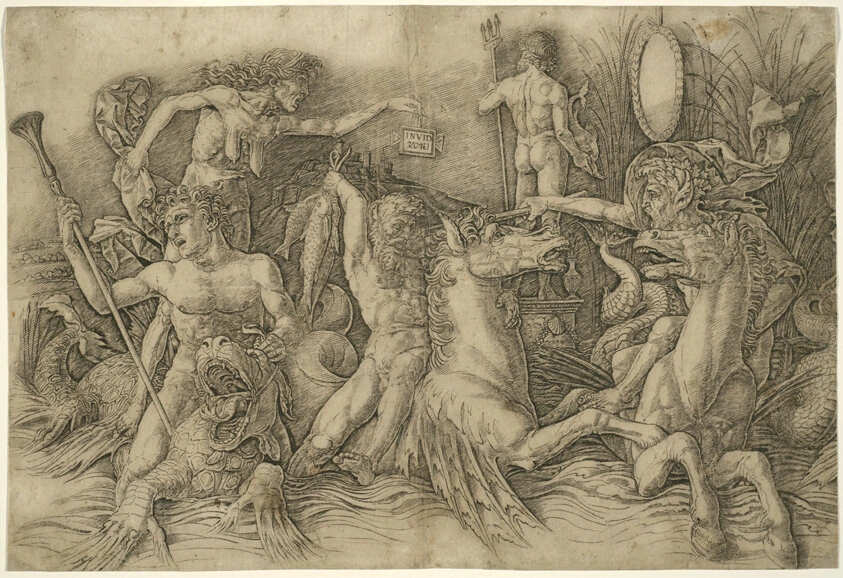
Andrea Mantegna’s Battle of the Sea Gods may be the first print with a unified composition occupying more than one sheet. Unlike the Andrea Andreani Triumph of Caesar (1926.452.2–9) and the engravings after the same Mantegna paintings by his own workshop, this mythological frieze has only one seam and no disguising columns. Albrecht Dürer drew a copy of the right half of the frieze in 1494, already establishing the seminal importance of the work in the Renaissance.
Accession Number
4285
Medium
Engraving in black on ivory laid paper, discolored to grayish brown
Dimensions
28.3 × 41.5 cm (11 3/16 × 16 3/8 in.)
Classification
engraving
Credit Line
Bequest of Mrs. Potter Palmer, Jr.
Background & Context
Background Story
"Battle of Sea-Gods, Left Half of a Frieze" is a 1470/1500 engraving by Andrea Mantegna that serves as the companion to the right half of the frieze, the two prints together forming one of the most ambitious and influential narrative compositions of the Renaissance printmaking tradition. The left half shows the continuation of the mythological battle, the sea gods and marine creatures engaged in combat with the same muscular energy and dramatic intensity that characterizes the right half, the two prints creating a panoramic scene that rivals the painted friezes of antiquity in its narrative scope and visual power. The engraving technique creates a surface of extraordinary precision and clarity, the fine lines suggesting both the solidity of the figures and the fluidity of the water, the black ink on the discolored ivory paper creating a tonal range that enhances the three-dimensional illusion. Art historians have compared this frieze to the painted battle scenes of Pollaiuolo and the sculptural reliefs of Donatello, noting that Mantegna's treatment achieves a comparable dynamism through the more limited medium of line engraving, the artist's technical mastery overcoming the constraints of the medium to create an image of extraordinary visual impact. The work also demonstrates the collaborative nature of Renaissance printmaking: the engraving was probably executed by a professional printmaker working from Mantegna's design, the division of labor between designer and engraver reflecting the commercial and reproductive function of prints in fifteenth-century Italy.
Cultural Impact
This 1470/1500 companion engraving completed panoramic mythological narrative through extraordinary line-engraving precision, using fine black-ivory tonal range to overcome medium constraints with designer-engraver collaborative commercial mastery.
Why It Matters
It matters because Mantegna finished the battle he started and made both halves feel like one endless fight—proving that even paper could hold an ocean if the gods were angry enough.