Description
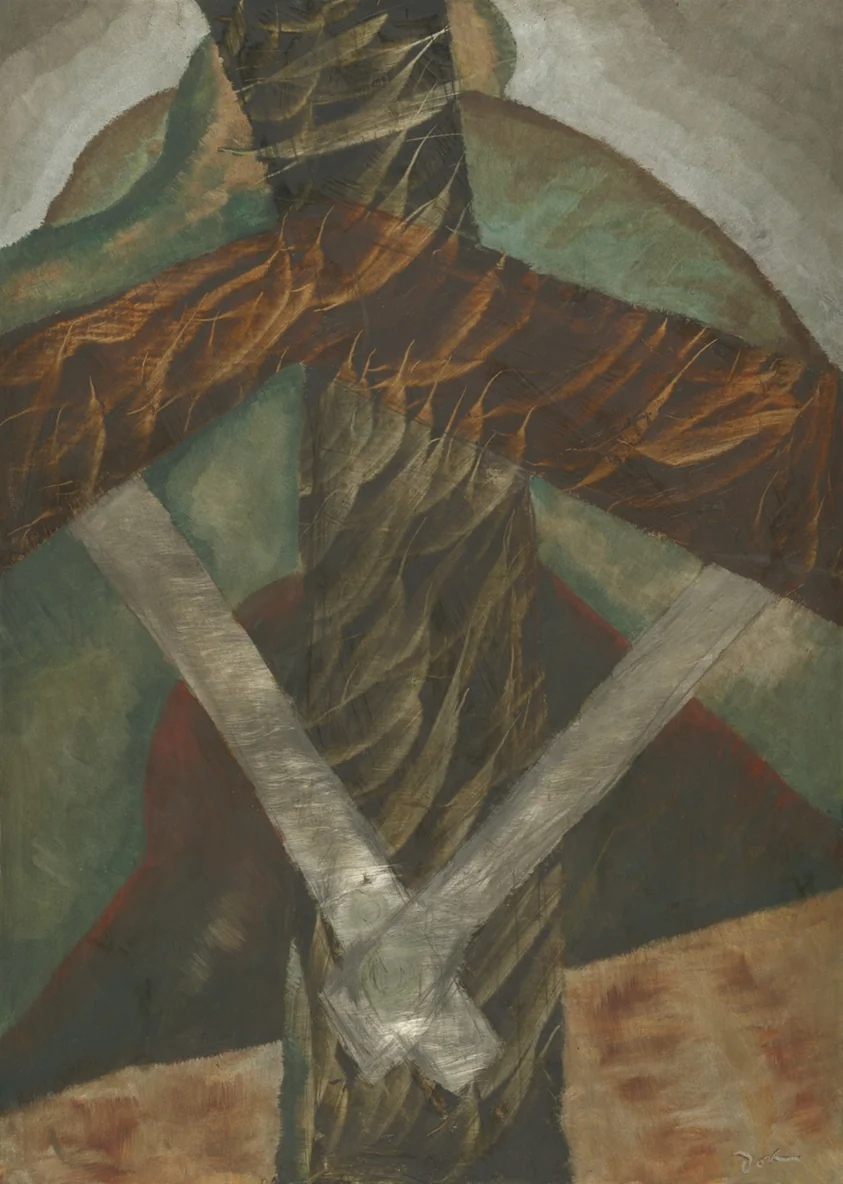
“Being a wet telegraph pole, some flying leaves and silver.” This is how Arthur Dove briefly described this painting, which juxtaposes the geometry of the pole in the extreme foreground against the curves of distant hills. Dove evoked the wetness of the scene by employing metallic paint on a steel plate; these unconventional materials makes the entire composition shimmer and shine. The varied brushwork and pulsating layers of color in the background further enliven the work’s appearance, suggesting that this industrial object has been subsumed into its natural setting.
Accession Number
65884
Medium
Oil, metallic paint, and pencil on steel plate
Dimensions
71.1 × 50.5 cm (28 × 19 7/8 in.)
Classification
Painting
Credit Line
Alfred Stieglitz Collection
Background & Context
Background Story
"Telegraph Pole" is a 1929 painting by Arthur Dove made with oil, metallic paint, and pencil on steel plate that captures the American modernist pioneer in his most materially experimental and architecturally observant mode, the image showing a telegraph pole rendered with the same attention to natural form and human technology that characterized his most innovative works. The composition is a medium-sized painting—71.1 × 50.5 centimeters—showing a telegraph pole with the oil, metallic paint, and pencil on steel plate creating a surface of extraordinary material richness and industrial poetry. The steel plate support adds a dimension of industrial presence and metallic luminosity that suggests both the physical reality of the telegraph pole and the material nature of modern communication. The 1929 date places this work in the period of Dove's most intensive production of paintings inspired by the industrial landscape and his exploration of human technology as a subject for artistic expression. Art historians have connected this painting to the broader tradition of the industrial subject in modern American art, from the paintings of the Precisionists to the works of the contemporary period, noting that Dove's treatment is more focused on the material experiment and the organic observation, the transformation of industrial technology into natural form, than the social commentary or the aesthetic abstraction of these other traditions.
Cultural Impact
This 1929 oil metallic paint pencil steel plate made telegraph pole materially industrial through medium 71cm metallic luminosity and steel-support modern communication presence, using intensive industrial period to transform human technology into natural organic form beyond Precisionist social aesthetic abstraction.
Why It Matters
It matters because Dove painted a telegraph pole and made the steel feel like it was humming with messages from across the country—proving that even a pole could sing if the metallic paint was bright enough.