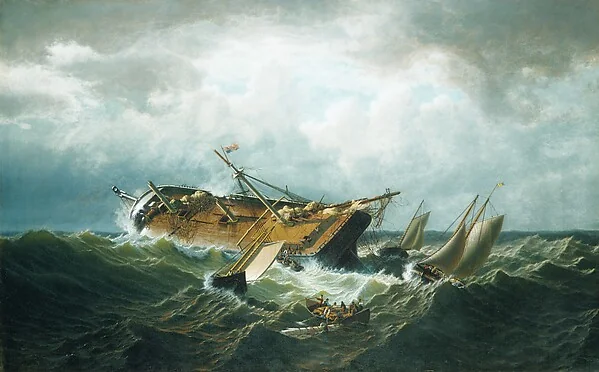
The Coast of Labrador

Description

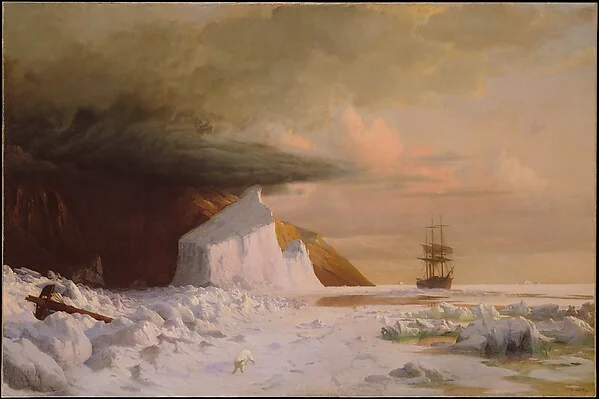
William Bradford devoted the bulk of his career to painting Arctic scenes like The Coast of Labrador. Rendered in minute detail and suffused with light, the artist’s Arctic compositions share stylistic motifs with John Frederick Kensett’s Luminist views of the Rhode Island coast. Bradford first traveled to Labrador between 1854 and 1857; it was not until 1861, however, that the region became his main source of inspiration. He returned to Labrador repeatedly over the next eight years. Signed and dated 1866, this painting probably derives from a number of sketches he accumulated during an 1865 journey, and it attests to Bradford’s interest in the diverse light effects and rocky landscape of the Arctic.

Provenance

Henry H. Brooks, Boston, by 1981; Alfred J. Walker, Boston, 1981; Vose Galleries, Boston, 1981; Alfred T. Morris, Providence, Rhode Island, 1981; Adams Davidson Galleries, Washington, DC, 1983; Marshall Field, Chicago, 1983; the Art Institute of Chicago, 1983.

The Coast of Labrador

William Bradford

1866

Accession Number

100489

Medium

Oil on canvas

Dimensions

72 × 113.3 cm (28 3/8 × 44 5/8 in.)

Classification

Painting

Museum

The Art Institute of Chicago

Chicago, United States

Credit Line

Ada Turnbull Hertle Fund
Background & Context

Background Story

"The Coast of Labrador" is an 1866 oil on canvas by William Bradford that captures the American Arctic painter in his most topographically specific and atmospherically grand mode, the image showing the Labrador coast rendered with the same crystalline clarity and luminous stillness that characterized his most powerful Arctic scenes. The composition is a medium-sized canvas—72 × 113.3 centimeters—showing the Labrador coast with the oil on canvas creating a surface of extraordinary luminosity and topographical precision. The 1866 date places this work in the period of Bradford's most intensive production of Arctic scenes and his documentation of the northern coasts and fisheries. Art historians have connected this painting to the broader tradition of the Arctic landscape in American art, from the paintings of Church to the illustrations of the period, noting that Bradford's treatment is more focused on the atmospheric clarity and the topographical precision, the transformation of observed reality into luminous vision, than the sublime terror or the scientific observation of these other traditions.

Cultural Impact

This 1866 oil canvas made Labrador coast luminously precise through medium 72cm crystalline Arctic atmospheric clarity and topographical detail, using intensive northern-fisheries documentation to transform observed coast into luminous still vision beyond Church sublime terror scientific observation.

Why It Matters

It matters because Bradford painted the Labrador coast and made the canvas feel like it was breathing cold clean air—proving that even ice could glow if the atmosphere was clear enough.