Description
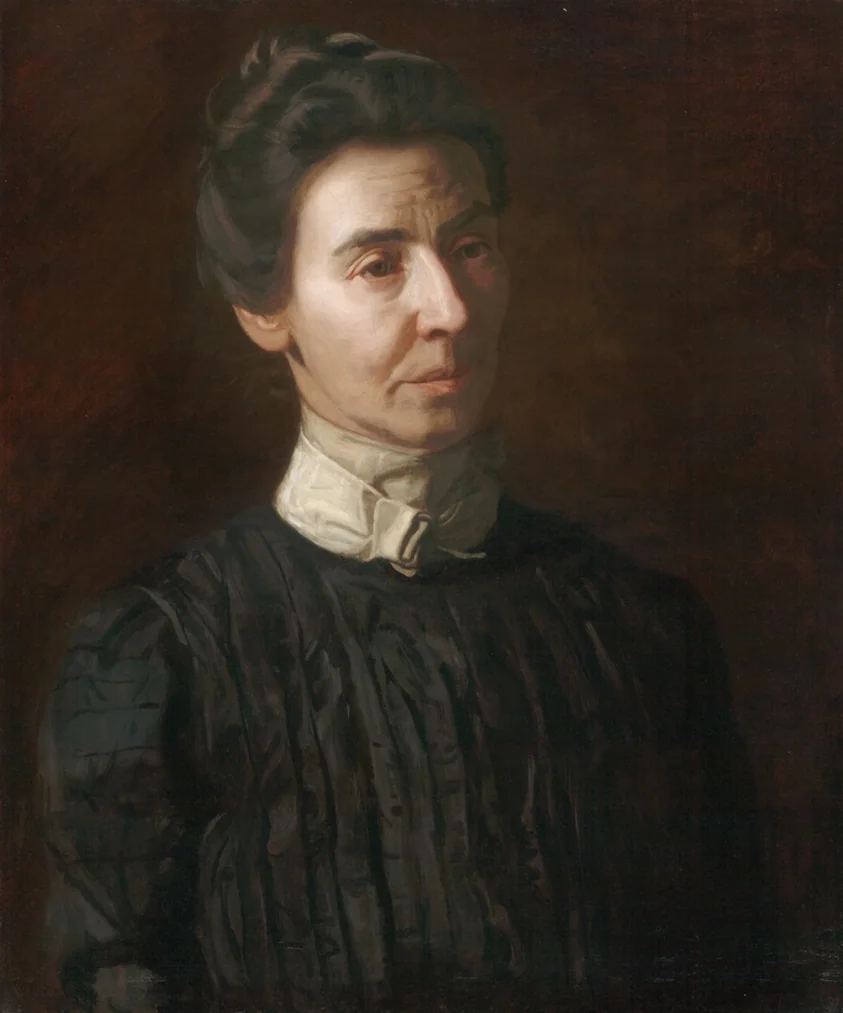
During his lifetime, Thomas Eakins painted more than 200 portraits, only 25 of which were commissioned. Mary Adeline Williams was a personal friend of the artist; Eakins first met her when she was a childhood playmate of his sister. Later, as an unmarried woman, Williams, who was known as Addie, lived with Eakins and his wife, Susan. Although Eakins’s portrait presents Addie as straight-laced and severe, this is in marked contrast with the active woman Susan Eakins described in her diary as riding bicycles, going to art exhibitions, and socializing between sittings for the painting.
Provenance
Thomas Eakins, from 1899 to 1916; Eakins Estate/Susan Macdowell Eakins, from 1916 to 1939; Babcock Galleries, New York City, 1939; sold to the Art Institute of Chicago, 1939.
Accession Number
31285
Medium
Oil on canvas
Dimensions
61 × 50.8 cm (24 × 20 1/16 in.)
Classification
Painting
Credit Line
Friends of American Art Collection
Background & Context
Background Story
"Portrait of Mary Adeline Williams" is one of Eakins's most sensitive late portraits, painted in 1899 during the final phase of a career that had moved from grand public commissions to intimate, almost private images of friends and family. Mary Williams was a neighbor and intimate friend, and the small scale of the canvas—61 × 51 centimeters—reflects the personal nature of the commission rather than the monumental demands of public portraiture. The composition is remarkably simple: Williams is shown in three-quarter view against a muted background, her face turned slightly toward the viewer with an expression of quiet intelligence and patient watchfulness. Eakins's treatment is softer than in his more famous portraits, the brushwork more yielding, the palette warmer. This gentleness suggests affection rather than the professional detachment that characterized his public commissions. The painting also reflects Eakins's declining physical condition in 1899: his health was failing, his eyesight deteriorating, and the smaller format may have been a concession to his diminished energy. Yet the psychological penetration remains acute; if anything, the reduced scale intensifies the sense of intimate encounter. Art historians have compared this portrait to the late works of Rembrandt and Cézanne, in which age and infirmity produce a tenderness absent from earlier, more robust productions. The painting also documents the social world of Philadelphia's artistic community, a tight-knit group that sustained Eakins through decades of professional disappointment. In the history of American portraiture, the work stands as evidence that Eakins's realism was not merely analytical but also capable of warmth and sympathy when the sitter was someone he trusted.
Cultural Impact
This late intimate portrait exchanged monumental public scale for private warmth, documenting Philadelphia's artistic community while revealing Eakins's capacity for affectionate psychological penetration.
Why It Matters
It matters because Eakins painted a friend who sat for him year after year—and finally let himself be gentle, as if age had softened his need to be right.