Provenance
By descent to Lily Klee (died 1946), Bern, Switzerland [according to Paul Klee Foundation 2000]; Klee-Gesellschaft, Bern, 1946 [according to Paul Klee Foundation 2000]. Galerie Rosengart, Lucerne, 1947 [according to Paul Klee Foundation 2000]; sold to the Art Institute, 1948.
Accession Number
62375
Medium
Watercolor and black ink transfer, on ivory laid paper, laid down on gray wood-pulp laminate board
Dimensions
23.2 × 30.5 cm (9 3/16 × 12 1/16 in.)
Classification
watercolor
Credit Line
Olivia Shaler Swan Memorial Collection
Background & Context
Background Story
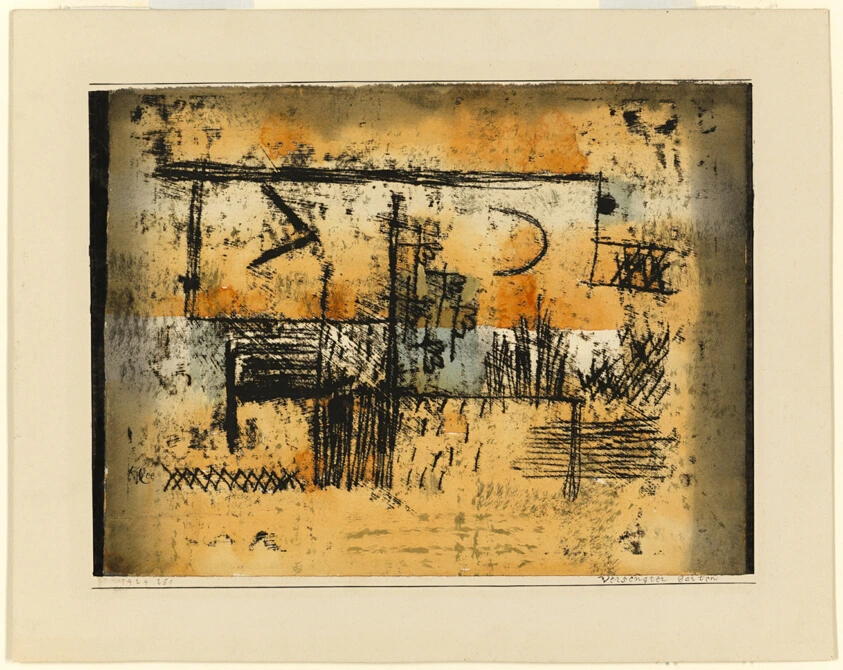
"Singed Garden" is a 1924 watercolor that belongs to the most inventive period of Paul Klee's career, when he was combining multiple media and transfer techniques to create images that hover between drawing and painting, between observation and dream. The composition shows a garden scene that has been partially "singed" or damaged, the forms blackened at the edges as if by fire while the central areas remain intact. This deliberate destruction of the image is both a technical experiment and a symbolic statement: Klee is exploring what happens when beauty is threatened, when the pastoral idyll is invaded by elemental violence. The black ink transfer technique is crucial; Klee would draw on one sheet and then press it against another, creating a reversed, slightly degraded image that carried the physical trace of its making. This process introduced chance and accident into the composition, aligning Klee with Surrealist automatism even though he maintained a more structured, musical approach to composition. The palette is muted and earthy—browns, grays, and pale greens that suggest a landscape recovering from catastrophe rather than blooming in its prime. Art historians have connected this work to the postwar German tradition of ruined landscapes, from Friedrich's ice fields to Kiefer's scorched fields, though Klee's treatment is gentler, more melancholic than apocalyptic. The garden motif itself has deep roots in European art history, from Eden to Versailles, and Klee's "singed" version asks what remains when the garden has been tested by fire. In the history of modern art, the work demonstrates that watercolor could sustain conceptual complexity and emotional depth without sacrificing its inherent luminosity.
Cultural Impact
This 1924 watercolor introduced ink transfer and deliberate singeing to explore beauty under threat, connecting German Romantic ruin tradition with Surrealist chance while preserving watercolor luminosity.
Why It Matters
It matters because Klee burned the edges of his garden and left the center standing—proving that even damaged beauty could be worth painting.